







Question: Two friends (J ohar and Zichen) are trying to split $1, 000. In the rst round of bargaining, Zichen makes an offer at cost 2
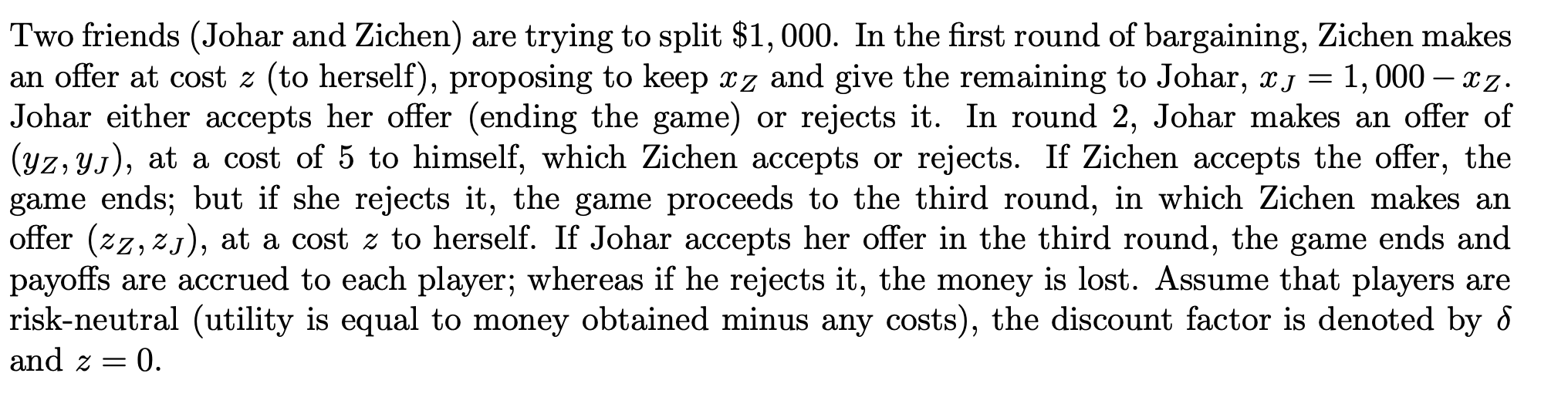
Two friends (J ohar and Zichen) are trying to split $1, 000. In the rst round of bargaining, Zichen makes an offer at cost 2 (to herself), proposing to keep :52 and give the remaining to J ohar, xJ = 1,000 :cz. Johar either accepts her offer (ending the game) or rejects it. In round 2, Johar makes an offer of (yz,yJ), at a cost of 5 to himself, which Zichen accepts or rejects. If Zichen accepts the offer, the game ends; but if she rejects it, the game proceeds to the third round, in Which Zichen makes an offer (22, 21,1), at a cost 2 to herself. If Johar accepts her offer in the third round, the game ends and payoffs are accrued to each player; Whereas if he rejects it, the money is lost. Assume that players are riskneutral (utility is equal to money obtained minus any costs), the discount factor is denoted by 5 and z = 0
Step by Step Solution
There are 3 Steps involved in it

Get step-by-step solutions from verified subject matter experts
 Study Help