





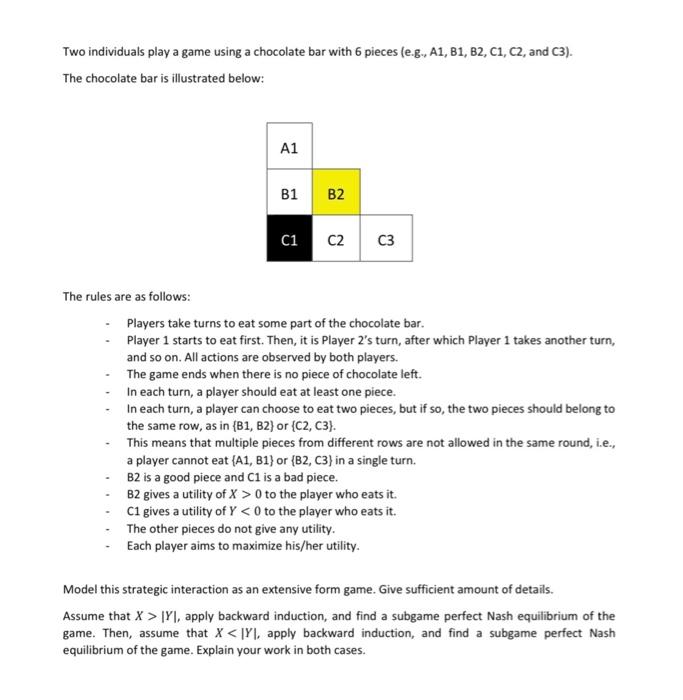
Question: Two individuals play a game using a chocolate bar with 6 pieces (e.g., A1, B1, B2, C1, C2, and C3). The chocolate bar is illustrated
Two individuals play a game using a chocolate bar
Two individuals play a game using a chocolate bar with 6 pieces (e.g., A1, B1, B2, C1, C2, and C3). The chocolate bar is illustrated below: A1 B1 B2 c1 C2 The rules are as follows: Players take turns to eat some part of the chocolate bar. Player 1 starts to eat first. Then, it is Player 2's turn, after which Player 1 takes another turn, and so on. All actions are observed by both players. The game ends when there is no piece of chocolate left. In each turn, a player should eat at least one piece. In each turn, a player can choose to eat two pieces, but if so, the two pieces should belong to the same row, as in (B1, B2) or (C2, C3). This means that multiple pieces from different rows are not allowed in the same round, i.e., a player cannot eat (A1, B1) or (B2, C3) in a single turn. B2 is a good piece and C1 is a bad piece. B2 gives a utility of X >0 to the player who eats it. Ci gives a utility of Y |Y), apply backward induction, and find a subgame perfect Nash equilibrium of the game. Then, assume that X

Step by Step Solution

There are 3 Steps involved in it

1 Expert Approved Answer
Step: 1 Unlock blur-text-image

Question Has Been Solved by an Expert!

Get step-by-step solutions from verified subject matter experts

Step: 2 Unlock
Step: 3 Unlock

Students Have Also Explored These Related General Management Questions!