







Question: Two part types arrive to a four-workstation system. Part type 1 arrives according to an exponential distribution with inter arrival-time mean 5 (all times are
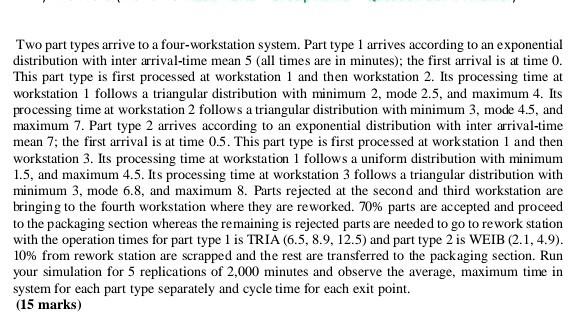
Two part types arrive to a four-workstation system. Part type 1 arrives according to an exponential distribution with inter arrival-time mean 5 (all times are in minutes); the first arrival is at time 0. This part type is first processed at workstation 1 and then workstation 2. Its processing time at workstation 1 follows a triangular distribution with minimum 2, mode 2.5, and maximum 4. Its processing time at workstation 2 follows a triangular distribution with minimum 3, mode 4.5, and maximum 7. Part type 2 arrives according to an exponential distribution with inter arrival-time mean 7; the first arrival is at time 0.5. This part type is first processed at workstation 1 and then workstation 3. Its processing time at workstation 1 follows a uniform distribution with minimum 1.5, and maximum 4.5. Its processing time at workstation 3 follows a triangular distribution with minimum 3, mode 6.8, and maximum 8. Parts rejected at the second and third workstation are bringing to the fourth workstation where they are reworked. 70% parts are accepted and proceed to the packaging section whereas the remaining is rejected parts are needed to go to rework station with the operation times for part type 1 is TRIA (6.5, 8.9, 12.5) and part type 2 is WEIB (2.1, 4.9). 10% from rework station are scrapped and the rest are transferred to the packaging section. Run your simulation for 5 replications of 2,000 minutes and observe the average, maximum time in system for each part type separately and cycle time for each exit point. (15 marks) Two part types arrive to a four-workstation system. Part type 1 arrives according to an exponential distribution with inter arrival-time mean 5 (all times are in minutes); the first arrival is at time 0. This part type is first processed at workstation 1 and then workstation 2. Its processing time at workstation 1 follows a triangular distribution with minimum 2, mode 2.5, and maximum 4. Its processing time at workstation 2 follows a triangular distribution with minimum 3, mode 4.5, and maximum 7. Part type 2 arrives according to an exponential distribution with inter arrival-time mean 7; the first arrival is at time 0.5. This part type is first processed at workstation 1 and then workstation 3. Its processing time at workstation 1 follows a uniform distribution with minimum 1.5, and maximum 4.5. Its processing time at workstation 3 follows a triangular distribution with minimum 3, mode 6.8, and maximum 8. Parts rejected at the second and third workstation are bringing to the fourth workstation where they are reworked. 70% parts are accepted and proceed to the packaging section whereas the remaining is rejected parts are needed to go to rework station with the operation times for part type 1 is TRIA (6.5, 8.9, 12.5) and part type 2 is WEIB (2.1, 4.9). 10% from rework station are scrapped and the rest are transferred to the packaging section. Run your simulation for 5 replications of 2,000 minutes and observe the average, maximum time in system for each part type separately and cycle time for each exit point. (15 marks)
Step by Step Solution
There are 3 Steps involved in it
1 Expert Approved Answer
Step: 1 Unlock

Question Has Been Solved by an Expert!
Get step-by-step solutions from verified subject matter experts
Step: 2 Unlock
Step: 3 Unlock
 Study Help