







Question: Two people (Player 1 and Player 2) are deciding whether to form a partnership firm. Player 1's productivity is unknown to Player 2 at the
Two people (Player 1 and Player 2) are deciding whether to form a partnership firm. Player 1's productivity is unknown to Player 2 at the time when these people must decide whether to create a] firm, but Player 2 knows that with probability 13 Player 1's productivity is high, and with probability 23 Player 1's productivity is low. Forming a partnership is always good for Player 1, but Player 2 would rather refuse a partnership with a low productivity Player 1. Before forming the partnership, Player 1 can give a gift to Player 2 in the amount of g. The payoffs are as follows:
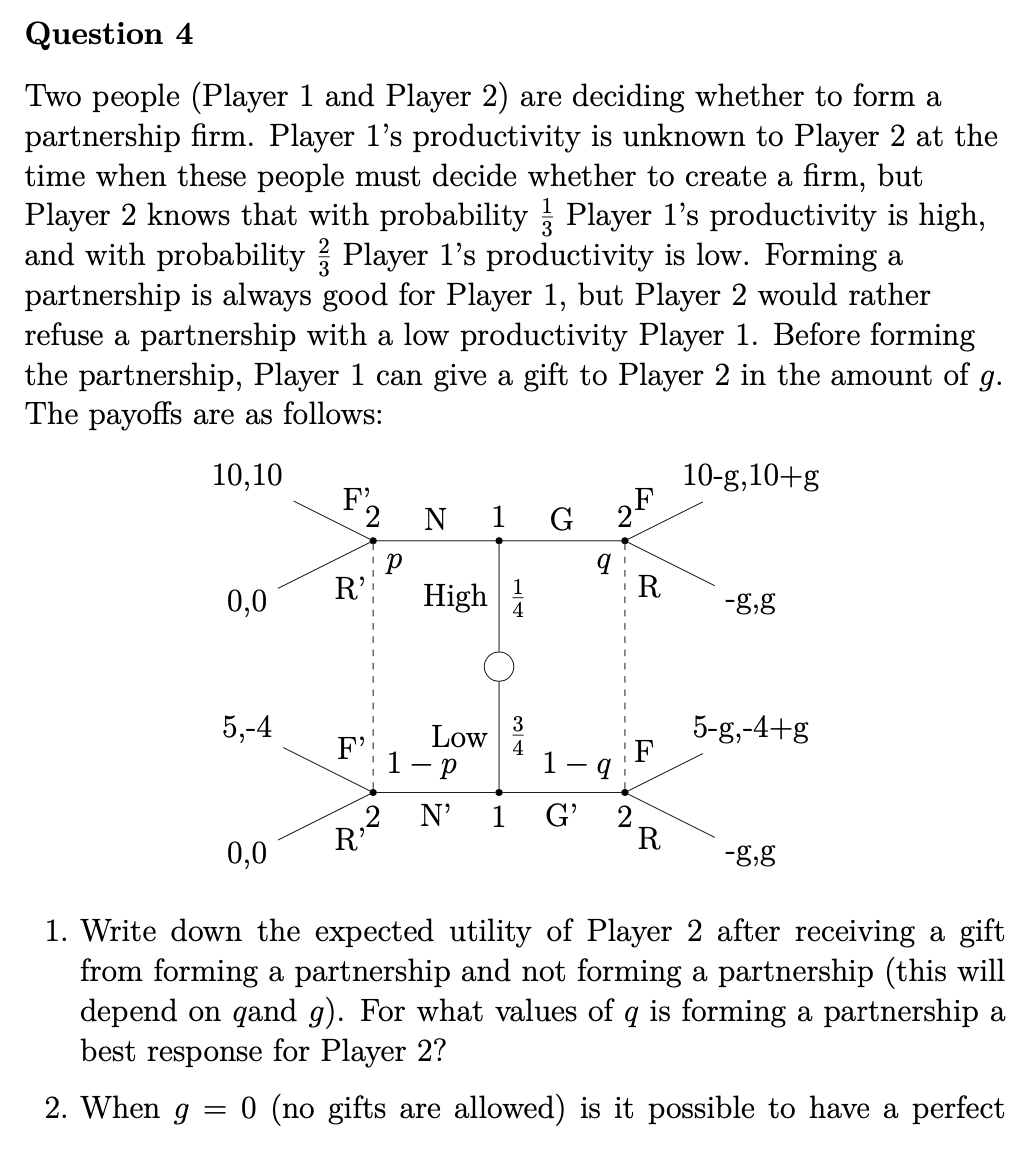
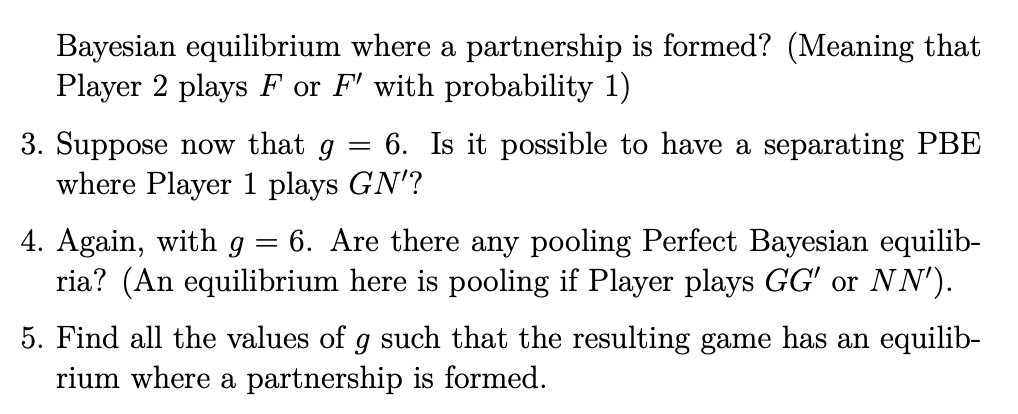
Question 4 Two people (Player 1 and Player 2) are deciding whether to form a partnership rm. Player 1's productivity is unknown to Player 2 at the time when these people must decide whether to create a rm, but Player 2 knows that with probability % Player 1's productivity is high, and with probability g Player 1's productivity is low. Forming a partnership is always good for Player 1, but Player 2 would rather refuse a partnership with a low productivity Player 1. Before forming the partnership, Player 1 can give a gift to Player 2 in the amount of g. The payoffs are as follows: 10,10 10g,10+g \"gag 1. Write down the expected utility of Player 2 after receiving a gift from forming a partnership and not forming a partnership (this will depend on qand 9). For what values of q is forming a partnership a best response for Player 2? 2. When g = 0 (no gifts are allowed) is it possible to have a perfect Bayesian equilibrium where a partnership is formed? (Meaning that Player 2 plays For F' with probability 1) 3. Suppose now that g = 6. Is it possible to have a separating PBE where Player 1 plays GN'? 4. Again, with g = 6. Are there any pooling Perfect Bayesian equilib ria? (An equilibrium here is pooling if Player plays GG' or NN'). 5. Find all the values of g such that the resulting game has an equilib rium where a partnership is formed
Step by Step Solution
There are 3 Steps involved in it

Get step-by-step solutions from verified subject matter experts
 Study Help