







Question: Uniform Circular Motion Object 1 is undergoing uniform circular motion at a radius of 1 cm. Object 2 is undergoing uniform circular motion at
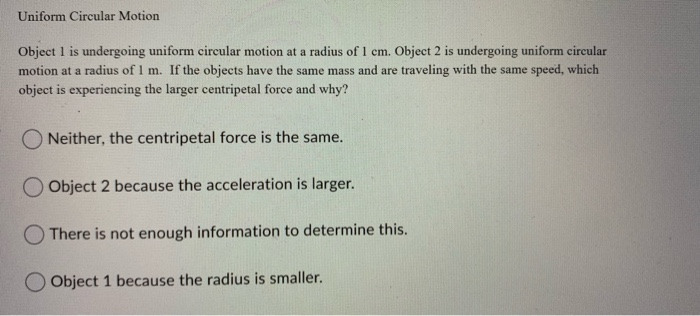
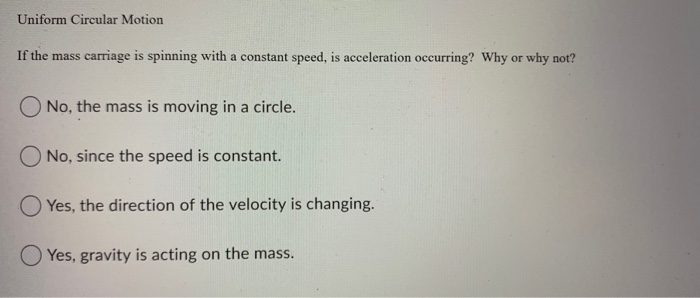
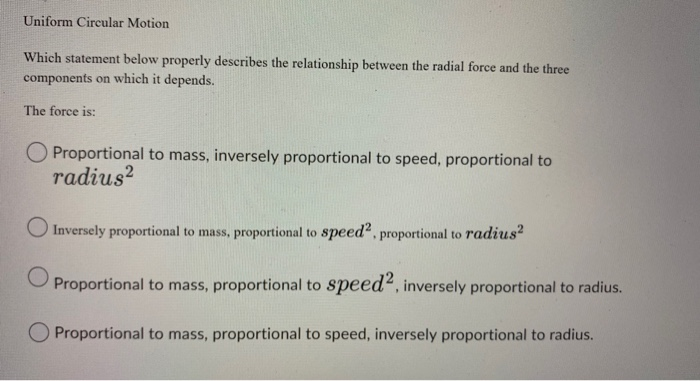
Uniform Circular Motion Object 1 is undergoing uniform circular motion at a radius of 1 cm. Object 2 is undergoing uniform circular motion at a radius of 1 m. If the objects have the same mass and are traveling with the same speed, which object is experiencing the larger centripetal force and why? O Neither, the centripetal force is the same. O Object 2 because the acceleration is larger. O There is not enough information to determine this. Object 1 because the radius is smaller. Uniform Circular Motion If the mass carriage is spinning with a constant speed, is acceleration occurring? Why or why not? O No, the mass is moving in a circle. No, since the speed is constant. O Yes, the direction of the velocity is changing. O Yes, gravity is acting on the mass. Uniform Circular Motion Which statement below properly describes the relationship between the radial force and the three components on which it depends. The force is: O Proportional to mass, inversely proportional to speed, proportional to radius? O Inversely proportional to mass, proportional to speed2, proportional to radius? O Proportional to mass, proportional to speed, inversely proportional to radius. O Proportional to mass, proportional to speed, inversely proportional to radius.
Step by Step Solution
3.49 Rating (159 Votes )
There are 3 Steps involved in it
It seems that no images we... View full answer

Get step-by-step solutions from verified subject matter experts
 Study Help