







Question: Unit 3 Application Assignment Saved 9 Required information Tableau Dashboard Activity 16-1 (Static) [The following information applies to the questions displayed below.) Part 5 of
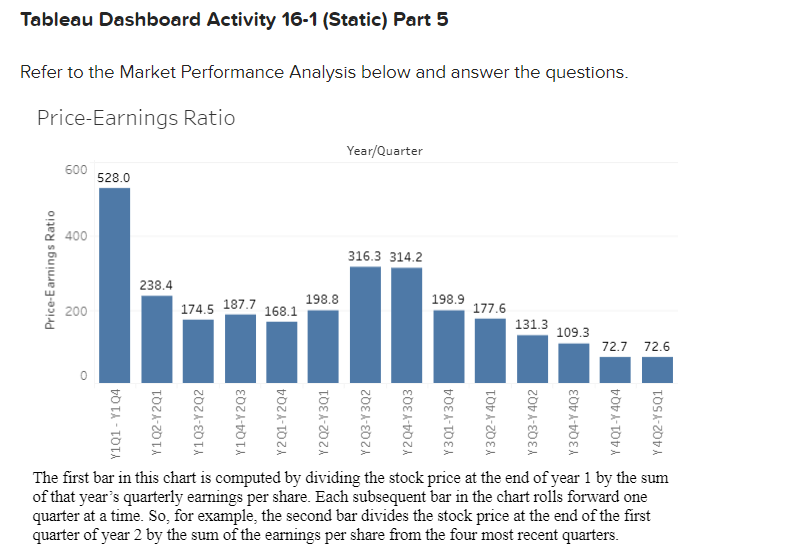
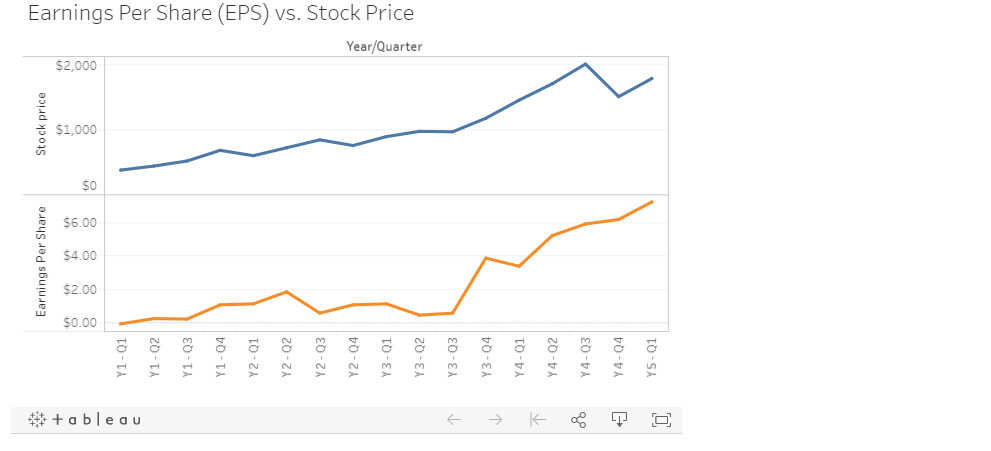
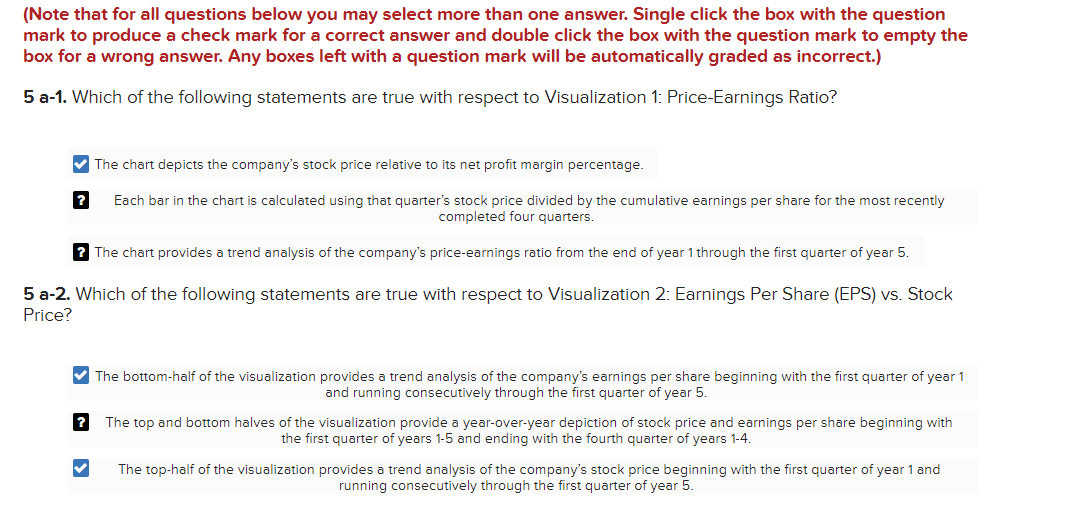
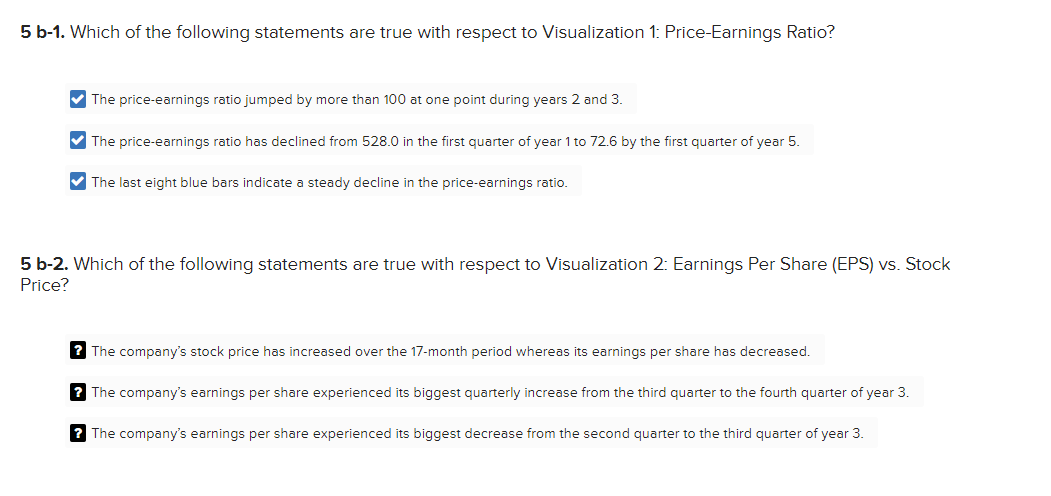
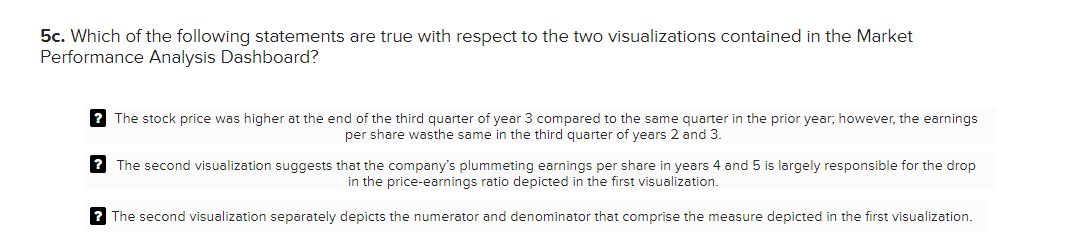
Unit 3 Application Assignment Saved 9 Required information Tableau Dashboard Activity 16-1 (Static) [The following information applies to the questions displayed below.) Part 5 of 6 This exercise provides a total of 13 data visualizations that describe a real company's performance based on 17 quarters of financial data. The visualizations are grouped into five dashboards that were created in Tableau: (1) sales analysis, (2) gross margin analysis, (3) operating expense analysis, (4) profitability analysis, and (5) market performance analysis. 5 points Required: For each section, review the Tableau visualizations and answer the questions. eBook References Tableau Dashboard Activity 16-1 (Static) Part 5 Tableau Dashboard Activity 16-1 (Static) Part 5 Refer to the Market Performance Analysis below and answer the questions. Price-Earnings Ratio Year/Quarter 600 528.0 400 316.3 314.2 Price-Earnings Ratio 238.4 198.8 187.7 198.9 200 174.5 168.1 177.6 131.3 109.3 72.7 72.6 Y101 - Y104 Y1Q2-Y 201 Y1Q3-Y202 Y104-Y203 Y201-1204 Y2Q2-Y301 Y2Q3-Y3Q2 Y204-Y303 Y3Q1-Y304 Y3Q2-Y 401 Y3Q3-Y 402 Y3Q4-Y 403 Y 401-Y 404 Y 402-Y501 The first bar in this chart is computed by dividing the stock price at the end of year 1 by the sum of that year's quarterly earnings per share. Each subsequent bar in the chart rolls forward one quarter at a time. So, for example, the second bar divides the stock price at the end of the first quarter of year 2 by the sum of the earnings per share from the four most recent quarters. Earnings Per Share (EPS) vs. Stock Price Year/Quarter $2,000 Stock price $1,000 $0 $6.00 Earnings Per Share $4.00 $2.00 $0.00 TO-TA 20-TA Y1-03 Y1-04 Y2-01 Y2-02 Y2-02 22 Y2-03 TA 12-04 Y3-01 13-02 Y3-03 Y3-04 Y4-01 Y 4-02 Y4-03 Y4-04 Y5-01 #tableau 1 1 0 (Note that for all questions below you may select more than one answer. Single click the box with the question mark to produce a check mark for a correct answer and double click the box with the question mark to empty the box for a wrong answer. Any boxes left with a question mark will be automatically graded as incorrect.) 5 a-1. Which of the following statements are true with respect to Visualization 1: Price-Earnings Ratio? The chart depicts the company's stock price relative to its net profit margin percentage. Each bar in the chart is calculated using that quarter's stock price divided by the cumulative earnings per share for the most recently completed four quarters. The chart provides a trend analysis of the company's price-earnings ratio from the end of year 1 through the first quarter of year 5. 5 a-2. Which of the following statements are true with respect to Visualization 2: Earnings Per Share (EPS) vs. Stock Price? The bottom-half of the visualization provides a trend analysis of the company's earnings per share beginning with the first quarter of year 1 and running consecutively through the first quarter of year 5. The top and bottom halves of the visualization provide a year-over-year depiction of stock price and earnings per share beginning with the first quarter of years 1-5 and ending with the fourth quarter of years 1-4. The top-half of the visualization provides a trend analysis of the company's stock price beginning with the first quarter of year 1 and running consecutively through the first quarter of year 5. 5 b-1. Which of the following statements are true with respect to Visualization 1: Price-Earnings Ratio? The price-earnings ratio jumped by more than 100 at one point during years 2 and 3. The price-earnings ratio has declined from 528.0 in the first quarter of year 1 to 72.6 by the first quarter of year 5. The last eight blue bars indicate a steady decline in the price-earnings ratio. 5 b-2. Which of the following statements are true with respect to Visualization 2: Earnings Per Share (EPS) vs. Stock Price? 2 The company's stock price has increased over the 17-month period whereas its earnings per share has decreased. 2 The company's earnings per share experienced its biggest quarterly increase from the third quarter to the fourth quarter of year 3. 2 The company's earnings per share experienced its biggest decrease from the second quarter to the third quarter of year 3. 5c. Which of the following statements are true with respect to the two visualizations contained in the Market Performance Analysis Dashboard? The stock price was higher at the end of the third quarter of year 3 compared to the same quarter in the prior year, however, the earnings per share wasthe same in the third quarter of years 2 and 3. ? The second visualization suggests that the company's plummeting earnings per share in years 4 and 5 is largely responsible for the drop in the price-earnings ratio depicted in the first visualization. The second visualization separately depicts the numerator and denominator that comprise the measure depicted in the first visualization
Step by Step Solution
There are 3 Steps involved in it

Get step-by-step solutions from verified subject matter experts
 Study Help