







Question: Urban Econ Question 1. This question will work through a simple example of Mohring economies, which is one of the strongest arguments for subsidizing public
Urban Econ Question
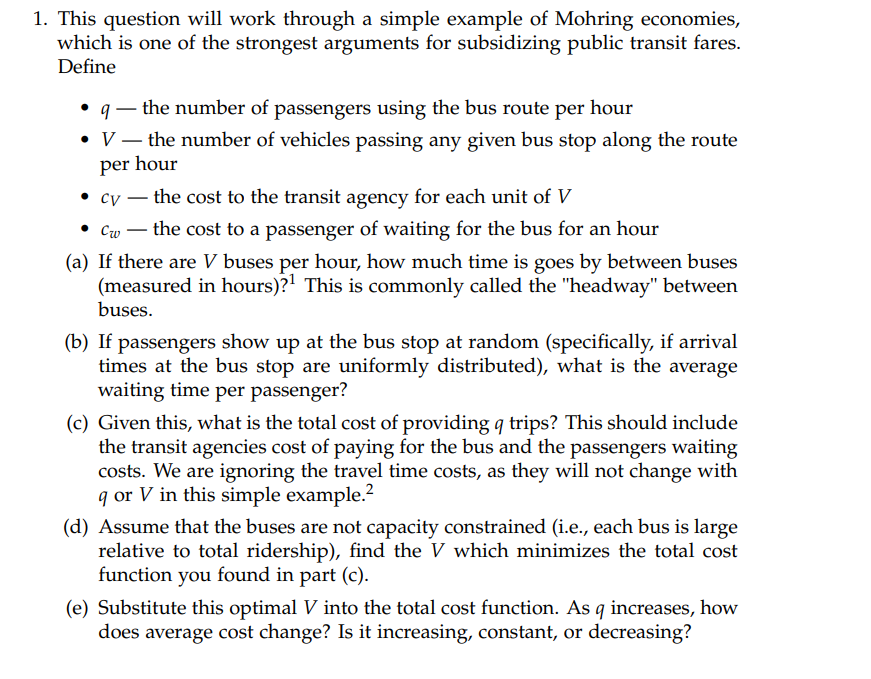
1. This question will work through a simple example of Mohring economies, which is one of the strongest arguments for subsidizing public transit fares. Dene - q the number of passengers using the bus route per hour - V the number of vehicles passing any given bus stop along the route per hour I- CV the cost to the transit agency for each unit of V - cw the cost to a passenger of waiting for the bus for an hour {a} If there are V buses per hour, how much time is goes by between buses (measured in hours)?1 This is commonly called the "headway" between buses. (b) If passengers show up at the bus stop at random (specifically, if arrival times at the bus stop are uniformly distributed), what is the average waiting time per passenger? (c) Given this, what is the total cost of providing q trips? This should include the transit agencies cost of paying for the bus and the passengers waiting costs. We are ignoring the travel time costs, as they will not change with q or V in this simple example.2 (d) Assume that the buses are not capacity constrained (i.e., each bus is large relative to total ridership}, nd the V which minimizes the total cost function you found in part (c). (e) Substitute this optimal V into the total cost function. As :5; increases, how does average cost change? Is it increasing, constant, or decreasing
Step by Step Solution
There are 3 Steps involved in it

Get step-by-step solutions from verified subject matter experts
 Study Help