







Question: Use again the ion concentrations given in Long Problem 2. You change the temperature to 25 oC and record an action potential from the neuron.
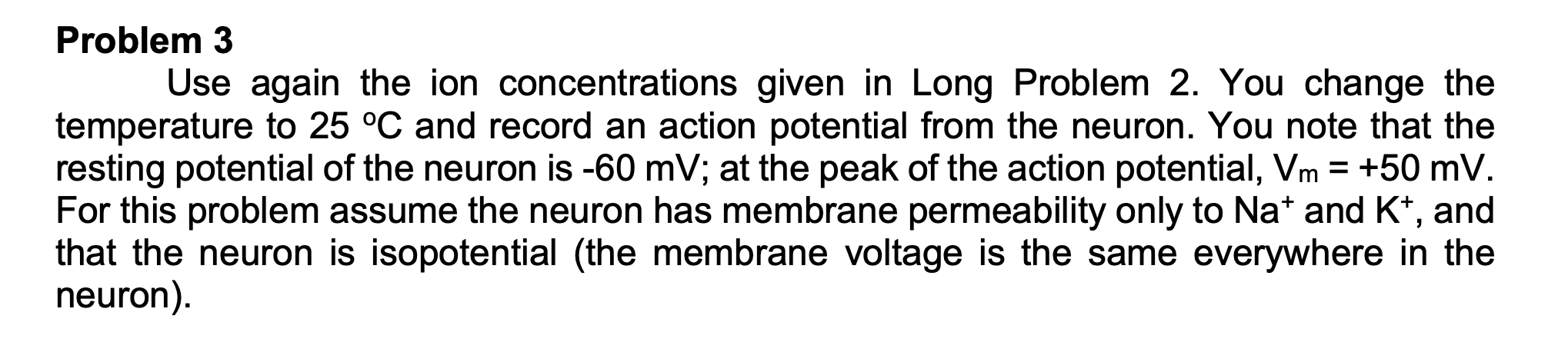
Use again the ion concentrations given in Long Problem 2. You change the temperature to 25 oC and record an action potential from the neuron. You note that the resting potential of the neuron is -60 mV; at the peak of the action potential, Vm = +50 mV. For this problem assume the neuron has membrane permeability only to Na+ and K+, and that the neuron is isopotential (the membrane voltage is the same everywhere in the neuron).
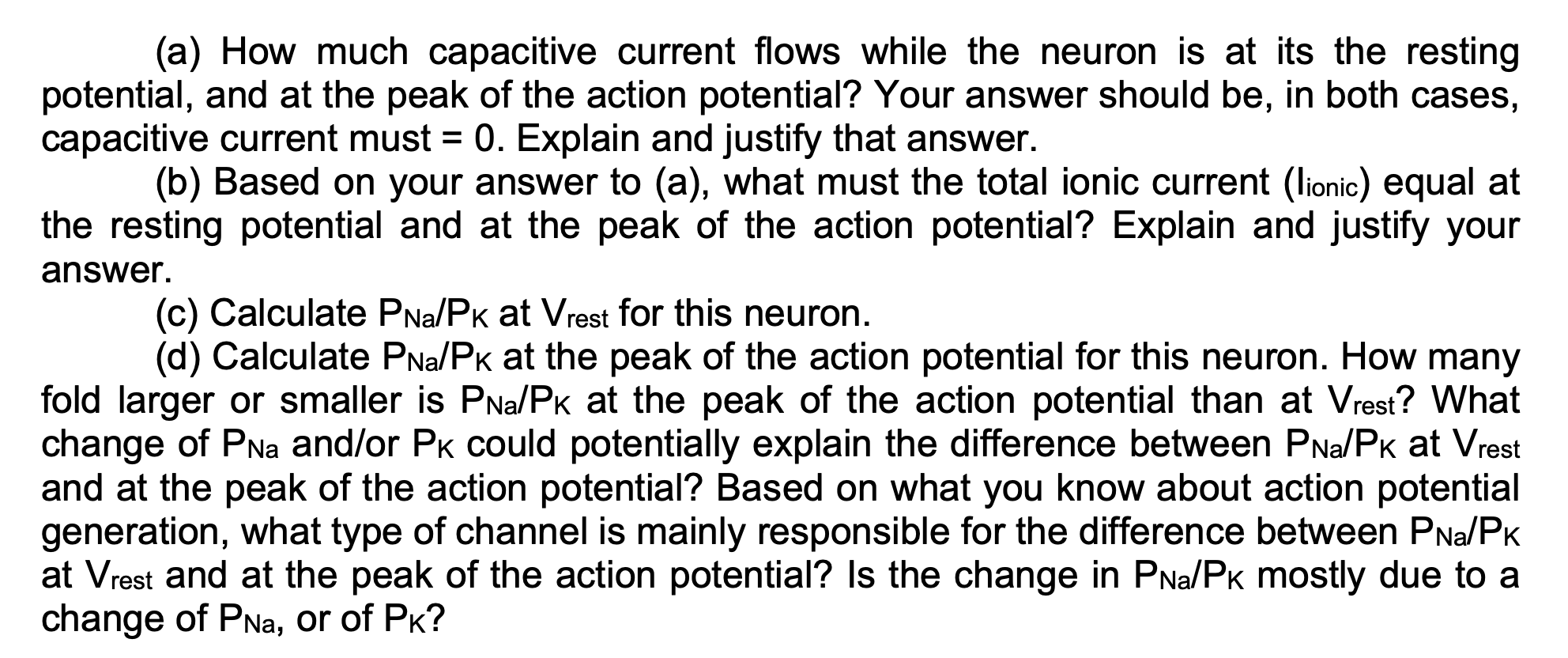
(a) How much capacitive current flows while the neuron is at its the resting potential, and at the peak of the action potential? Your answer should be, in both cases, capacitive current must = 0. Explain and justify that answer.
(b) Based on your answer to (a), what must the total ionic current (Iionic) equal at the resting potential and at the peak of the action potential? Explain and justify your answer.
(c) Calculate PNa/PK at Vrest for this neuron.
(d) Calculate PNa/PK at the peak of the action potential for this neuron. How many fold larger or smaller is PNa/PK at the peak of the action potential than at Vrest? What change of PNa and/or PK could potentially explain the difference between PNa/PK at Vrest and at the peak of the action potential? Based on what you know about action potential generation, what type of channel is mainly responsible for the difference between PNa/PK at Vrest and at the peak of the action potential? Is the change in PNa/PK mostly due to a change of PNa, or of PK?
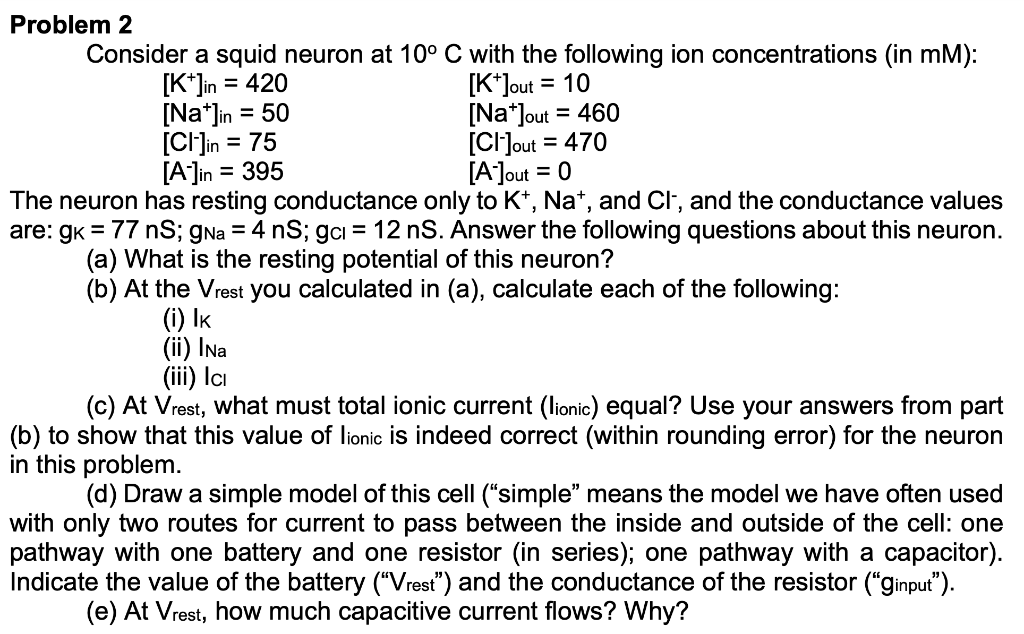
Problem 3 Use again the ion concentrations given in Long Problem 2. You change the temperature to 25 C and record an action potential from the neuron. You note that the resting potential of the neuron is -60 mV; at the peak of the action potential, Vm = +50 mV. For this problem assume the neuron has membrane permeability only to Nat and K+, and that the neuron is isopotential (the membrane voltage is the same everywhere in the neuron). (a) How much capacitive current flows while the neuron is at its the resting potential, and at the peak of the action potential? Your answer should be, in both cases, capacitive current must = 0. Explain and justify that answer. (b) Based on your answer to (a), what must the total ionic current (lionic) equal at the resting potential and at the peak of the action potential? Explain and justify your answer. (c) Calculate PNa/Pk at Vrest for this neuron. (d) Calculate Pna/Pk at the peak of the action potential for this neuron. How many fold larger or smaller is PNa/Pk at the peak of the action potential than at Vrest? What change of PNa and/or Pk could potentially explain the difference between PNa/Pk at Vrest and at the peak of the action potential? Based on what you know about action potential generation, what type of channel is mainly responsible for the difference between PNa/Pk at Vrest and at the peak of the action potential? Is the change in PNa/Pk mostly due to a change of PNa, or of Pk? Problem 2 Consider a squid neuron at 10 C with the following ion concentrations (in mM): [K]in = = 420 [K+]out = 10 [Na+Jin = 50 [Na]out = 460 [Cl-Jin = 75 [Cl]out = 470 [A-]in = 395 [A-]out = 0 The neuron has resting conductance only to K+, Na+, and Cl, and the conductance values are: gk = 77 nS; gNa = 4 nS; gci = 12 ns. Answer the following questions about this neuron. (a) What is the resting potential of this neuron? (b) At the Vrest you calculated in (a), calculate each of the following: (i) IK (ii) Ina (iii) lci (c) At Vrest, what must total ionic current (lionic) equal? Use your answers from part (b) to show that this value of lionic is indeed correct (within rounding error) for the neuron in this problem. (d) Draw a simple model of this cell ("simple means the model we have often used with only two routes for current to pass between the inside and outside of the cell: one pathway with one battery and one resistor (in series); one pathway with a capacitor). Indicate the value of the battery ("Vrest") and the conductance of the resistor ("input"). (e) At Vrest, how much capacitive current flows? Why
Step by Step Solution
There are 3 Steps involved in it

Get step-by-step solutions from verified subject matter experts
 Study Help