







Question: USE MATLAB PLEASE Solve the ODE using the following methods: Fourth-order Taylor, Euler, and Heun. (a) Take h = 0.1 and take 20 steps using
USE MATLAB PLEASE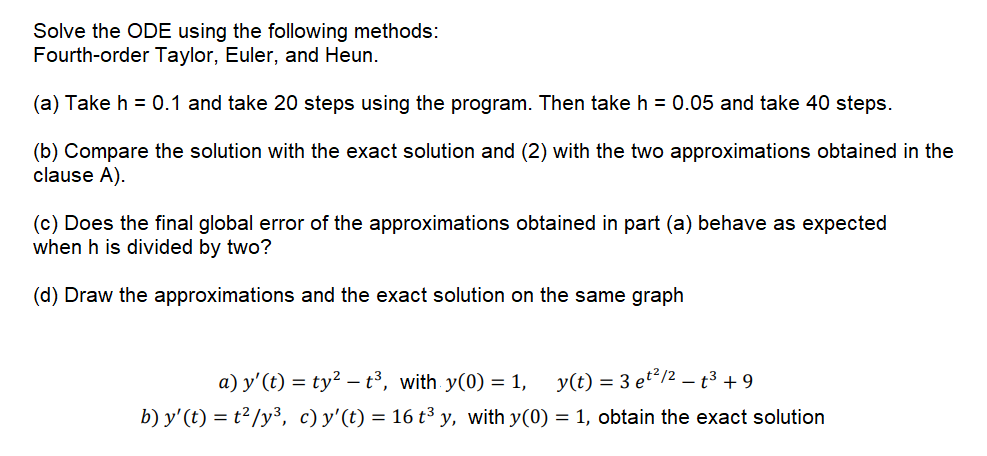
Solve the ODE using the following methods: Fourth-order Taylor, Euler, and Heun. (a) Take h = 0.1 and take 20 steps using the program. Then take h = 0.05 and take 40 steps. (b) Compare the solution with the exact solution and (2) with the two approximations obtained in the clause A). (c) Does the final global error of the approximations obtained in part (a) behave as expected when his divided by two? (d) Draw the approximations and the exact solution on the same graph a) y'(t) = ty2 t3, with y(0) = 1, y(t) = 3 et? /2 3 + 9 b) y'(t) = +2 /y3, c) y'(t) = 16 t3 y, with y(0) = 1, obtain the exact solution Solve the ODE using the following methods: Fourth-order Taylor, Euler, and Heun. (a) Take h = 0.1 and take 20 steps using the program. Then take h = 0.05 and take 40 steps. (b) Compare the solution with the exact solution and (2) with the two approximations obtained in the clause A). (c) Does the final global error of the approximations obtained in part (a) behave as expected when his divided by two? (d) Draw the approximations and the exact solution on the same graph a) y'(t) = ty2 t3, with y(0) = 1, y(t) = 3 et? /2 3 + 9 b) y'(t) = +2 /y3, c) y'(t) = 16 t3 y, with y(0) = 1, obtain the exact solution
Step by Step Solution
There are 3 Steps involved in it

Get step-by-step solutions from verified subject matter experts
 Study Help