







Question: USE PYTHON An important problem in structural engineering is that of finding forces in a statically de- terminate truss (Fig. 1). 1000 N 90 F
USE PYTHON
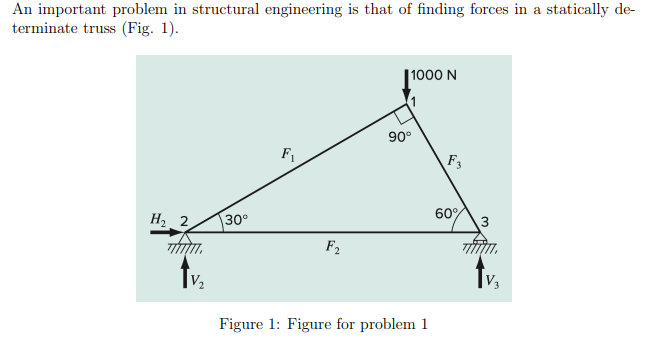
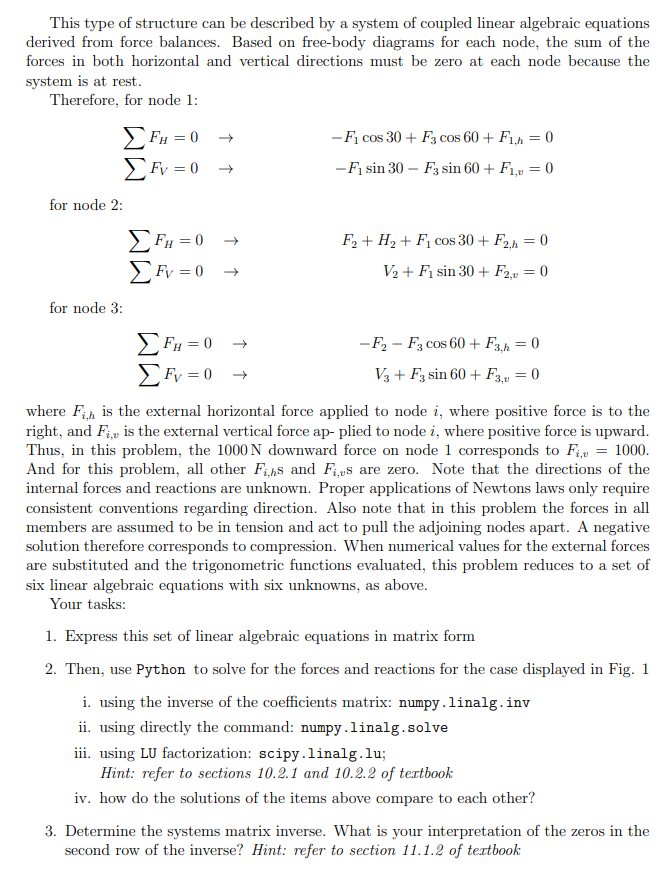
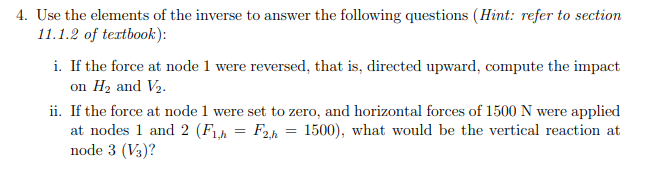
An important problem in structural engineering is that of finding forces in a statically de- terminate truss (Fig. 1). 1000 N 90 F F3 60% 30 3 H2 2 F2 TV, V: Figure 1: Figure for problem 1 This type of structure can be described by a system of coupled linear algebraic equations derived from force balances. Based on free-body diagrams for each node, the sum of the forces in both horizontal and vertical directions must be zero at each node because the system is at rest. Therefore, for node 1: FH = 0 -Fi cos 30 + Fz cos 60+ F1, n = 0 F = 0 -F1 sin 30 F3 sin 60+ F1,0 = 0 for node 2: FH = 0 F2 + H2 + Ficos 30 + F2n = 0 F = 0 V2 + F1 sin 30 + F2v = 0 1 COS for node 3: 1 FH = 0 -F, - Fzcos 60+ F3.h = 0 F = 0 - Fv = 0 V3 + Fz sin 60+ F3v = 0 where Fin is the external horizontal force applied to node i, where positive force is to the right, and Fi, is the external vertical force ap- plied to node i, where positive force is upward. Thus, in this problem, the 1000 N downward force on node 1 corresponds to Fiv = 1000. And for this problem, all other Fins and Fius are zero. Note that the directions of the internal forces and reactions are unknown. Proper applications of Newtons laws only require consistent conventions regarding direction. Also note that in this problem the forces in all members are assumed to be in tension and act to pull the adjoining nodes apart. A negative solution therefore corresponds to compression. When numerical values for the external forces are substituted and the trigonometric functions evaluated, this problem reduces to a set of six linear algebraic equations with six unknowns, as above. Your tasks: 1. Express this set of linear algebraic equations in matrix form 2. Then, use Python to solve for the forces and reactions for the case displayed in Fig. 1 i. using the inverse of the coefficients matrix: numpy.linalg. inv ii. using directly the command: numpy.linalg.solve iii. using LU factorization: scipy.linalg.lu; Hint: refer to sections 10.2.1 and 10.2.2 of textbook iv. how do the solutions of the items above compare to each other? 3. Determine the systems matrix inverse. What is your interpretation of the zeros in the second row of the inverse? Hint: refer to section 11.1.2 of textbook 4. Use the elements of the inverse to answer the following questions (Hint: refer to section 11.1.2 of textbook): i. If the force at node 1 were reversed, that is, directed upward, compute the impact on H, and V2. ii. If the force at node 1 were set to zero, and horizontal forces of 1500 N were applied at nodes 1 and 2 (F1h = F2.h = 1500), what would be the vertical reaction at node 3 (V3)
Step by Step Solution
There are 3 Steps involved in it

Get step-by-step solutions from verified subject matter experts
 Study Help