







Question: Use python please! The Collatz problem our code for this problem should go in a file called collatz.py he Collatz function works like this: given
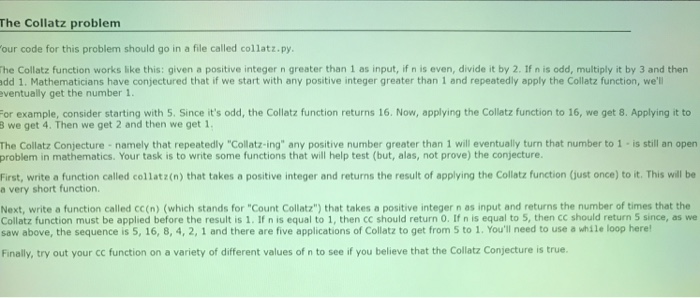
The Collatz problem our code for this problem should go in a file called collatz.py he Collatz function works like this: given a positive integer n greater than 1 as input, if n is even, divide it by 2. If n is odd, multiply it by 3 and then dd 1. Mathematicians have conjectured that if we start with any positive integer greater than 1 and repeatedly apply the Collatz function, we'll eventually get the number 1. or example, consider starting with 5. Since it's odd, the Collatz function returns 16. Now, applying the Collatz function to 16, we get 8. Applying it to 8 we get 4. Then we get 2 and then we get 1 The Collatz Conjecture namely that repeatedly "Collatz-ing" any positive number greater than 1 will eventually turn that number to 1 - is still an open problem in mathematics. Your task is to write some functions that will help test (but, alas, not prove) the conjecture. First, write a function called collatz(n) that takes a positive integer and returns the result of applying the Collatz function (just once) to it. This will be e very short function. Next, write a function called cC(n) (which stands for "Count Collatz") that takes a positive integer n as input and returns the number of times that the Collatz function must be applied before the result is 1. If n is equal to 1, then cC should return 0. If n is equal to 5, then cc should return 5 since, as we saw above, the sequence is 5, 16, 8, 4, 2, 1 and there are five applications of Collatz to get from 5 to 1. You'll need to use a while loop herel Finally, try out your cc function on a variety of different values of n to see if you believe that the Collatz Conjecture is true
Step by Step Solution
There are 3 Steps involved in it

Get step-by-step solutions from verified subject matter experts
 Study Help