







Question: USE THE 7 STEP GUIDE TO ETHICAL DECISION MAKING LISTED BELOW: Seven-step guide to ethical decision-making (Davis 1999) 1. State the problem. For example, there's
USE THE 7 STEP GUIDE TO ETHICAL DECISION MAKING LISTED BELOW:
Seven-step guide to ethical decision-making (Davis 1999)
1. State the problem.
For example, "there's something about this decision that makes me uncomfortable" or "do I have a conflict of interest?".
2. Check the facts.
Many problems disappear upon closer examination of the situation, while others change radically. For example, persons involved, laws, professional codes, other practical constraints
3. Identify relevant factors.
4. Develop a list of options. Who to go to/what to day. Avoid "dilemma"; not "yes" or" no"
5. Test the options. Use some of the following tests:
harm test: Does this option do less harm than the alternatives?
publicity test: Would I want my choice of this option published in the newspaper?
defensibility test: Could I defend my choice of this option before a congressional committee or committee of peers?
reversibility test: Would I still think this option was a good choice if I were adversely affected by it?
colleague test: What do my colleagues say when I describe my problem and suggest this option as my solution?
professional test: What might my profession's governing body for ethics say about this option?
organization test: What does my company's ethics officer or legal counsel say about this?
6. Make a choice based on steps 1-5.
7. Review steps 1-6. How can you reduce the likelihood that you will need to make a similar decision again? Are there any cautions you can take as an individual (and announce your policy on question, job change, etc.)? Is there any way to have more support next time? Is there any way to change the organization (for example, suggest policy change at next departmental meeting)?
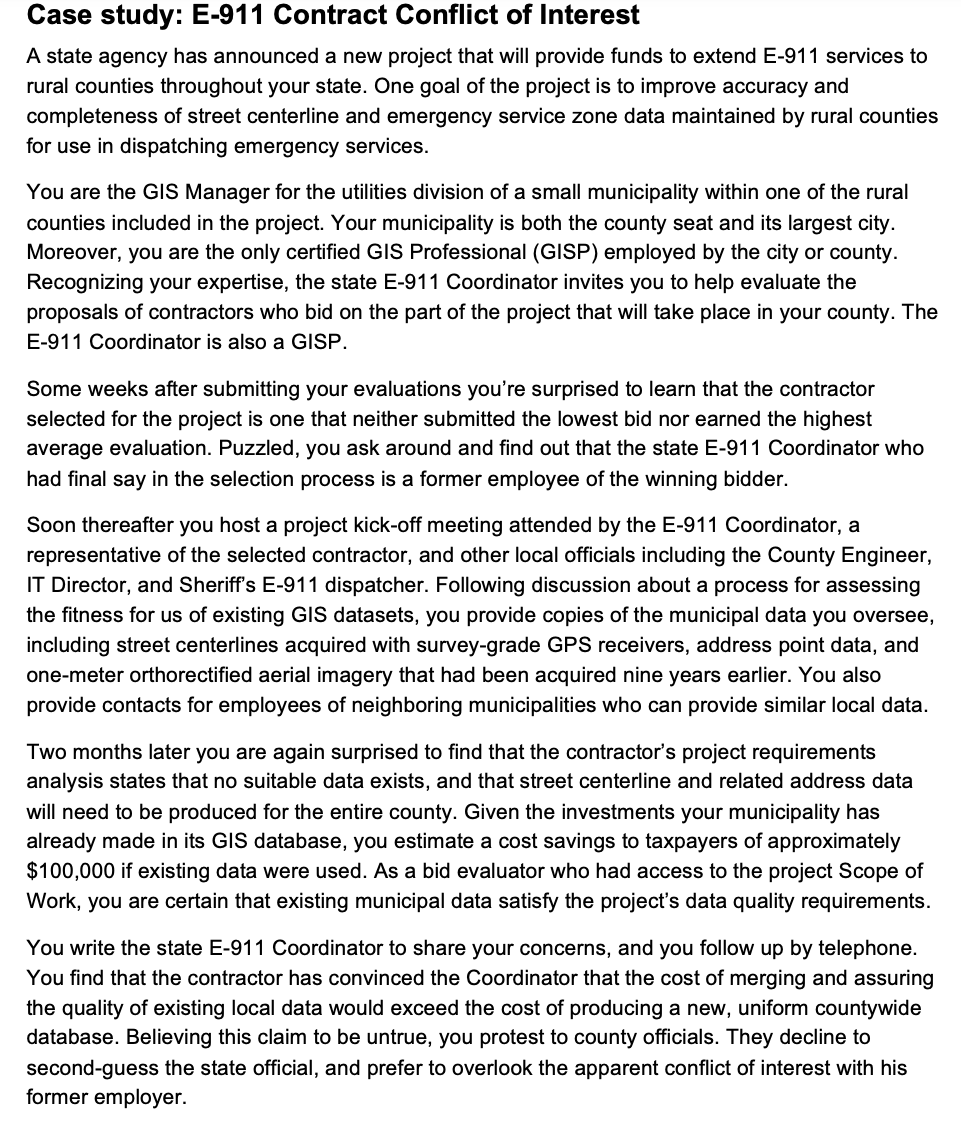
Case study: E-911 Contract Conflict of Interest A state agency has announced a new project that will provide funds to extend E-911 services to rural counties throughout your state. One goal of the project is to improve accuracy and completeness of street centerline and emergency service zone data maintained by rural counties for use in dispatching emergency services. You are the GIS Manager for the utilities division of a small municipality within one of the rural counties included in the project. Your municipality is both the county seat and its largest city. Moreover, you are the only certified GIS Professional (GISP) employed by the city or county. Recognizing your expertise, the state E-911 Coordinator invites you to help evaluate the proposals of contractors who bid on the part of the project that will take place in your county. The E-911 Coordinator is also a GISP. Some weeks after submitting your evaluations you're surprised to learn that the contractor selected for the project is one that neither submitted the lowest bid nor earned the highest average evaluation. Puzzled, you ask around and find out that the state E-911 Coordinator who had final say in the selection process is a former employee of the winning bidder. Soon thereafter you host a project kick-off meeting attended by the E-911 Coordinator, a representative of the selected contractor, and other local officials including the County Engineer, IT Director, and Sheriff's E-911 dispatcher. Following discussion about a process for assessing the fitness for us of existing GIS datasets, you provide copies of the municipal data you oversee, including street centerlines acquired with survey-grade GPS receivers, address point data, and one-meter orthorectified aerial imagery that had been acquired nine years earlier. You also provide contacts for employees of neighboring municipalities who can provide similar local data. Two months later you are again surprised to find that the contractor's project requirements analysis states that no suitable data exists, and that street centerline and related address data will need to be produced for the entire county. Given the investments your municipality has already made in its GIS database, you estimate a cost savings to taxpayers of approximately $100,000 if existing data were used. As a bid evaluator who had access to the project Scope of Work, you are certain that existing municipal data satisfy the project's data quality requirements. You write the state E-911 Coordinator to share your concerns, and you follow up by telephone. You find that the contractor has convinced the Coordinator that the cost of merging and assuring the quality of existing local data would exceed the cost of producing a new, uniform countywide database. Believing this claim to be untrue, you protest to county officials. They decline to second-guess the state official, and prefer to overlook the apparent conflict of interest with his former employerStep by Step Solution
There are 3 Steps involved in it

Get step-by-step solutions from verified subject matter experts
 Study Help