







Question: Use the data given in Example 2.6 and also consider the following added new load. Suppose that several buildings which have electric air-conditioning are converted
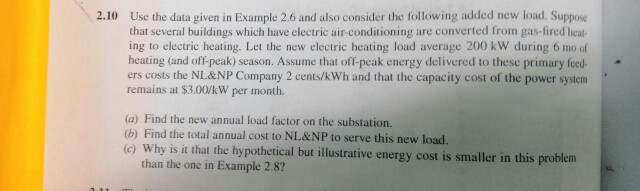
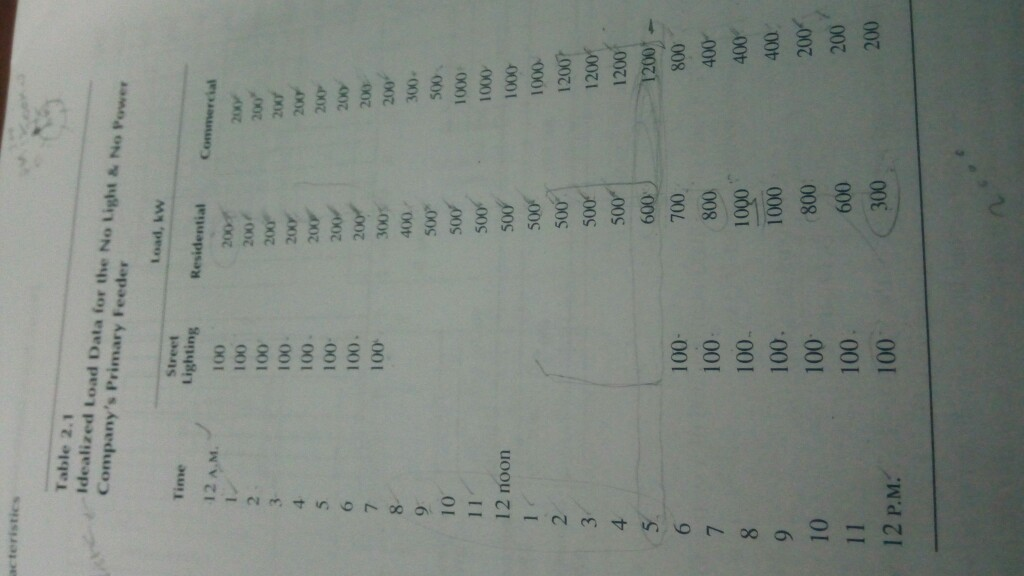
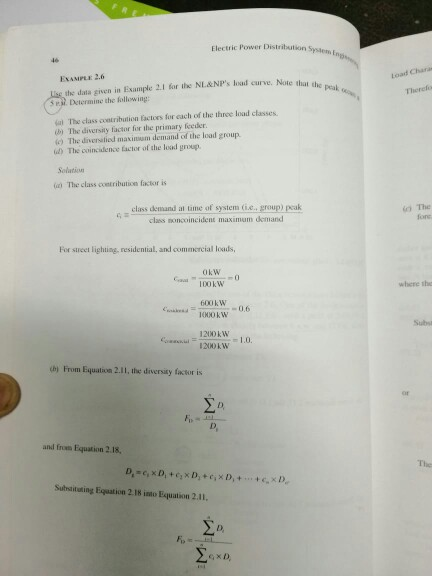
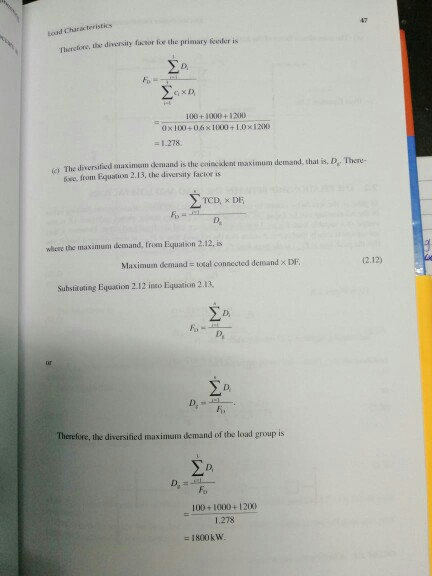
Use the data given in Example 2.6 and also consider the following added new load. Suppose that several buildings which have electric air-conditioning are converted from gas-fired heat- ing to electric heating. Let the new electric heating load average 200 kW during 6 mo of heating (and off-peak) season. Assume that off-peak energy delivered to these primary feed ers costs the NL&NP Company 2 cents/kWh and that the capacity cost of the power system remains at $3.00/kW per month. 2.10 (a) Find the new annual load factor on the substation. (b) Find the total annual cost to NL&NP to serve this new load e) Why is it that the hypothetical but illustrative energy cost is smaller in this problem than the one in Example 2.8? acteristics Table 2.1 Idealized Load Data for the No Light& No Power Company's Primary Feeder Time Lighting 100 100 100 100 100 100 100 100 12 A M. 200 200/ 200 200 200 200 400 300 500 1000 1000 1000 1000 1200 12 noon 1200 1200 1200' 700 100 100 100 100 100 100 100 800 800 10 200 200 300 12 P.M. Electric Power Distribution en E 46 ne ExAMPLE 2.6 Load Chara the dala given in Esample 2.1 for the NL&NP's lbsal curve. Note that the 5 P.IDelermillete following Therefis (al The class contribution Eactoes for each of the three load classes b) The diversity factor for the primary feeder () The diversatiod maxinum demand of the load group 6) The coincilence factor of the load group. Solation ) The class contribution factor is class demand at time of system ti.e. group) peak The fone class noncoincident maximum demand For street lighting, residential, and commercial loads okW 100kW where the 610kW-0.6 1000kw-06 200kW Subs , From Equalan 2.ll, tie diversay factor is D, and fras Equation 2.18, The Suhbaituting Equation 2.18 imo Equation 2.11 D, exD Loud Characteristics Theretore, the diversity facsor fox the primary feeder is c, x D 100+D+1200 Ox 100+0.6 x100 +1.0x1200 1.278. ct The diversified maximum demand is the coincident maximum demand, that is, D There- foe, from Equation 2.13, the diversity factor is TCD, DE D, whese the maximum demand, from Equalion 2.12, is Maximum demand total connected demand x DF (2.12) Suhstituting Equation 2.12 ino Equation 2.1.3, D, D, Fi D, Therefore, the diversified maximum demand of the load group is Fa 100+ 1000+1200 1.278 1800 kW. Use the data given in Example 2.6 and also consider the following added new load. Suppose that several buildings which have electric air-conditioning are converted from gas-fired heat- ing to electric heating. Let the new electric heating load average 200 kW during 6 mo of heating (and off-peak) season. Assume that off-peak energy delivered to these primary feed ers costs the NL&NP Company 2 cents/kWh and that the capacity cost of the power system remains at $3.00/kW per month. 2.10 (a) Find the new annual load factor on the substation. (b) Find the total annual cost to NL&NP to serve this new load e) Why is it that the hypothetical but illustrative energy cost is smaller in this problem than the one in Example 2.8? acteristics Table 2.1 Idealized Load Data for the No Light& No Power Company's Primary Feeder Time Lighting 100 100 100 100 100 100 100 100 12 A M. 200 200/ 200 200 200 200 400 300 500 1000 1000 1000 1000 1200 12 noon 1200 1200 1200' 700 100 100 100 100 100 100 100 800 800 10 200 200 300 12 P.M. Electric Power Distribution en E 46 ne ExAMPLE 2.6 Load Chara the dala given in Esample 2.1 for the NL&NP's lbsal curve. Note that the 5 P.IDelermillete following Therefis (al The class contribution Eactoes for each of the three load classes b) The diversity factor for the primary feeder () The diversatiod maxinum demand of the load group 6) The coincilence factor of the load group. Solation ) The class contribution factor is class demand at time of system ti.e. group) peak The fone class noncoincident maximum demand For street lighting, residential, and commercial loads okW 100kW where the 610kW-0.6 1000kw-06 200kW Subs , From Equalan 2.ll, tie diversay factor is D, and fras Equation 2.18, The Suhbaituting Equation 2.18 imo Equation 2.11 D, exD Loud Characteristics Theretore, the diversity facsor fox the primary feeder is c, x D 100+D+1200 Ox 100+0.6 x100 +1.0x1200 1.278. ct The diversified maximum demand is the coincident maximum demand, that is, D There- foe, from Equation 2.13, the diversity factor is TCD, DE D, whese the maximum demand, from Equalion 2.12, is Maximum demand total connected demand x DF (2.12) Suhstituting Equation 2.12 ino Equation 2.1.3, D, D, Fi D, Therefore, the diversified maximum demand of the load group is Fa 100+ 1000+1200 1.278 1800 kW
Step by Step Solution
There are 3 Steps involved in it
1 Expert Approved Answer
Step: 1 Unlock

Question Has Been Solved by an Expert!
Get step-by-step solutions from verified subject matter experts
Step: 2 Unlock
Step: 3 Unlock
 Study Help