



Question: Use the largest candidate rule to solve the line balancing problem . pleas the due line is tommorw please only solve the how many staions
- Use the largest candidate rule to solve the line balancing problem .
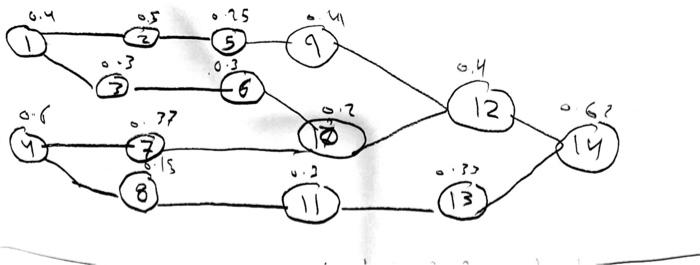
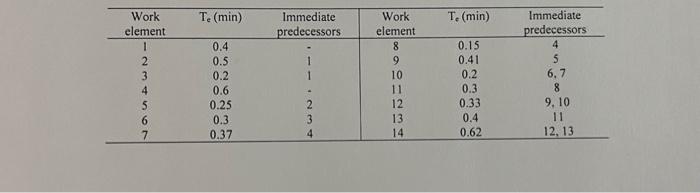
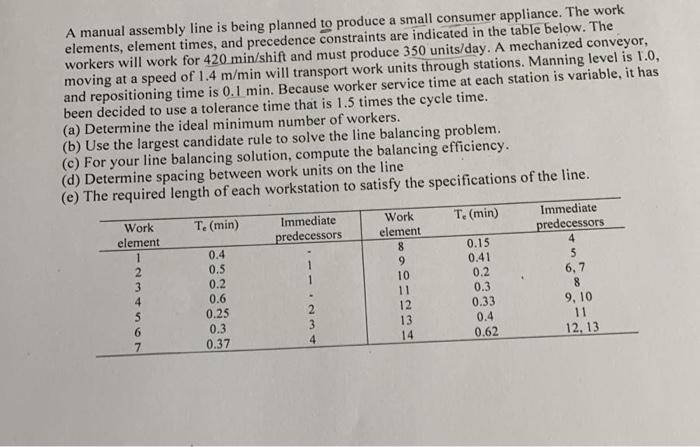
\begin{tabular}{ccc|ccc} \hline Workelement & Te(min) & Immediatepredecessors & Workelement & Te(min) & Immediatepredecessors \\ \hline 1 & 0.4 & - & 8 & 0.15 & 4 \\ 2 & 0.5 & 1 & 9 & 0.41 & 5 \\ 3 & 0.2 & 1 & 10 & 0.2 & 6.7 \\ 4 & 0.6 & - & 11 & 0.3 & 8 \\ 5 & 0.25 & 12 & 0.33 & 9,10 \\ 6 & 0.3 & 3 & 13 & 0.4 & 11 \\ 7 & 0.37 & 4 & 14 & 0.62 & 12,13 \\ \hline \end{tabular} A manual assembly line is being planned to produce a small consumer appliance. The work elements, element times, and precedence constraints are indicated in the table below. The workers will work for 420min/shift and must produce 350 units/day. A mechanized conveyor, moving at a speed of 1.4m/min will transport work units through stations. Manning level is 1.0 , and repositioning time is 0.1min. Because worker service time at each station is variable, it has been decided to use a tolerance time that is 1.5 times the cycle time. (a) Determine the ideal minimum number of workers. (b) Use the largest candidate rule to solve the line balancing problem. (c) For your line balancing solution, compute the balancing efficiency. (d) Determine spacing between work units on the line (d) Determine spacing between work ef each workstation to satisfy the specifications the. \begin{tabular}{ccc|ccc} \hline Workelement & Te(min) & Immediatepredecessors & Workelement & Te(min) & Immediatepredecessors \\ \hline 1 & 0.4 & - & 8 & 0.15 & 4 \\ 2 & 0.5 & 1 & 9 & 0.41 & 5 \\ 3 & 0.2 & 1 & 10 & 0.2 & 6.7 \\ 4 & 0.6 & - & 11 & 0.3 & 8 \\ 5 & 0.25 & 12 & 0.33 & 9,10 \\ 6 & 0.3 & 3 & 13 & 0.4 & 11 \\ 7 & 0.37 & 4 & 14 & 0.62 & 12,13 \\ \hline \end{tabular} A manual assembly line is being planned to produce a small consumer appliance. The work elements, element times, and precedence constraints are indicated in the table below. The workers will work for 420min/shift and must produce 350 units/day. A mechanized conveyor, moving at a speed of 1.4m/min will transport work units through stations. Manning level is 1.0 , and repositioning time is 0.1min. Because worker service time at each station is variable, it has been decided to use a tolerance time that is 1.5 times the cycle time. (a) Determine the ideal minimum number of workers. (b) Use the largest candidate rule to solve the line balancing problem. (c) For your line balancing solution, compute the balancing efficiency. (d) Determine spacing between work units on the line (d) Determine spacing between work ef each workstation to satisfy the specifications the
Step by Step Solution
There are 3 Steps involved in it

Get step-by-step solutions from verified subject matter experts