







Question: Use the References to access important values if needed for this question. For the following reaction, 5.06 grams of benzene (CH) are allowed to react
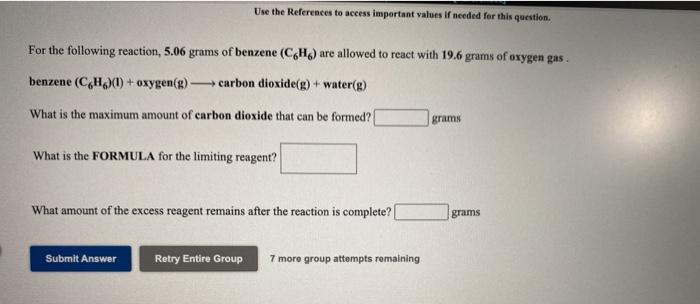
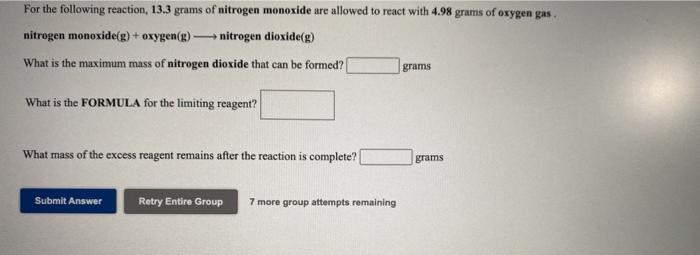
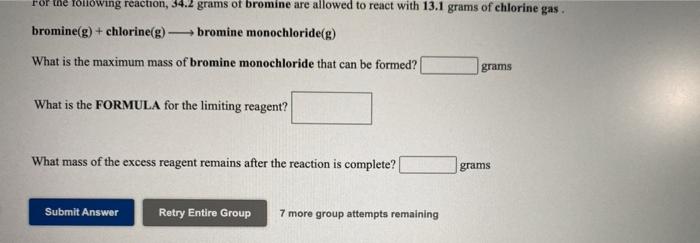
Use the References to access important values if needed for this question. For the following reaction, 5.06 grams of benzene (CH) are allowed to react with 19.6 grams of oxygen gas. benzene (CH2(1) + oxygen(e) carbon dioxide(g) + water(g) What is the maximum amount of carbon dioxide that can be formed? grams What is the FORMULA for the limiting reagent? What amount of the excess reagent remains after the reaction is complete? grams Submit Answer Retry Entire Group 7 more group attempts remaining For the following reaction, 13.3 grams of nitrogen monoxide are allowed to react with 4.98 grams of oxygen gas. nitrogen monoxide(g) + oxygen(g) nitrogen dioxide(g) What is the maximum mass of nitrogen dioxide that can be formed? grams What is the FORMULA for the limiting reagent? What mass of the excess reagent remains after the reaction is complete? grams Submit Answer Retry Entire Group 7 more group attempts remaining For the following reaction, 34.2 grams of bromine are allowed to react with 13.1 grams of chlorine gas. bromine(g) + chlorine(g) - -bromine monochloride(g) What is the maximum mass of bromine monochloride that can be formed? grams What is the FORMULA for the limiting reagent? What mass of the excess reagent remains after the reaction is complete? grams Submit Answer Retry Entire Group 7 more group attempts remaining
Step by Step Solution
There are 3 Steps involved in it

Get step-by-step solutions from verified subject matter experts
 Study Help