







Question: Use the routine sig_noise to generate a waveform containing 200- and 400-Hz sine waves as in Problem 9, but add noise so that the signal-to-noise
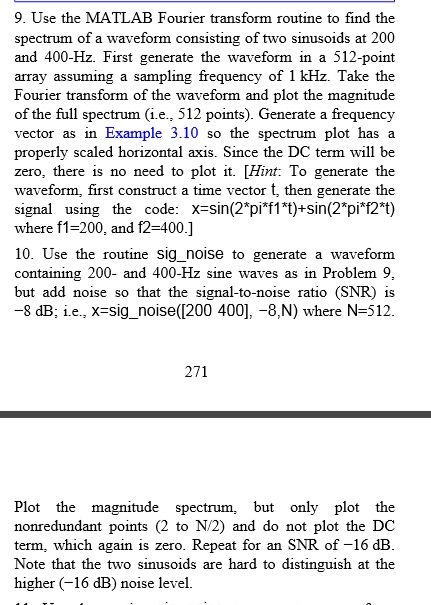
Use the routine sig_noise to generate a waveform containing 200- and 400-Hz sine waves as in Problem 9, but add noise so that the signal-to-noise ratio (SNR) is 8dB; i.e., x=sig_noise([200 400], 8,N) where N=512. Plot the magnitude spectrum, but only plot the nonredundant points (2 to N/2) and do not plot the DC term, which again is zero. Repeat for an SNR of 16dB. Note that the two sinusoids are hard to distinguish at the higher (16dB) noise level.
9. Use the MATLAB Fourier transform routine to find the spectrum of a waveform consisting of two sinusoids at the 200 and 400-Hz. First generate the waveform in a 512-point array assuming a sampling frequency of 1 kHz. Take the Fourier transform of the waveform and plot the magnitude of the full spectrum (ie.. 512 points). Generate a frequency vector as in Example 3.10 so the spectrum plot has a properly scaled horizontal axis. Since the DC term will be zero, there is no need to plot it. Hint: To generate the waveform, first construct a time vector t, then generate the signal using the code: x sin(2*pi*f1*t)+sin (2*pi*f2't) 10. se the routine sig noise to generate a waveform containing 200- and 400-Hz sine waves as in Problem 9 but add noise so that the signal-to-noise ratio (SNR) is 8 dB ie.. x sig noise(1200 400], -8,N) where N 512. 271 Plot the magnitude spectrum but only plot the nonredundant points (2 to N/2) and do not plot the DC term, which again is zero. Repeat for an SNR of -16 dB Note that the two sinusoids are hard to distinguish at the higher C16 dB) noise level. 9. Use the MATLAB Fourier transform routine to find the spectrum of a waveform consisting of two sinusoids at the 200 and 400-Hz. First generate the waveform in a 512-point array assuming a sampling frequency of 1 kHz. Take the Fourier transform of the waveform and plot the magnitude of the full spectrum (ie.. 512 points). Generate a frequency vector as in Example 3.10 so the spectrum plot has a properly scaled horizontal axis. Since the DC term will be zero, there is no need to plot it. Hint: To generate the waveform, first construct a time vector t, then generate the signal using the code: x sin(2*pi*f1*t)+sin (2*pi*f2't) 10. se the routine sig noise to generate a waveform containing 200- and 400-Hz sine waves as in Problem 9 but add noise so that the signal-to-noise ratio (SNR) is 8 dB ie.. x sig noise(1200 400], -8,N) where N 512. 271 Plot the magnitude spectrum but only plot the nonredundant points (2 to N/2) and do not plot the DC term, which again is zero. Repeat for an SNR of -16 dB Note that the two sinusoids are hard to distinguish at the higher C16 dB) noise level
Step by Step Solution
There are 3 Steps involved in it
Fourier Transform Analysis of Two Sinusoids with Noise in MATLAB This guide provides a stepbystep solution to problems involving Fourier Transform analysis of two sinusoids at 200 Hz and 400 Hz with a... View full answer

Get step-by-step solutions from verified subject matter experts
 Study Help