







Question: Usee java A MathVector object will be passed to your method. Return its contents as a String. If you look in the file MathVector.java you'll
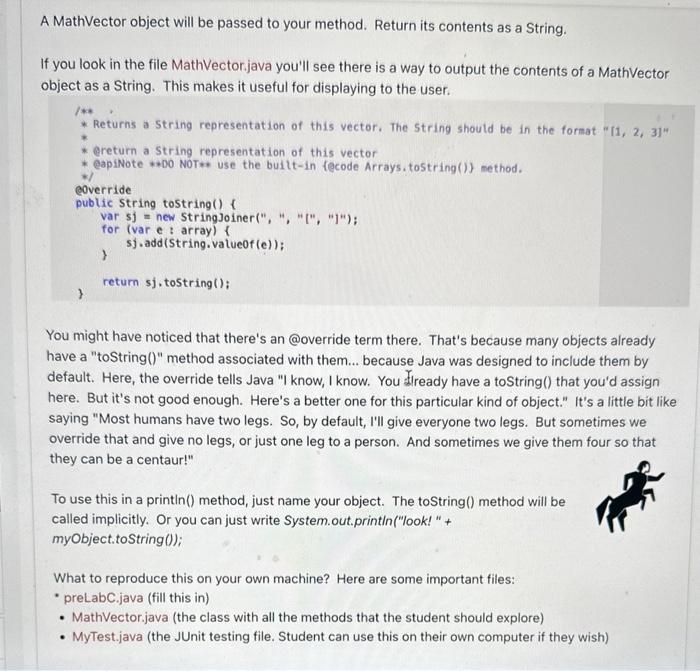
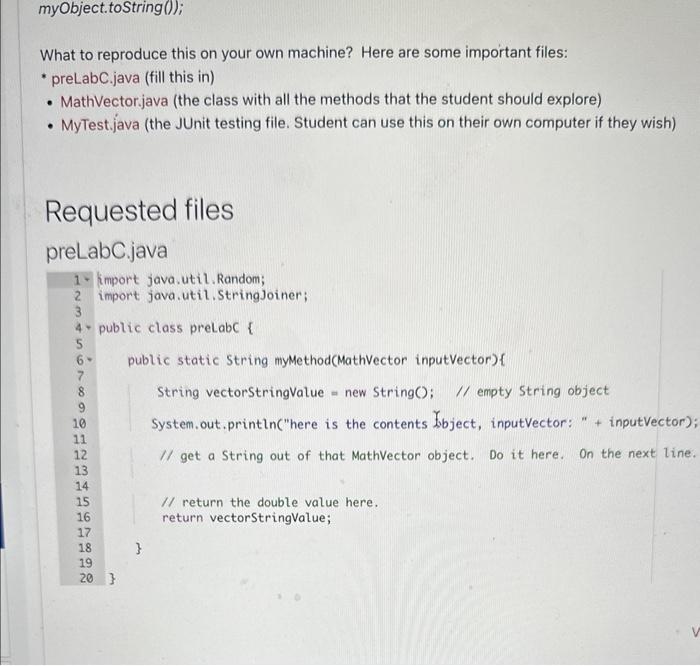
A MathVector object will be passed to your method. Return its contents as a String. If you look in the file MathVector.java you'll see there is a way to output the contents of a MathVector object as a String. This makes it useful for displaying to the user. You might have noticed that there's an @override term there. That's because many objects already have a "toString () method associated with them... because Java was designed to include them by default. Here, the override tells Java "I know, I know. You Itready have a toString() that you'd assign here. But it's not good enough. Here's a better one for this particular kind of object." It's a little bit like saying "Most humans have two legs. So, by default, I'll give everyone two legs. But sometimes we override that and give no legs, or just one leg to a person. And sometimes we give them four so that they can be a centaur!" To use this in a println() method, just name your object. The toString() method will be called implicitly. Or you can just write System.out.println("look! "+ myObject.toString()); What to reproduce this on your own machine? Here are some important files: - preLabC.java (fill this in) - MathVector.java (the class with all the methods that the student should explore) - MyTest.java (the JUnit testing file. Student can use this on their own computer if they wish) What to reproduce this on your own machine? Here are some important files: * preLabC.java (fill this in) - MathVector.java (the class with all the methods that the student should explore) - MyTest.java (the JUnit testing file. Student can use this on their own computer if they wish) Requested files preLabC.java
Step by Step Solution
There are 3 Steps involved in it

Get step-by-step solutions from verified subject matter experts
 Study Help