







Question: Using a TBR reactor packed with spherical palladium-alumina catalyst pellets dilute aqueous ethanol (-3 %) is oxidized to acetic acid. Pure oxygen is used at
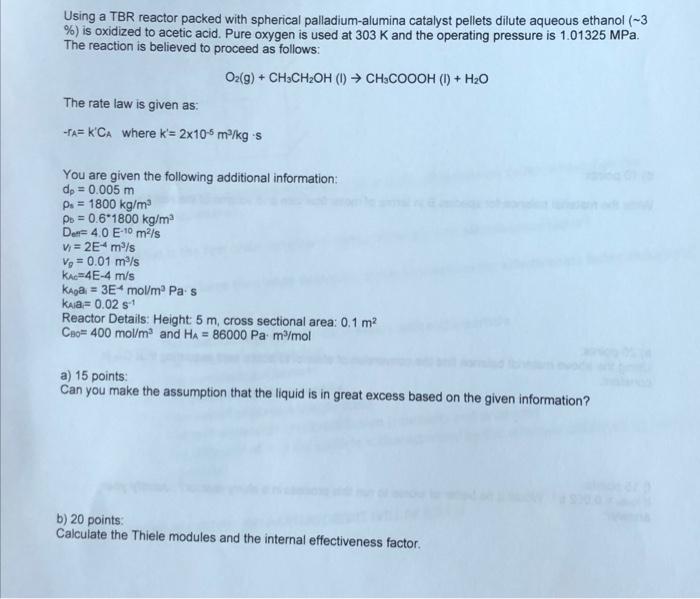
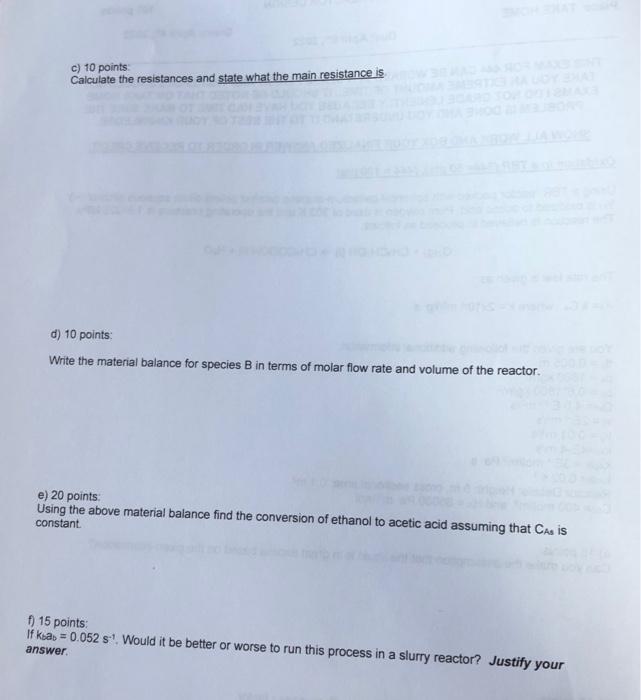

Using a TBR reactor packed with spherical palladium-alumina catalyst pellets dilute aqueous ethanol (-3 %) is oxidized to acetic acid. Pure oxygen is used at 303 K and the operating pressure is 1.01325 MPa. The reaction is believed to proceed as follows: O2(g) + CH3CH2OH (1) CH3COOOH (1) + H2O The rate law is given as - A= k'CA where k'= 2x10⁵m/kg-s You are given the following additional information: dp = 0.005 m ps = 1800 kg/m Do = 0.6*1800 kg/m De 40 E-10 m/s v=2E4 m/s Vy = 0.01 m/s KA-4E-4 m/s kaga, = 3E+ mol/ mPas kaa= 0.02 s1 Reactor Details: Height 5 m, cross sectional area: 0.1 m2 Cao 400 mol/m and HA = 86000 Pa m/mol a) 15 points: Can you make the assumption that the liquid is in great excess based on the given information? b) 20 points Calculate the Thiele modules and the internal effectiveness factor. C) 10 points Calculate the resistances and state what the main resistance is d) 10 points Write the material balance for species B in terms of molar flow rate and volume of the reactor. e) 20 points Using the above material balance find the conversion of ethanol to acetic acid assuming that Cas is constant f) 15 points if koap = 0.052 s' Would it be better or worse to run this process in a slurry reactor? Justify your answer. g) 10 points What effect would using a catalyst particle size of 2.5 mm have on this process either in a TBR or a slurry
Step by Step Solution
There are 3 Steps involved in it

Get step-by-step solutions from verified subject matter experts
 Study Help