







Question: Using Interfacial Mass Transfer Phenomena formulas please calculate Diffusion - Reaction cylindrical dimensions A gas stream of pure ' B ' at pressure P =
Using Interfacial Mass Transfer Phenomena formulas please calculate
DiffusionReaction cylindrical dimensions
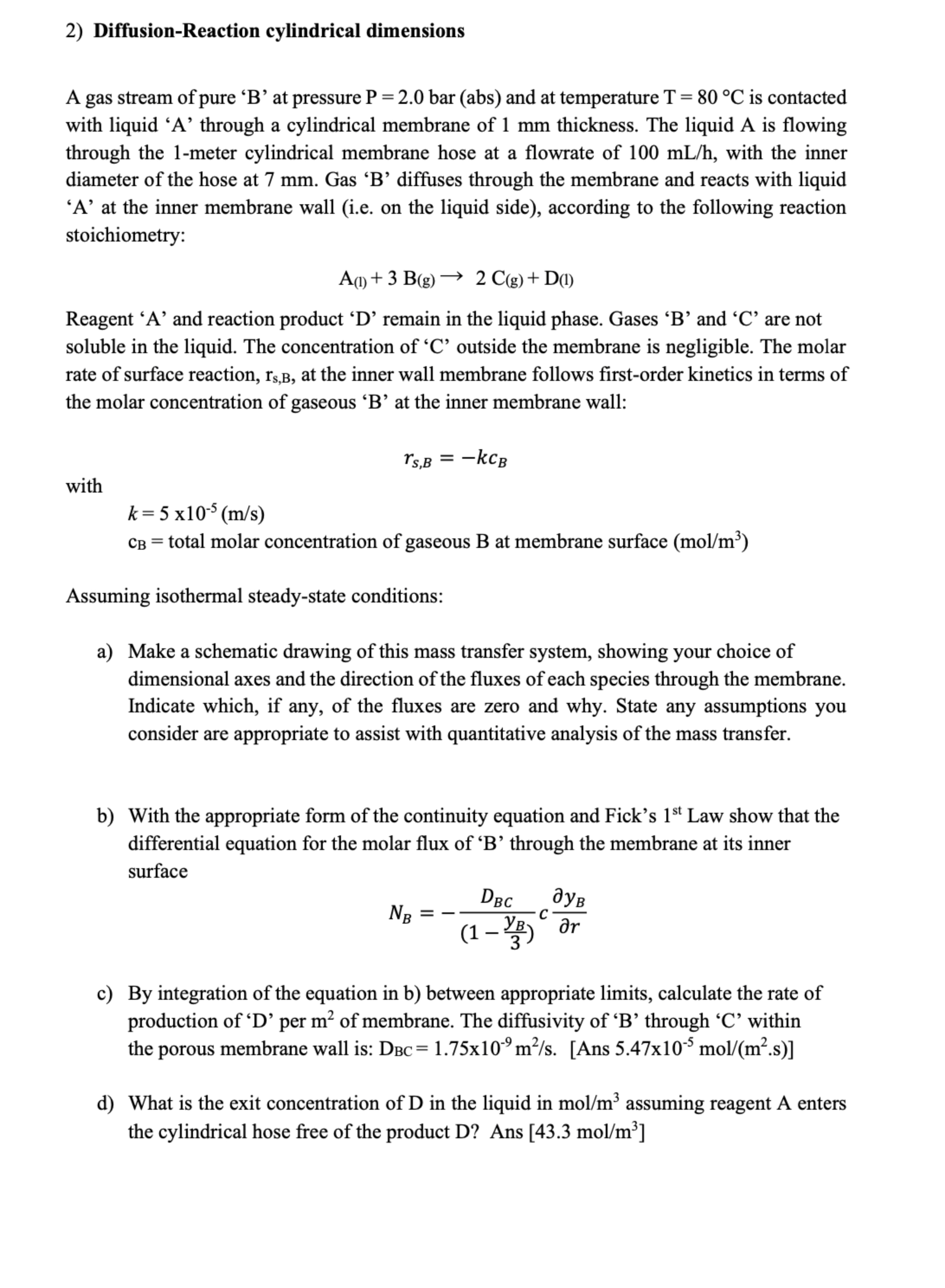
A gas stream of pure at pressure and at temperature is contacted
with liquid through a cylindrical membrane of thickness. The liquid is flowing
through the meter cylindrical membrane hose at a flowrate of with the inner
diameter of the hose at Gas diffuses through the membrane and reacts with liquid
at the inner membrane wall ie on the liquid side according to the following reaction
stoichiometry:
Reagent and reaction product remain in the liquid phase. Gases and are not
soluble in the liquid. The concentration of outside the membrane is negligible. The molar
rate of surface reaction, at the inner wall membrane follows firstorder kinetics in terms of
the molar concentration of gaseous at the inner membrane wall:
with
total molar concentration gaseous membrane surface
Assuming isothermal steadystate conditions:
a Make a schematic drawing of this mass transfer system, showing your choice of
dimensional axes and the direction of the fluxes of each species through the membrane.
Indicate which, if any, of the fluxes are zero and why. State any assumptions you
consider are appropriate to assist with quantitative analysis of the mass transfer.
b With the appropriate form of the continuity equation and Fick's Law show that the
differential equation for the molar flux of through the membrane at its inner
surface
c By integration of the equation in b between appropriate limits calculate the rate of
production of per of membrane. The diffusivity of through within
the porous membrane wall is: Ans
d What is the exit concentration of in the liquid in assuming reagent A enters
the cylindrical hose free of the product D Ans
Step by Step Solution
There are 3 Steps involved in it
1 Expert Approved Answer
Step: 1 Unlock

Question Has Been Solved by an Expert!
Get step-by-step solutions from verified subject matter experts
Step: 2 Unlock
Step: 3 Unlock
 Study Help