







Question: USING MATLAB LANGUAGE Create a file called plantes.txt with the contents shown below and place it in your working directory: Mercury: R = 1, 516
USING MATLAB LANGUAGE
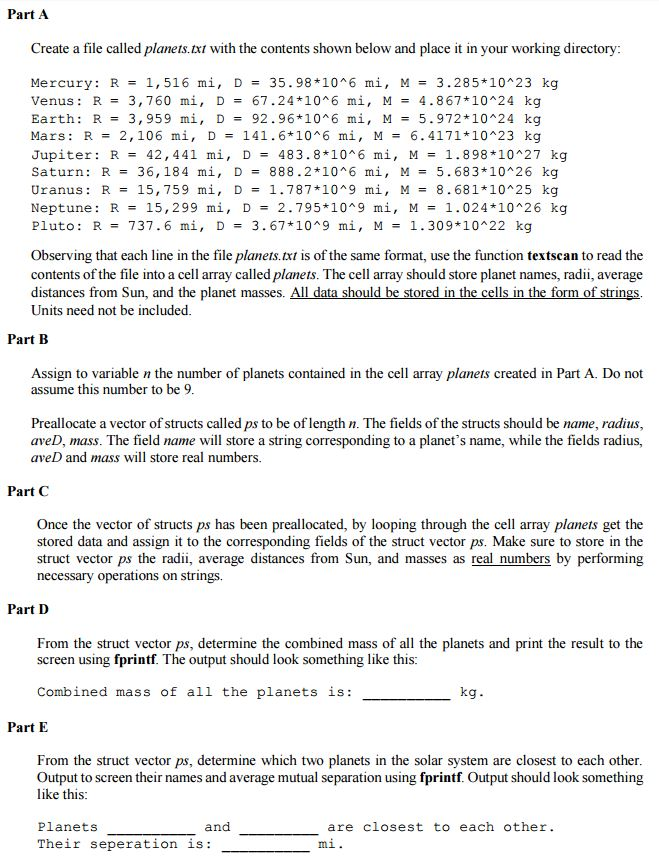
Create a file called plantes.txt with the contents shown below and place it in your working directory: Mercury: R = 1, 516 mi, D = 35.98 * 10^6 mi, M = 3.285 * 10^23 kg Venus: R = 3, 760 mi, D = 67.24 * 10^6 mi, M = 4.867 * 10^24 kg Earth: R = 3, 959 mi, D = 92.96 * 10^6 mi, M = 5.972 * 10^24 kg Mars: R = 2, 106 mi, D = 141.6 * 10^6 mi, M = 6.4171 * 10^23 kg Jupiter: R = 42, 441 mi, D = 483.8 * 10^6 mi, M = 1.898 * 10^27 kg Saturn: R = 36, 184 mi, D = 888.2 * 10^6 mi, M = 5.683 * 10^26 kg Uranus: R = 15, 759 mi, D = 1.787 * 10^9 mi, M = 8.681 * 10^25 kg Neptune: R = 15, 299 mi, D = 2.795 * 10^9 mi, M = 1.024 * 10^26 kg Pluto: R = 737.6 mi, D = 3.67 * 10^9 mi, M = 1.309 * 10^22 kg Observing that each line in the file planets.txt is of the same format, use the function textscan to read the contents of the file into a cell array called planets. The cell array should store planet names, radii, average distances from Sun, and the planet masses. All data should be stored in the cells in the form of strings. Units need not be included. Assign to variable n the number of planets contained in the cell array planets created in Part A. Do not assume this number to be 9. Preallocate a vector of structs called ps to be of length n. The fields of the structs should be name, radius, aveD, mass. The field name will store a string corresponding to a planet's name, while the fields radius aveD and mass will store real numbers. Once the vector of structs ps has been preallocated, by looping through the cell array planets get the stored data and assign it to the corresponding fields of the struct vector ps. Make sure to store in the struct vector ps the radii, average distances from Sun, and masses as real numbers by performing necessary operations on strings. From the struct vector ps, determine the combined mass of all the planets and print the result to the screen using fprintf. The output should look something like this: Combined mass of all the planets is: _____ kg. From the struct vector ps, determine which two planets in the solar system are closest to each other. Output to screen their names and average mutual separation using fprintf. Output should look something like this: Planets _____ and _____ are closest to each other. Their separation is: _____ mi
Step by Step Solution
There are 3 Steps involved in it

Get step-by-step solutions from verified subject matter experts
 Study Help