







Question: Using Matlab You must have heard the term correlation and always wondered what exactly it is. This question will not help you find what it
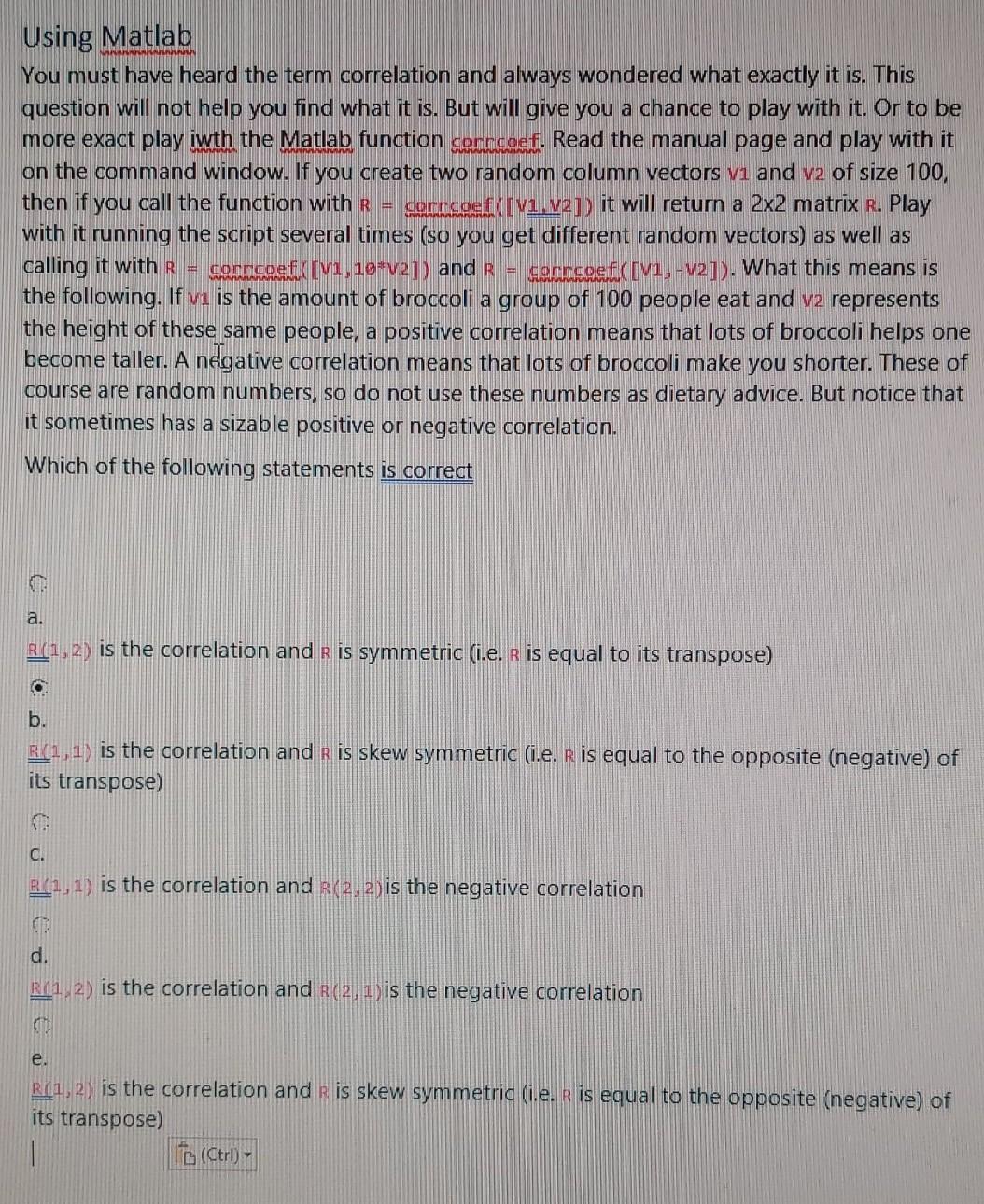
Using Matlab You must have heard the term correlation and always wondered what exactly it is. This question will not help you find what it is. But will give you a chance to play with it. Or to be more exact play iwth the Matlab function corrcoef. Read the manual page and play with it on the command window. If you create two random column vectors vi and v2 of size 100, then if you call the function with r = corrcoef[[V1, V2]) it will return a 2x2 matrix R. Play with it running the script several times (so you get different random vectors) as well as calling it with R = corncoef[V1, 19*v2]) and R corrcoef[V1, -V2]). What this means is the following. If vi is the amount of broccoli a group of 100 people eat and v2 represents the height of these same people, a positive correlation means that lots of broccoli helps one become taller. A negative correlation means that lots of broccoli make you shorter. These of course are random numbers, so do not use these numbers as dietary advice. But notice that it sometimes has a sizable positive or negative correlation. Which of the following statements is correct a. R(1, 2) is the correlation and r is symmetric (i.e. R is equal to its transpose) O b. R41,1) is the correlation and r is skew symmetric (i.e. R is equal to the opposite (negative) of its transpose) C. R(1, 1) is the correlation and R (22) is the negative correlation d. RM 2) is the correlation and R(2, 1)is the negative correlation e. RP1, 2) is the correlation and is skew symmetric (ie. R is equal to the opposite (negative) of its transpose) L (Ctrl)
Step by Step Solution
There are 3 Steps involved in it

Get step-by-step solutions from verified subject matter experts
 Study Help