







Question: Using Table 5.3 as your guide, what is your estimate of the expected annual HPR on the S&P 500 stock portfolio if the current risk-free
Using Table 5.3 as your guide, what is your estimate of the expected annual HPR on the S&P 500 stock portfolio if the current risk-free interest rate is 4.1%? (Round your answer to 2 decimal places.)
Expected annual HPR 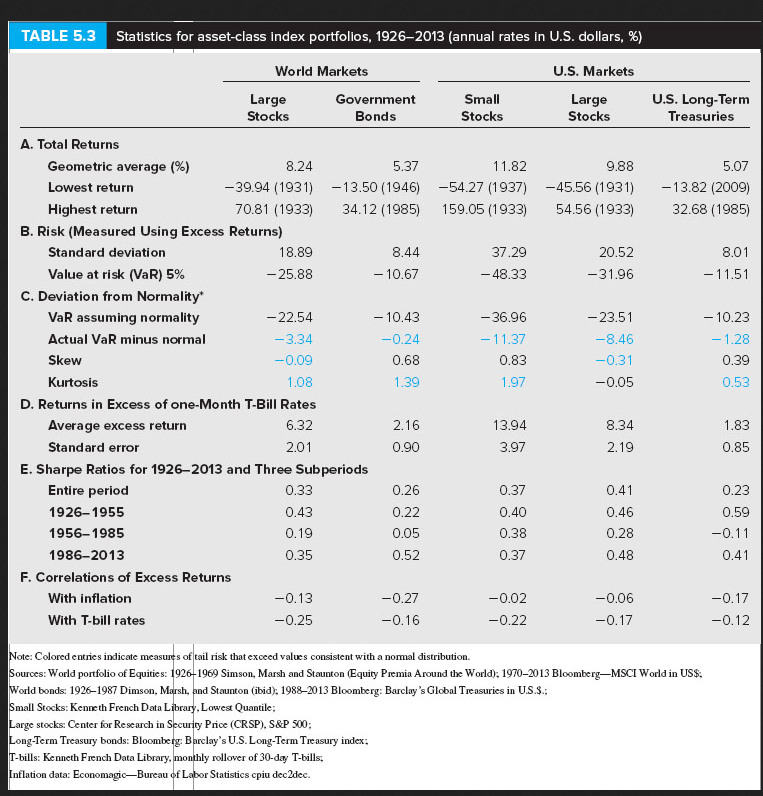
TABLE 5.3 Statistics for asset-class index portfolios, 1926-2013 (annual rates in U.S. dollars, %) World Markets U.S. Markets Government Bonds Small Stocks U.S. Long-Term Treasuries Stocks Stocks A. Total Returns Geometric average (%) Lowest return Highest return 8.24 5.37 9.88 5.07 -39.94 (1931) -13.50 (1946) -54.27 (1937) -45.56 (1931) -13.82 (2009) 70.81 (1933) 34.12 (1985) 159.05 (1933) 54.56 (1933) 32.68 (1985) B. Risk (Measured Using Excess Returns) 18.89 -25.88 37.29 48.33 20.52 8.44 10.67 Standard deviation Value at risk (VaR) 5% C. Deviation from Normality -22.54 3.34 0.09 1.08 D. Returns in Excess of one-Month T-Bill Rates 6.32 2.01 -23.51 8.46 0.31 0.05 10.43 -36.96 VaR assuming normality Actual VaR minus normal Skew Kurtosis 10.23 1.28 0.39 0.53 -0.24 11.37 1.39 1.97 Average excess return Standard error 8.34 2.19 0.90 E. Sharpe Ratios for 1926-2013 and Three Subperiods 0.23 Entire period 1926-1955 1956-1985 1986-2013 0.33 0.26 0.22 0.37 0.59 0.38 0.28 0.35 0.52 0.37 F. Correlations of Excess Returns 0.27 0.06 0.17 With inflation With T-bill rates -0.25 -0.22 Note: Colored entries indicate Sources: World portfolio of Equities: 1926-1969 Simson, Marsh and Staunton Equity Premia Around the World). 1970-2013 Bloomberg-MSCI World in USS World bonds: 1926-1987 Dimson, s of tail risk thatexceed vales consistent with a normal distribution. d Staunton (ibid), 1988-2013 Bloomberg: Barclay's Global Treasuries in US.S. Lowest Quantile Price (CRSP). S&P 500 mall Stocks: Kenneth French Data L Large stocks: Center for Research in S Long-Term Treasury bonds: Bloomberg: Barclay's U.S. Long-Term Treasury index T-bills: Kenneth French Data Library nflation data: Ecnomagic-Bureau ly rollover of 30-day T-bills r Statistics cpiu dec2dec. TABLE 5.3 Statistics for asset-class index portfolios, 1926-2013 (annual rates in U.S. dollars, %) World Markets U.S. Markets Government Bonds Small Stocks U.S. Long-Term Treasuries Stocks Stocks A. Total Returns Geometric average (%) Lowest return Highest return 8.24 5.37 9.88 5.07 -39.94 (1931) -13.50 (1946) -54.27 (1937) -45.56 (1931) -13.82 (2009) 70.81 (1933) 34.12 (1985) 159.05 (1933) 54.56 (1933) 32.68 (1985) B. Risk (Measured Using Excess Returns) 18.89 -25.88 37.29 48.33 20.52 8.44 10.67 Standard deviation Value at risk (VaR) 5% C. Deviation from Normality -22.54 3.34 0.09 1.08 D. Returns in Excess of one-Month T-Bill Rates 6.32 2.01 -23.51 8.46 0.31 0.05 10.43 -36.96 VaR assuming normality Actual VaR minus normal Skew Kurtosis 10.23 1.28 0.39 0.53 -0.24 11.37 1.39 1.97 Average excess return Standard error 8.34 2.19 0.90 E. Sharpe Ratios for 1926-2013 and Three Subperiods 0.23 Entire period 1926-1955 1956-1985 1986-2013 0.33 0.26 0.22 0.37 0.59 0.38 0.28 0.35 0.52 0.37 F. Correlations of Excess Returns 0.27 0.06 0.17 With inflation With T-bill rates -0.25 -0.22 Note: Colored entries indicate Sources: World portfolio of Equities: 1926-1969 Simson, Marsh and Staunton Equity Premia Around the World). 1970-2013 Bloomberg-MSCI World in USS World bonds: 1926-1987 Dimson, s of tail risk thatexceed vales consistent with a normal distribution. d Staunton (ibid), 1988-2013 Bloomberg: Barclay's Global Treasuries in US.S. Lowest Quantile Price (CRSP). S&P 500 mall Stocks: Kenneth French Data L Large stocks: Center for Research in S Long-Term Treasury bonds: Bloomberg: Barclay's U.S. Long-Term Treasury index T-bills: Kenneth French Data Library nflation data: Ecnomagic-Bureau ly rollover of 30-day T-bills r Statistics cpiu dec2dec
Step by Step Solution
There are 3 Steps involved in it

Get step-by-step solutions from verified subject matter experts
 Study Help