







Question: Using the below information, please answer the yellow spaces on the below forms. Barton Simpson, the chief financial officer of Broadband, Inc., could hardly believe
Using the below information, please answer the yellow spaces on the below forms.
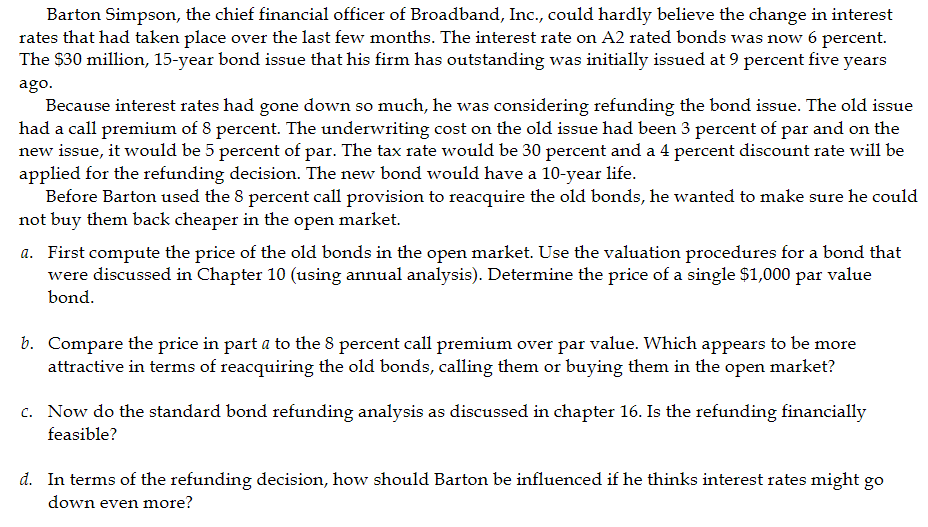
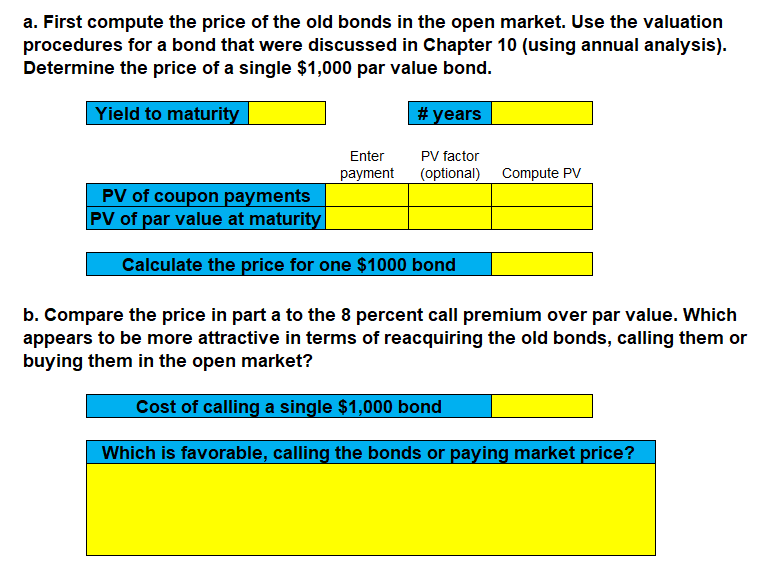
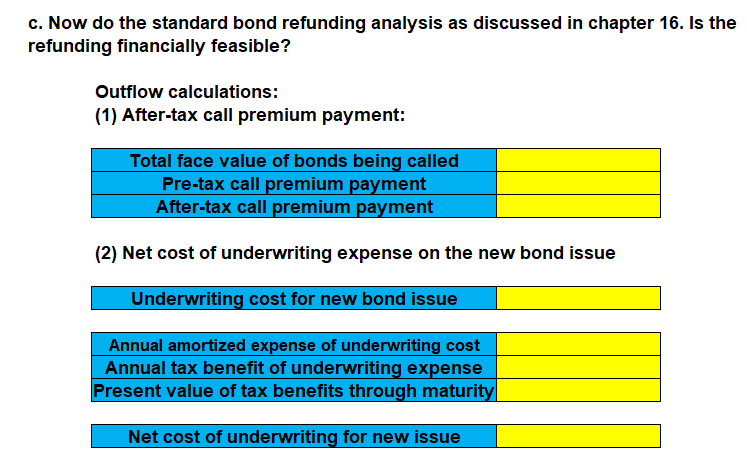
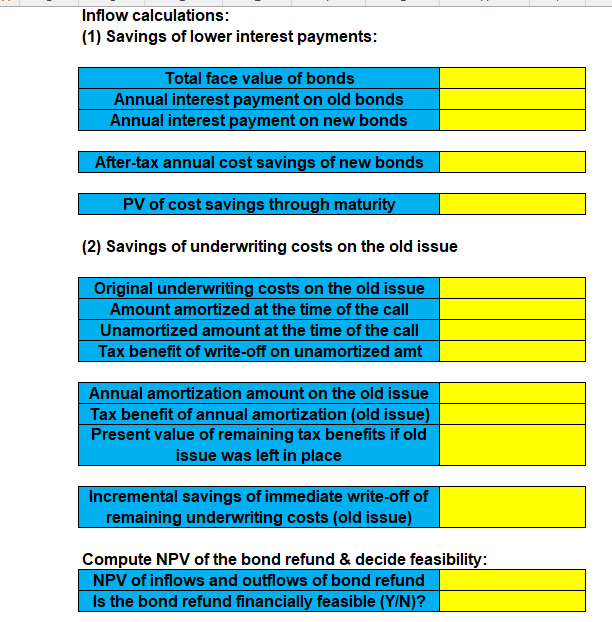
Barton Simpson, the chief financial officer of Broadband, Inc., could hardly believe the change in interest rates that had taken place over the last few months. The interest rate on A2 rated bonds was now 6 percent. The $30 million, 15-year bond issue that his firm has outstanding was initially issued at 9 percent five years ago. Because interest rates had gone down so much, he was considering refunding the bond issue. The old issu had a call premium of 8 percent. The underwriting cost on the old issue had been 3 percent of par and on the new issue, it would be 5 percent of par. The tax rate would be 30 percent and a 4 percent discount rate will be applied for the refunding decision. The new bond would have a 10-year life. Before Barton used the 8 percent call provision to reacquire the old bonds, he wanted to make sure he coul not buy them back cheaper in the open market. a. First compute the price of the old bonds in the open market. Use the valuation procedures for a bond that were discussed in Chapter 10 (using annual analysis). Determine the price of a single $1,000 par value bond. b. Compare the price in part a to the 8 percent call premium over par value. Which appears to be more attractive in terms of reacquiring the old bonds, calling them or buying them in the open market? c. Now do the standard bond refunding analysis as discussed in chapter 16 . Is the refunding financially feasible? d. In terms of the refunding decision, how should Barton be influenced if he thinks interest rates might go down even more? a. First compute the price of the old bonds in the open market. Use the valuation procedures for a bond that were discussed in Chapter 10 (using annual analysis). Determine the price of a single $1,000 par value bond. b. Compare the price in part a to the 8 percent call premium over par value. Which appears to be more attractive in terms of reacquiring the old bonds, calling them or buying them in the open market? Now do the standard bond refunding analysis as discussed in chapter 16 . Is the funding financially feasible? Outflow calculations: (1) After-tax call premium payment: (2) Net cost of underwriting expense on the new bond issue Inflow calculations: (1) Savings of lower interest payments: After-tax annual cost savings of new bonds (2) Savings of underwriting costs on the old issue d. In terms of the refunding decision, how should Barton be influenced if he thinks interest rates might go down even more? Barton Simpson, the chief financial officer of Broadband, Inc., could hardly believe the change in interest rates that had taken place over the last few months. The interest rate on A2 rated bonds was now 6 percent. The $30 million, 15-year bond issue that his firm has outstanding was initially issued at 9 percent five years ago. Because interest rates had gone down so much, he was considering refunding the bond issue. The old issu had a call premium of 8 percent. The underwriting cost on the old issue had been 3 percent of par and on the new issue, it would be 5 percent of par. The tax rate would be 30 percent and a 4 percent discount rate will be applied for the refunding decision. The new bond would have a 10-year life. Before Barton used the 8 percent call provision to reacquire the old bonds, he wanted to make sure he coul not buy them back cheaper in the open market. a. First compute the price of the old bonds in the open market. Use the valuation procedures for a bond that were discussed in Chapter 10 (using annual analysis). Determine the price of a single $1,000 par value bond. b. Compare the price in part a to the 8 percent call premium over par value. Which appears to be more attractive in terms of reacquiring the old bonds, calling them or buying them in the open market? c. Now do the standard bond refunding analysis as discussed in chapter 16 . Is the refunding financially feasible? d. In terms of the refunding decision, how should Barton be influenced if he thinks interest rates might go down even more? a. First compute the price of the old bonds in the open market. Use the valuation procedures for a bond that were discussed in Chapter 10 (using annual analysis). Determine the price of a single $1,000 par value bond. b. Compare the price in part a to the 8 percent call premium over par value. Which appears to be more attractive in terms of reacquiring the old bonds, calling them or buying them in the open market? Now do the standard bond refunding analysis as discussed in chapter 16 . Is the funding financially feasible? Outflow calculations: (1) After-tax call premium payment: (2) Net cost of underwriting expense on the new bond issue Inflow calculations: (1) Savings of lower interest payments: After-tax annual cost savings of new bonds (2) Savings of underwriting costs on the old issue d. In terms of the refunding decision, how should Barton be influenced if he thinks interest rates might go down even more
Step by Step Solution
There are 3 Steps involved in it
import numpyfinancial as npf Bond characteristics parvalue 1000 couponrate 009 yearsrema... View full answer

Get step-by-step solutions from verified subject matter experts
 Study Help