







Question: Using the C++ language, could I see a basic answer to this programming task? This is my first programig langauge and I really need help.
Using the C++ language, could I see a basic answer to this programming task? This is my first programig langauge and I really need help. Much thanks. I posted this question once, but no one answered.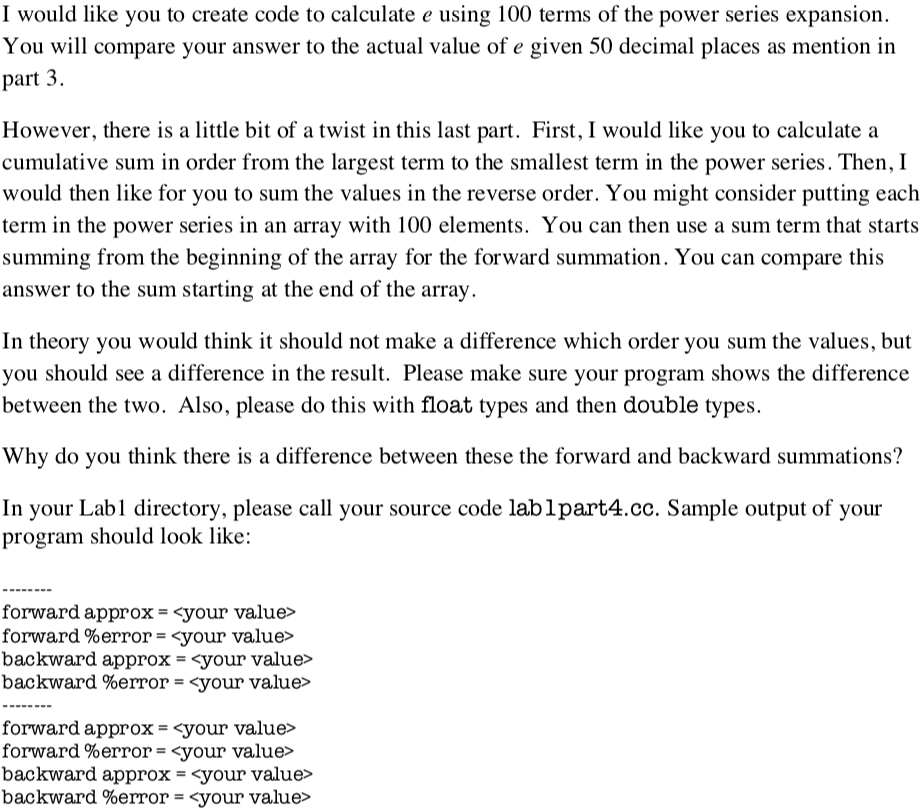
I would like you to create code to calculate e using 100 terms of the power series expansion. You will compare your answer to the actual value of e given 50 decimal places as mention in part 3 However, there is a little bit of a twist in this last part. First, I would like you to calculate a cumulative sum in order from the largest term to the smallest term in the power series. Then, I would then like for you to sum the values in the reverse order. You might consider putting each term in the power series in an array with 100 elements. You can then use a sum term that starts summing from the beginning of the array for the forward summation. You can compare this answer to the sum starting at the end of the array. In theory you would think it should not make a difference which order you sum the values, but you should see a difference in the result. Please make sure your program shows the difference between the two. Also, please do this with float types and then double types. Why do you think there is a difference between these the forward and backward summations? In your Labl directory, please call your source code lablpart4.cc. Sample output of your program should look like: forward approx-
Step by Step Solution
There are 3 Steps involved in it

Get step-by-step solutions from verified subject matter experts
 Study Help