Question: Using the CSU Global Library, Google Scholar, or a company website, find an example of company that has implemented one of the generic strategies represented
Using the CSU Global Library, Google Scholar, or a company website, find an example of company that has implemented one of the generic strategies represented in Figure 5.1 of the class text. (NOTE: Do not select an example company that is used in the text.) Assess the generic strategy's effectiveness using the following criteria:
- Strategic target
- Basis of competitive advantage
- Product line/
- Production emphasis
- Marketing emphasis
- Keys to maintaining the strategy
- Resources and capabilities required
Make sure to explain how each of the criteria applies to the specific company about which you are writing. Address any misalignment or change-driven issues, and include an overall evaluation of the effectiveness of the strategy given the operating environment of the company.
Please see resources below from text for Figure 5.1 and provide at least 5 paragraphs.
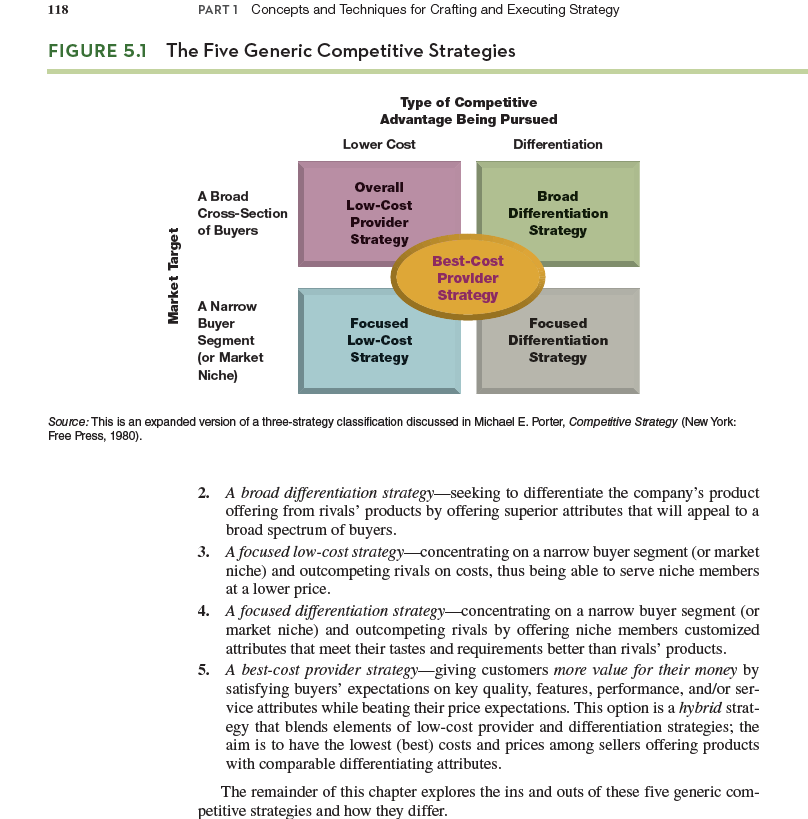
118 PART I Concepts and Techniques for Crafting and Executing Strategy FIGURE 5.1 The Five Generic Competitive Strategies Type of Competitive Advantage Being Pursued Lower Cost Differentiation A Broad Cross-Section of Buyers Overall Low-Cost Provider Strategy Broad Differentiation Strategy Market Target A Narrow Buyer Segment (or Market Niche) Best-Cost Provider Strategy Focused Differentiation Strategy Focused Low-Cost Strategy Source: This is an expanded version of a three-strategy classification discussed in Michael E. Porter, Competitive Strategy (New York: Free Press, 1980). 2. A broad differentiation strategyseeking to differentiate the company's product offering from rivals' products by offering superior attributes that will appeal to a broad spectrum of buyers. 3. A focused low-cost strategyconcentrating on a narrow buyer segment (or market niche) and outcompeting rivals on costs, thus being able to serve niche members at a lower price. 4. A focused differentiation strategyconcentrating on a narrow buyer segment (or market niche) and outcompeting rivals by offering niche members customized attributes that meet their tastes and requirements better than rivals' products. 5. A best-cost provider strategygiving customers more value for their money by satisfying buyers' expectations on key quality, features, performance, and/or ser- vice attributes while beating their price expectations. This option is a hybrid strat- egy that blends elements of low-cost provider and differentiation strategies; the aim is to have the lowest (best) costs and prices among sellers offering products with comparable differentiating attributes. The remainder of this chapter explores the ins and outs of these five generic com- petitive strategies and how they differ. LOW-COST PROVIDER STRATEGIES - Striving to be the industry's overall low-cost provider is a powerful competitive approach in markets with many price-sensitive buyers. A company achieves low-cost leadership when it becomes the industry's lowest-cost provider rather than just being CHAPTER 5 The Five Generic Competitive Strategies 119 LO 2 The major avenues for achieving a competitive advantage based on lower costs. one of perhaps several competitors with comparatively low costs. Successful low-cost providers boast lower costs than rivalsbut not necessarily the absolutely lowest pos- sible cost. In striving for a cost advantage over rivals, company managers must incorpo- rate features and services that buyers consider essential. A product offering that is too frills-free can be viewed by consumers as offering little value regardless of its pricing. A company has two options for translating a low-cost advantage over rivals into attractive profit performance. Option 1 is to use the lower-cost edge to underprice competitors and attract price-sensitive buyers in great enough numbers to increase total profits. Option 2 is to maintain the present price, be content with the present market share, and use the lower-cost edge to earn a higher profit margin on each unit sold, thereby raising the firm's total profits and overall return on investment. While many companies are inclined to exploit a low-cost advantage by using option 1 (attacking rivals with lower prices), this strategy can backfire if rivals respond with their own retaliatory price cuts in order to protect their customer base). A rush to cut prices can often trigger a price war that lowers the profits of all price discounters. The bigger the risk that rivals will respond with matching price cuts, the more appealing it becomes to employ the second option for using a low- cost advantage to achieve higher profitability. CORE CONCEPT A low-cost provider's basis for competitive advantage is lower overall costs than competitors. Successful low-cost leaders, who have the lowest industry costs, are exceptionally good at finding ways to drive costs out of their businesses and still provide a product or service that buyers find acceptable. The Two Major Avenues for Achieving a Cost Advantage To achieve a low-cost edge over rivals, a firm's cumulative costs across its overall value chain must be lower than competitors' cumulative costs. There are two major avenues for accomplishing this:2 1. Perform value chain activities more cost-effectively than rivals. A low-cost advantage over rivals can translate into better profitability than rivals attain 2. Revamp the firm's overall value chain to eliminate or bypass some cost- producing activities. CORE CONCEPT A cost driver is a factor that has a strong influence on a company's costs. Cost-Efficient Management of Value Chain Activities for a company to do a more cost-efficient job of managing its value chain than rivals, managers must diligently search out cost-saving opportunities in every part of the value chain. No activity can escape cost-saving scrutiny, and all company person- nel must be expected to use their talents and ingenuity to come up with innovative and effective ways to keep costs down. Particular attention must be paid to a set of factors known as cost drivers that have a strong effect on a company's costs and can be used as levers to lower costs. Figure 5.2 shows the most important cost drivers. Cost-cutting approaches that demonstrate an effective use of the cost drivers include: 1. Capturing all available economies of scale. Economies of scale stem from an ability to lower unit costs by increasing the scale of operation. Often a large plant or distribution center is more economical to operate than a small one. In global industries, selling a mostly standard product worldwide tends to lower unit costs as opposed to making separate products for each country market, an approach in which costs are typically higher due to an inability to reach the most economic scale of production for each country. There are economies of scale in advertising as well. For example, Anheuser-Busch could afford to pay the $4 million cost of a 30-second Super Bowl ad in 2014 because the cost could be spread out over the hundreds of millions of units of Budweiser that the company sells. 118 PART I Concepts and Techniques for Crafting and Executing Strategy FIGURE 5.1 The Five Generic Competitive Strategies Type of Competitive Advantage Being Pursued Lower Cost Differentiation A Broad Cross-Section of Buyers Overall Low-Cost Provider Strategy Broad Differentiation Strategy Market Target A Narrow Buyer Segment (or Market Niche) Best-Cost Provider Strategy Focused Differentiation Strategy Focused Low-Cost Strategy Source: This is an expanded version of a three-strategy classification discussed in Michael E. Porter, Competitive Strategy (New York: Free Press, 1980). 2. A broad differentiation strategyseeking to differentiate the company's product offering from rivals' products by offering superior attributes that will appeal to a broad spectrum of buyers. 3. A focused low-cost strategyconcentrating on a narrow buyer segment (or market niche) and outcompeting rivals on costs, thus being able to serve niche members at a lower price. 4. A focused differentiation strategyconcentrating on a narrow buyer segment (or market niche) and outcompeting rivals by offering niche members customized attributes that meet their tastes and requirements better than rivals' products. 5. A best-cost provider strategygiving customers more value for their money by satisfying buyers' expectations on key quality, features, performance, and/or ser- vice attributes while beating their price expectations. This option is a hybrid strat- egy that blends elements of low-cost provider and differentiation strategies; the aim is to have the lowest (best) costs and prices among sellers offering products with comparable differentiating attributes. The remainder of this chapter explores the ins and outs of these five generic com- petitive strategies and how they differ. LOW-COST PROVIDER STRATEGIES - Striving to be the industry's overall low-cost provider is a powerful competitive approach in markets with many price-sensitive buyers. A company achieves low-cost leadership when it becomes the industry's lowest-cost provider rather than just being CHAPTER 5 The Five Generic Competitive Strategies 119 LO 2 The major avenues for achieving a competitive advantage based on lower costs. one of perhaps several competitors with comparatively low costs. Successful low-cost providers boast lower costs than rivalsbut not necessarily the absolutely lowest pos- sible cost. In striving for a cost advantage over rivals, company managers must incorpo- rate features and services that buyers consider essential. A product offering that is too frills-free can be viewed by consumers as offering little value regardless of its pricing. A company has two options for translating a low-cost advantage over rivals into attractive profit performance. Option 1 is to use the lower-cost edge to underprice competitors and attract price-sensitive buyers in great enough numbers to increase total profits. Option 2 is to maintain the present price, be content with the present market share, and use the lower-cost edge to earn a higher profit margin on each unit sold, thereby raising the firm's total profits and overall return on investment. While many companies are inclined to exploit a low-cost advantage by using option 1 (attacking rivals with lower prices), this strategy can backfire if rivals respond with their own retaliatory price cuts in order to protect their customer base). A rush to cut prices can often trigger a price war that lowers the profits of all price discounters. The bigger the risk that rivals will respond with matching price cuts, the more appealing it becomes to employ the second option for using a low- cost advantage to achieve higher profitability. CORE CONCEPT A low-cost provider's basis for competitive advantage is lower overall costs than competitors. Successful low-cost leaders, who have the lowest industry costs, are exceptionally good at finding ways to drive costs out of their businesses and still provide a product or service that buyers find acceptable. The Two Major Avenues for Achieving a Cost Advantage To achieve a low-cost edge over rivals, a firm's cumulative costs across its overall value chain must be lower than competitors' cumulative costs. There are two major avenues for accomplishing this:2 1. Perform value chain activities more cost-effectively than rivals. A low-cost advantage over rivals can translate into better profitability than rivals attain 2. Revamp the firm's overall value chain to eliminate or bypass some cost- producing activities. CORE CONCEPT A cost driver is a factor that has a strong influence on a company's costs. Cost-Efficient Management of Value Chain Activities for a company to do a more cost-efficient job of managing its value chain than rivals, managers must diligently search out cost-saving opportunities in every part of the value chain. No activity can escape cost-saving scrutiny, and all company person- nel must be expected to use their talents and ingenuity to come up with innovative and effective ways to keep costs down. Particular attention must be paid to a set of factors known as cost drivers that have a strong effect on a company's costs and can be used as levers to lower costs. Figure 5.2 shows the most important cost drivers. Cost-cutting approaches that demonstrate an effective use of the cost drivers include: 1. Capturing all available economies of scale. Economies of scale stem from an ability to lower unit costs by increasing the scale of operation. Often a large plant or distribution center is more economical to operate than a small one. In global industries, selling a mostly standard product worldwide tends to lower unit costs as opposed to making separate products for each country market, an approach in which costs are typically higher due to an inability to reach the most economic scale of production for each country. There are economies of scale in advertising as well. For example, Anheuser-Busch could afford to pay the $4 million cost of a 30-second Super Bowl ad in 2014 because the cost could be spread out over the hundreds of millions of units of Budweiser that the company sells









 Study Help