







Question: Using the data in the table below a. What was the average dividend yield for the S&P 500 from 2005-2017? The average dividend yield is
Using the data in the table below
a. What was the average dividend yield for the S&P 500 from 2005-2017?
The average dividend yield is ............%. (Round to two decimal places.)
b. What was the volatility of the dividend yield?
The volatility of the dividend yield is the square root of the variance of dividend yields .............%.(Round to two decimal places.)
c. What was the average annual return of the S&P 500 from 2005-2017 excluding dividends (i.e., from capital gains only)?
The average annual return is ............%.(Round to two decimal places.)
d. What was the volatility of the S&P 500 returns from capital gains?
Annual volatility of returns is the square root of the variance of returns............%.(Round to two decimal places.)
e. Were dividends or capital gains a more important component of the S&P 500's average returns during this period? Which were the more important source of volatility?(Select one)
(dividend..... or ......capital gains) were more important for returns and volatility.
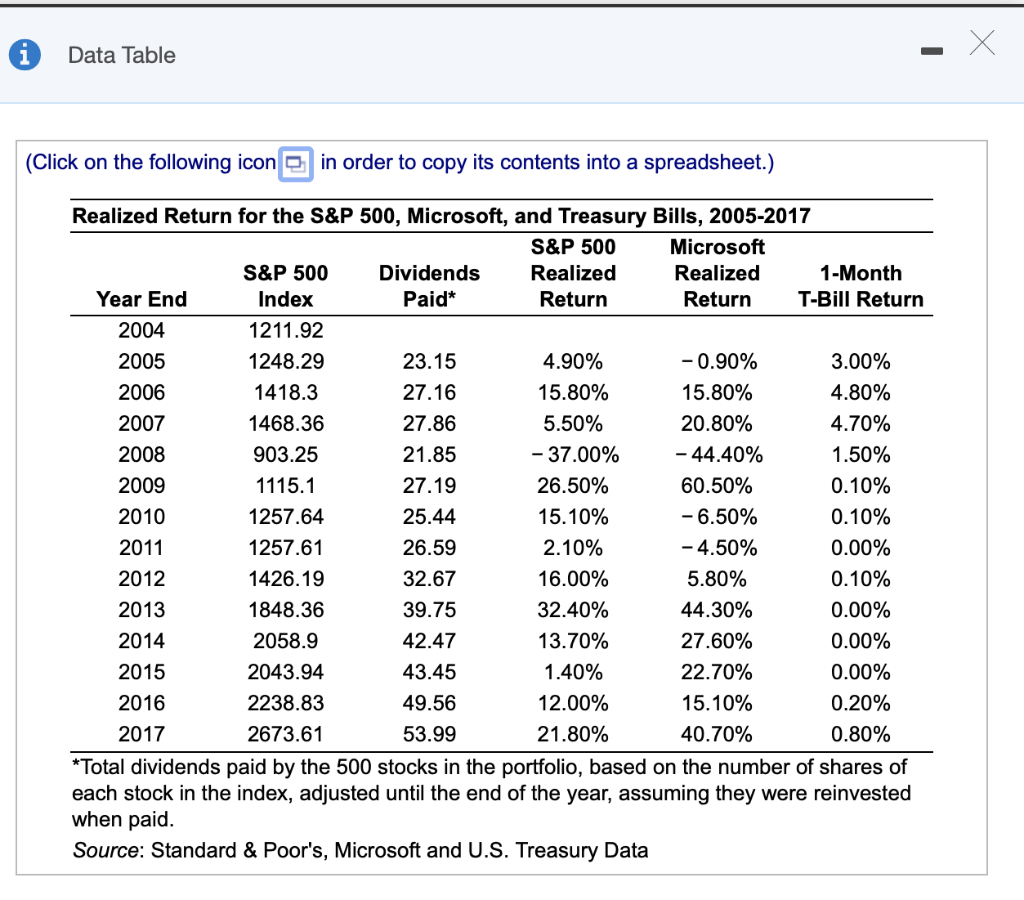
Data Table (Click on the following icon in order to copy its contents into a spreadsheet.) Realized Return for the S&P 500, Microsoft, and Treasury Bills, 2005-2017 S&P 500 Microsoft S&P 500 Dividends Realized Realized 1-Month Year End Index Paid* Return Return T-Bill Return 2004 1211.92 2005 1248.29 23.15 4.90% -0.90% 3.00% 2006 1418.3 27.16 15.80% 15.80% 4.80% 2007 1468.36 27.86 5.50% 20.80% 4.70% 2008 903.25 21.85 - 37.00% - 44.40% 1.50% 2009 1115.1 27.19 26.50% 60.50% 0.10% 2010 1257.64 25.44 15.10% - 6.50% 0.10% 2011 1257.61 26.59 2.10% - 4.50% 0.00% 2012 1426.19 32.67 16.00% 5.80% 0.10% 2013 1848.36 39.75 32.40% 44.30% 0.00% 2014 2058.9 42.47 13.70% 27.60% 0.00% 2015 2043.94 43.45 1.40% 22.70% 0.00% 2016 2238.83 49.56 12.00% 15.10% 0.20% 2017 2673.61 53.99 21.80% 40.70% 0.80% *Total dividends paid by the 500 stocks in the portfolio, based on the number of shares of each stock in the index, adjusted until the end of the year, assuming they were reinvested when paid. Source: Standard & Poor's, Microsoft and U.S. Treasury Data
Step by Step Solution
There are 3 Steps involved in it

Get step-by-step solutions from verified subject matter experts
 Study Help