Question: Using the textbook, the internet, and at least two peer-reviewed journal articles, answer the following questions. Each answer should not require more than two paragraphs
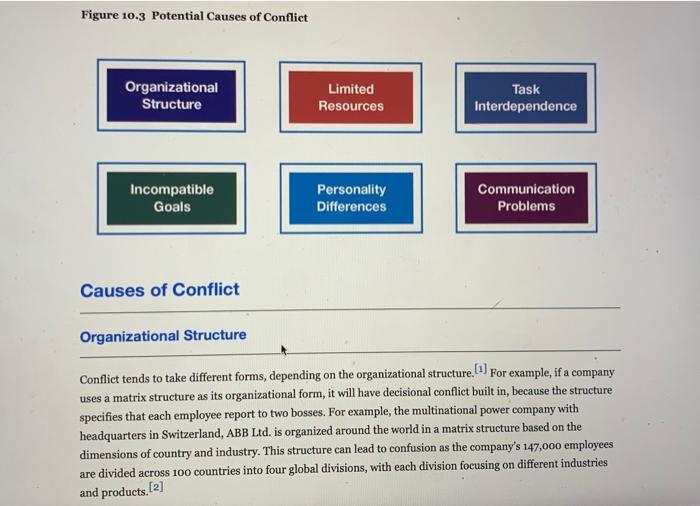
Using the textbook, the internet, and at least two peer-reviewed journal articles, answer the following questions. Each answer should not require more than two paragraphs of content. Please be thorough and follow the Case Study example closely (and APA example on the Announcements Page) for formatting guidance. Please read attached grading rubric as well. 1. Why is healthy conflict in an organization a good thing? Please defend (resource) your answer. At what point can healthy conflict become a bad thing? 2. Explain the types of conflict that exist. Provide examples for them all. 3. Why would it be feasible for most companies to follow the "Two Pizza Rule"? 4. Find a peer-reviewed article that supports one of Amazon's Leadership Principles. Provide an overview of the article and how it might tie-in to Amazon's culture. 5. Which of the 14 Leadership Principles do you think stimulate a culture of conflict over ideas? 6. Amazon has become a very large organization. How do leaders of organizations this size make such a large, international company run smoothly and continue to grow even though there are so many people with different personalities and different cultures? Figure 10.3 Potential Causes of Conflict Causes of Conflict Organizational Structure Conflict tends to take different forms, depending on the organizational structure. [1] For example, if a company uses a matrix structure as its organizational form, it will have decisional conflict built in, because the structure specifies that each employee report to two bosses. For example, the multinational power company with headquarters in Switzerland, ABB Ltd. is organized around the world in a matrix structure based on the dimensions of country and industry. This structure can lead to confusion as the company's 147,000 employees are divided across 100 countries into four global divisions, with each division focusing on different industries and products. [2] Resources such as money, time, and equipment are often scarce. Competition among people or departments for limited resources is a frequent cause for conflict. For example, cutting-edge laptops and other devices are expensive resources that may be allocated to employees on a need-to-have basis in some companies. When a group of employees have access to such resources while others do not, conflict may arise among employees or between employees and management. While technical employees may feel that these devices are crucial to their productivity, employees with customer contact such as sales representatives may make the point that these devices are important for them to make a good impression to clients. Because important resources are often limited, this is one source of conflict many companies have to live with. Task Interdependence Another cause of conflict is task interdependence; that is, when accomplishment of your goal requires reliance on others to perform their tasks. For example, if you're tasked with creating advertising for your product, you're dependent on the creative team to design the words and layout, the photographer or videographer to create the visuals, the media buyer to purchase the advertising space, and so on. The completion of your goal (airing or publishing your ad) is dependent on others. Sometimes conflict arises when two parties think that their goals are mutually exclusive. Within an organization, incompatible goals often arise because of the different ways department managers are compenkated. For example, a sales manager's bonus may be tied to how many sales are made for the company. As a result, the individual might be tempted to offer customers "freebies" such as expedited delivery in order to make the sale. In contrast, a transportation manager's compensation may be based on how much money the company saves on transit. In this case, the goal might be to eliminate expedited delivery because it adds expense. The two will butt heads until the company resolves the conflict by changing the compensation seheme. For example, if the company assigns the bonus based on profitability of a sale, not just the dollar amount, the cost of the expediting would be subtracted from the value of the sale. It might still make sense to expedite the order if the sale is large enough, in which case both parties would support it. On the other hand, if the expediting negates the value of the sale, neither party would be in favor of the added expense. Personality Differences Personality differences among coworkers are common. By understanding some fundamental differences among the way people think and act, we can better understand how others see the world. Knowing that these differences are natural and normal lets us anticipate and mitigate interpersonal conflict-it's often not about "you" but simply a different way of seeing and behaving. For example, Type A individuals have been found to have more conflicts with their coworkers than Type B individuals. [3] Sometimes conflict arises simply out of a small, unintentional communication problem, such as lost emails or dealing with people who don't return phone calls. Giving feedback is also a case in which the best intentions can quickly escalate into a conflict situation. When communicating, focusing on behavior and its effects rather than the person is one strategy that may prevent well-intentioned feedback from creating conflict. In a corporate example, the Hershey Company was engaged in talks behind closed doors with Cadbury Schweppes about a possible merger. No information about this deal was shared with Hershey's major stakeholder, the Hershey Trust. When Robert Vowler, the CEO of the Hershey Trust at that time, discovered that talks were underway without anyone consulting the Trust, tensions between the major stakeholders began to rise. As Hershey continued to underperform, steps were taken in what is now called the "Sunday night massacre," in which several board members were forced to resign and Richard Lenny, Hershey's then CEO, retired. [4] This example shows how a lack of communication can lead to an escalation of conflict. Now, let's turn our attention to the outcomes of conflict. Outcomes of Conflict One of the most common outcomes of conflict is that it upsets parties in the short run. [5] However, as we saw earlier, conflict can have both positive anty negative outcomes. On the positive side, conflict can result in greater creativity or better decisions. For example, as a result of a disagreement over a policy, a manager may learn from an employee that newer technologies are available that may help solve problems in an unanticipated new way. Positive outcomes include the following: - Consideration of a broader range of ideas, resulting in a better, stronger idea Surfacing of assumptions that may be inaccurate Positive outcomes include the following: - Consideration of a broader range of ideas, resulting in a better, stronger idea - Surfacing of assumptions that may be inaccurate - Increased participation and creativity - Clarification of individual views that build learning On the other hand, conflict can be dysfurctional if it is excessive or involves personal attacks or underhanded tactics. Examples of negative outcomes include the following: - Increased stress and anxiety among individuals, which decreases productivity and satisfaction - Feelings of being defeated and demeaned, which lowers individuals' morale and may increase turnover - A climate of mistrust, which hinders the teamwork and cooperation necessary to get work done









 Study Help