







Question: Using your graph from the Unit 7 Discussion, start this discussion by addressing the following to explore the modeling of your context even further: Update
Using your graph from the Unit 7 Discussion, start this discussion by addressing the following to explore the modeling of your context even further:
- Update your Unit 7 Discussion graph by adding a weight to each of your edges. You must have at least 3 different weights represented. If your graph from the Unit 7 Discussion does not contain 5-10 vertices, at least two vertices with degree 3 or greater, and at least one circuit, add sufficient vertices or edges. Present your updated graph with the weights of all edges.
- Based on the real-world context of your graph, briefly explain what these weights represent.
- Present a second illustration where you have identified a spanning tree and its total weight within your weighted graph. Describe how you know this subgraph meets the requirements of a spanning tree.
BELOW IS THE UNIT 7 DISCUSSION
Situation Modeled
1. Think of a university project where a group of people is working together.2. It could be a research team, each person contributing to different aspects of the project.What Each Vertex Represents
1. Each person or important thing in the project is a "vertex."2. If there is a leader or someone handling data analysis or a lab technician or specific resources each gets a letter label as A, B, C, D, etc.What Each Edge Represents
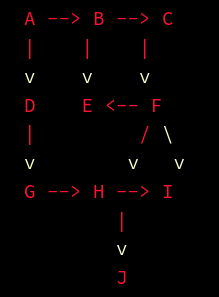
1. Now, imagine lines connecting these people or things. 2. These lines represent the connections or dependencies between them.3. For example if the leader needs data analysis, there is a line from the leader (A) to the data analyst (B), showing they are working together.Connected Graph Representation
1. Look at the graph below. Each letter is a person or thing and the arrows show who depends on whom.2. For instance, A depends on B for data analysis.Explanation of the graph
1. Vertices (A, B, C, D, E, F, G, H, I, J)
1. A (leader): The one in charge.2. B (data analyst): Analyzing information.3. C (lab technician): Handling lab stuff.4. D, E, F (resources): Important things for the project.5. G, H, I, J (contributors): Other people helping.2. Connections
1. A (leader) needs help from B (data analyst).2. B (data analyst) uses resources D, E, F.3. C (lab technician) uses resource D.4. F (resource) is shared between E and H.5. H (contributor) needs help from I (another contributor).3. Degrees
1. B and H are busier because they are connected to three things each.4. Loop (Circuit)
1. A sequence of tasks involving A, B, E, F and H that depend on each other forming a closed loop.Reply to Thread
\f
Step by Step Solution
There are 3 Steps involved in it
1 Expert Approved Answer
Step: 1 Unlock

Question Has Been Solved by an Expert!
Get step-by-step solutions from verified subject matter experts
Step: 2 Unlock
Step: 3 Unlock
 Study Help