



Question: Variance and standard deviation (expected). Hull Consultants, a famous think tank in the Midwest, has provided probability estimates for the four potential economic states for
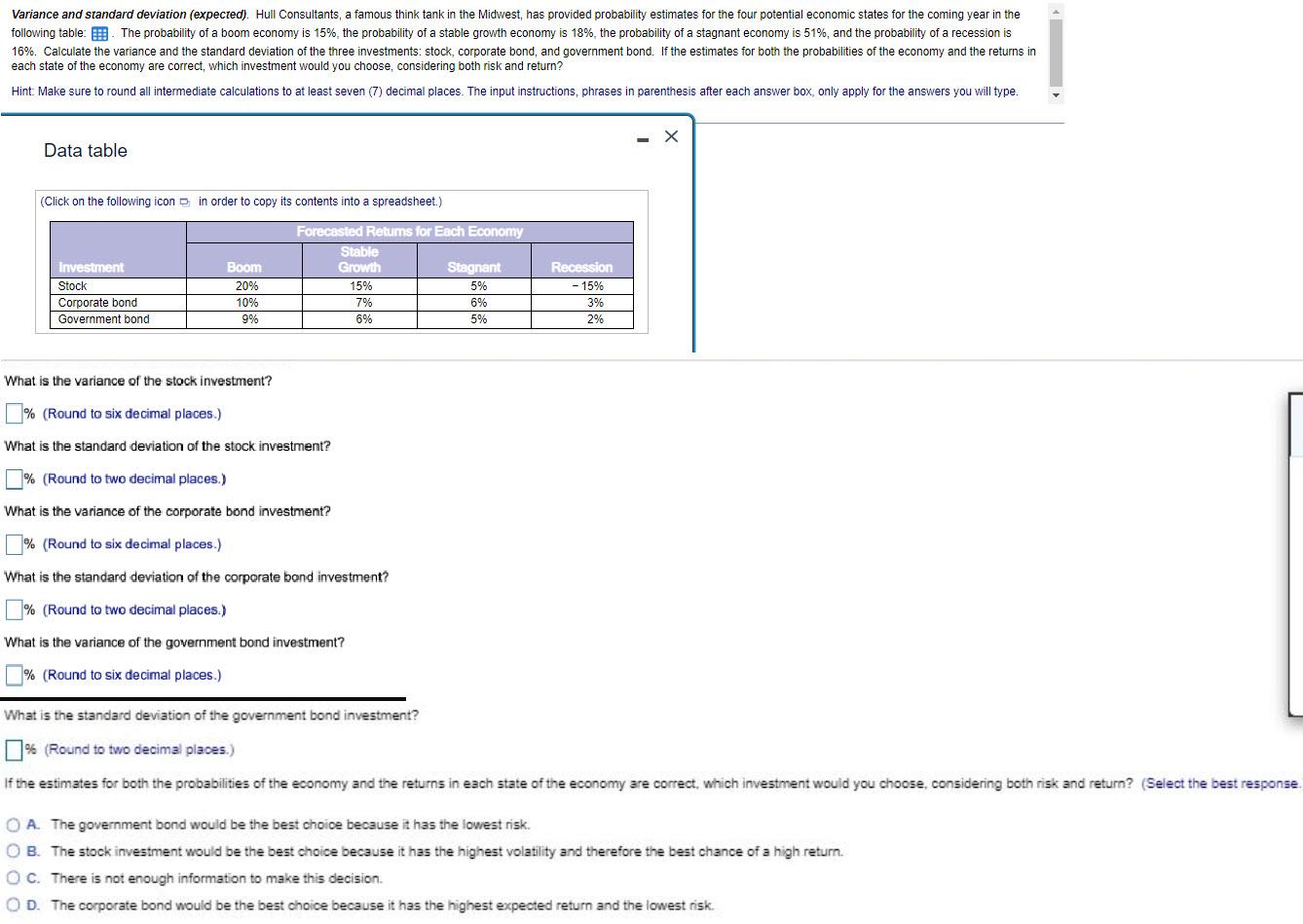
Variance and standard deviation (expected). Hull Consultants, a famous think tank in the Midwest, has provided probability estimates for the four potential economic states for the coming year in the following table: The probability of a boom economy is 15%, the probability of a stable growth economy is 18%, the probability of a stagnant economy is 51%, and the probability of a recession is 16%. Calculate the variance and the standard deviation of the three investments: stock, corporate bond, and government bond. If the estimates for both the probabilities of the economy and the returns in each state of the economy are correct, which investment would you choose, considering both risk and return? Hint: Make sure to round all intermediate calculations to at least seven (7) decimal places. The input instructions, phrases in parenthesis after each answer box, only apply for the answers you will type. Data table (Click on the following icon p in order to copy its contents into a spreadsheet.) What is the variance of the stock investment? % (Round to six decimal places.) What is the standard deviation of the stock investment? % (Round to two decimal places.) What is the variance of the corporate bond investment? \% (Round to six decimal places.) What is the standard deviation of the corporate bond investment? \% (Round to two decimal places.) What is the variance of the government bond investment? % (Round to six decimal places.) What is the standard deviation of the government bond investment? % (Round to two decimal places.) A. The government bond would be the best choice because it has the lowest risk. B. The stock investment would be the best choice because it has the highest volatility and therefore the best chance of a high return. C. There is not enough information to make this decision. D. The corporate bond would be the best choice because it has the highest expected return and the lowest risk. Variance and standard deviation (expected). Hull Consultants, a famous think tank in the Midwest, has provided probability estimates for the four potential economic states for the coming year in the following table: The probability of a boom economy is 15%, the probability of a stable growth economy is 18%, the probability of a stagnant economy is 51%, and the probability of a recession is 16%. Calculate the variance and the standard deviation of the three investments: stock, corporate bond, and government bond. If the estimates for both the probabilities of the economy and the returns in each state of the economy are correct, which investment would you choose, considering both risk and return? Hint: Make sure to round all intermediate calculations to at least seven (7) decimal places. The input instructions, phrases in parenthesis after each answer box, only apply for the answers you will type. Data table (Click on the following icon p in order to copy its contents into a spreadsheet.) What is the variance of the stock investment? % (Round to six decimal places.) What is the standard deviation of the stock investment? % (Round to two decimal places.) What is the variance of the corporate bond investment? \% (Round to six decimal places.) What is the standard deviation of the corporate bond investment? \% (Round to two decimal places.) What is the variance of the government bond investment? % (Round to six decimal places.) What is the standard deviation of the government bond investment? % (Round to two decimal places.) A. The government bond would be the best choice because it has the lowest risk. B. The stock investment would be the best choice because it has the highest volatility and therefore the best chance of a high return. C. There is not enough information to make this decision. D. The corporate bond would be the best choice because it has the highest expected return and the lowest risk
Step by Step Solution
There are 3 Steps involved in it

Get step-by-step solutions from verified subject matter experts