







Question: VII D. Design a balanced, full-factorial, 2x2 experiment. Note that you are NOT to do the experiment or analyze the data. Use one response (e.g.,
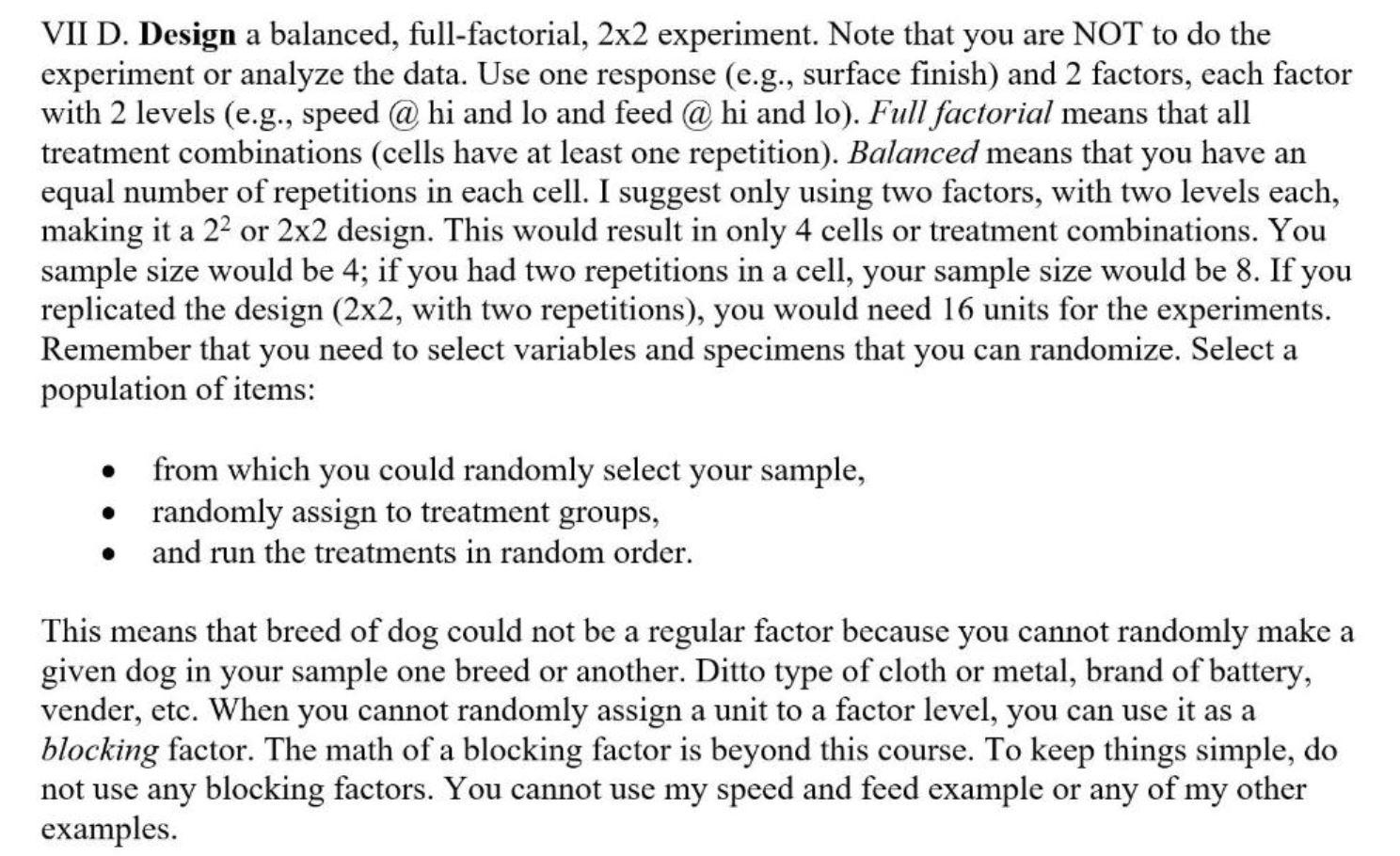

VII D. Design a balanced, full-factorial, 2x2 experiment. Note that you are NOT to do the experiment or analyze the data. Use one response (e.g., surface finish) and 2 factors, each factor with 2 levels (e.g., speed @hi and lo and feed @ hi and lo). Full factorial means that all treatment combinations (cells have at least one repetition). Balanced means that you have an equal number of repetitions in each cell. I suggest only using two factors, with two levels each, making it a 22 or 2x2 design. This would result in only 4 cells or treatment combinations. You sample size would be 4; if you had two repetitions in a cell, your sample size would be 8. If you replicated the design (2x2, with two repetitions), you would need 16 units for the experiments. Remember that you need to select variables and specimens that you can randomize. Select a population of items: . from which you could randomly select your sample, randomly assign to treatment groups, and run the treatments in random order. This means that breed of dog could not be a regular factor because you cannot randomly make a given dog in your sample one breed or another. Ditto type of cloth or metal, brand of battery, vender, etc. When you cannot randomly assign a unit to a factor level, you can use it as a blocking factor. The math of a blocking factor is beyond this course. To keep things simple, do not use any blocking factors. You cannot use my speed and feed example or any of my other examples. g. Explain the design using a table, e.g., the 2x2 speed, feed, and surface finish example. h. How will you ensure random assignment of units to the treatment groups? i. How will you ensure random order of experimental runs? j. What are the environmental or noise factors? VII D. Design a balanced, full-factorial, 2x2 experiment. Note that you are NOT to do the experiment or analyze the data. Use one response (e.g., surface finish) and 2 factors, each factor with 2 levels (e.g., speed @hi and lo and feed @ hi and lo). Full factorial means that all treatment combinations (cells have at least one repetition). Balanced means that you have an equal number of repetitions in each cell. I suggest only using two factors, with two levels each, making it a 22 or 2x2 design. This would result in only 4 cells or treatment combinations. You sample size would be 4; if you had two repetitions in a cell, your sample size would be 8. If you replicated the design (2x2, with two repetitions), you would need 16 units for the experiments. Remember that you need to select variables and specimens that you can randomize. Select a population of items: . from which you could randomly select your sample, randomly assign to treatment groups, and run the treatments in random order. This means that breed of dog could not be a regular factor because you cannot randomly make a given dog in your sample one breed or another. Ditto type of cloth or metal, brand of battery, vender, etc. When you cannot randomly assign a unit to a factor level, you can use it as a blocking factor. The math of a blocking factor is beyond this course. To keep things simple, do not use any blocking factors. You cannot use my speed and feed example or any of my other examples. g. Explain the design using a table, e.g., the 2x2 speed, feed, and surface finish example. h. How will you ensure random assignment of units to the treatment groups? i. How will you ensure random order of experimental runs? j. What are the environmental or noise factors
Step by Step Solution
There are 3 Steps involved in it

Get step-by-step solutions from verified subject matter experts
 Study Help