



Question: We analyzed the problem of first-order reaction-diffusion-convection. Here, we will consider a variation of that problem in the context of dimensional analysis. Consider an nth-order
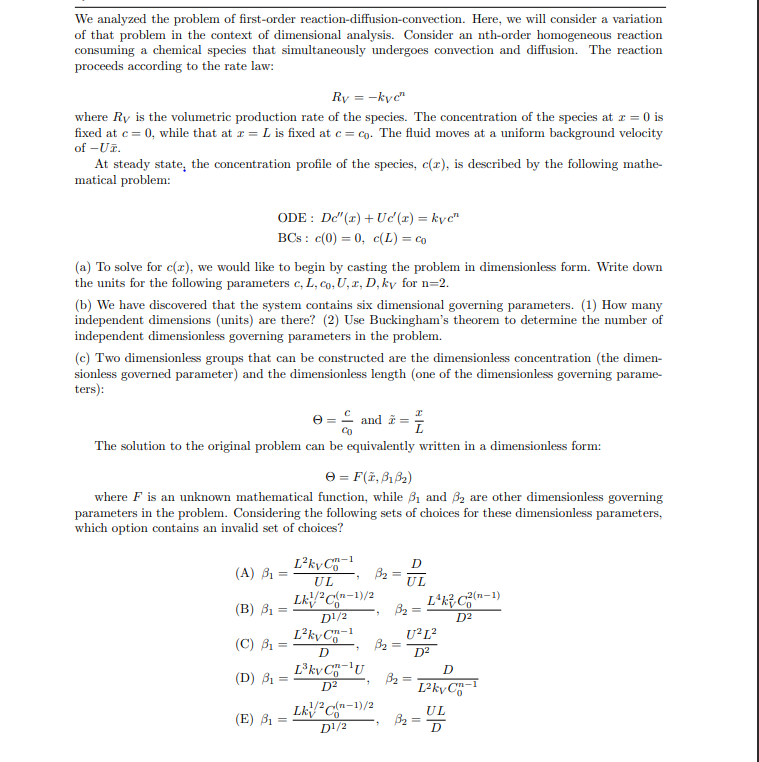
We analyzed the problem of first-order reaction-diffusion-convection. Here, we will consider a variation of that problem in the context of dimensional analysis. Consider an nth-order homogeneous reaction consuming a chemical species that simultaneously undergoes convection and diffusion. The reaction proceeds according to the rate law: RV=kVcn where RV is the volumetric production rate of the species. The concentration of the species at x=0 is fixed at c=0, while that at x=L is fixed at c=c0. The fluid moves at a uniform background velocity of Ux. At steady state, the concentration profile of the species, c(x), is described by the following mathematical problem: ODE:Dc(x)+Uc(x)=kVcnBCs:c(0)=0,c(L)=c0 (a) To solve for c(x), we would like to begin by casting the problem in dimensionless form. Write down the units for the following parameters c,L,c0,U,x,D,kV for n=2. (b) We have discovered that the system contains six dimensional governing parameters. (1) How many independent dimensions (units) are there? (2) Use Buckingham's theorem to determine the number of independent dimensionless governing parameters in the problem. (c) Two dimensionless groups that can be constructed are the dimensionless concentration (the dimensionless governed parameter) and the dimensionless length (one of the dimensionless governing parameters): =c0candx~=Lx The solution to the original problem can be equivalently written in a dimensionless form: =F(x~,12) where F is an unknown mathematical function, while 1 and 2 are other dimensionless governing parameters in the problem. Considering the following sets of choices for these dimensionless parameters, which option contains an invalid set of choices? (A) 1=ULL2kVC0m1,2=ULD (B) 1=D1/2LkV1/2C0(n1)/2,2=D2L4kV2C02(n1) (C) 1=DL2kVC0n1,2=D2U2L2 (D) 1=D2L3kVC0n1U,2=L2kVC0n1D (E) 1=D1/2LkV1/2C0(n1)/2,2=DUL
Step by Step Solution
There are 3 Steps involved in it

Get step-by-step solutions from verified subject matter experts