



Question: We are interested in random variable X, the number of miles run per week by an individual training for the LA marathon. Consider n individuals,
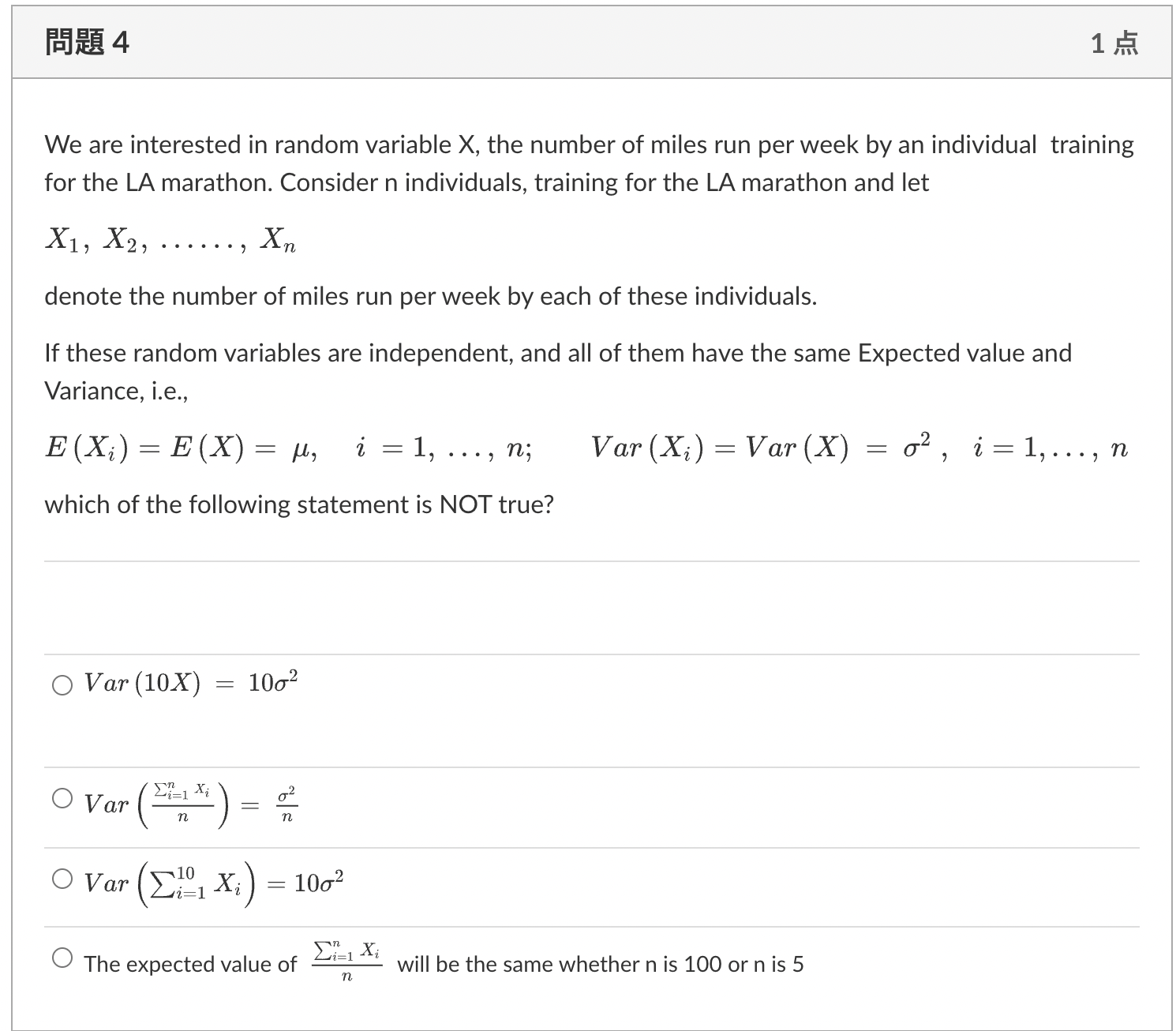
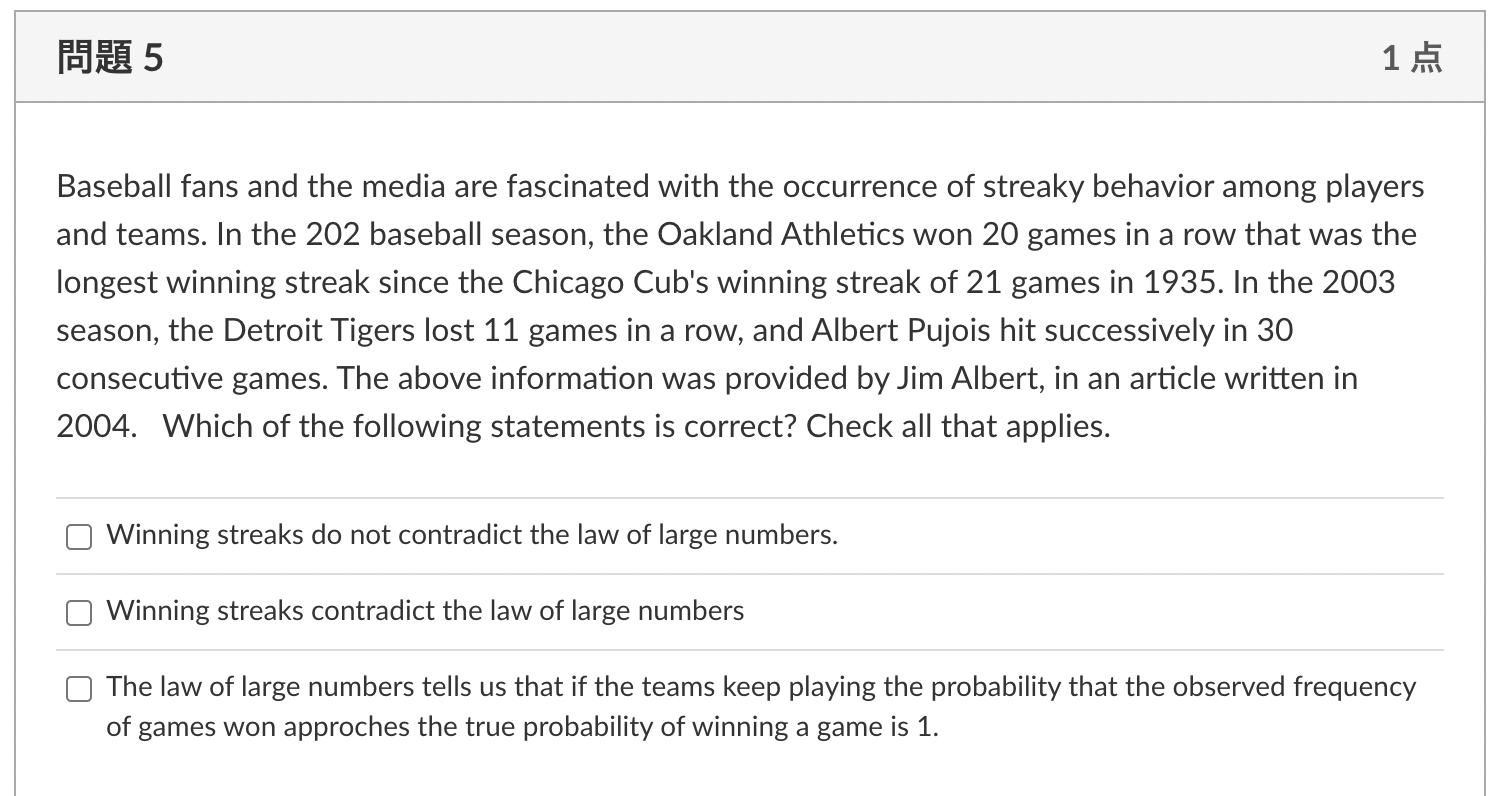
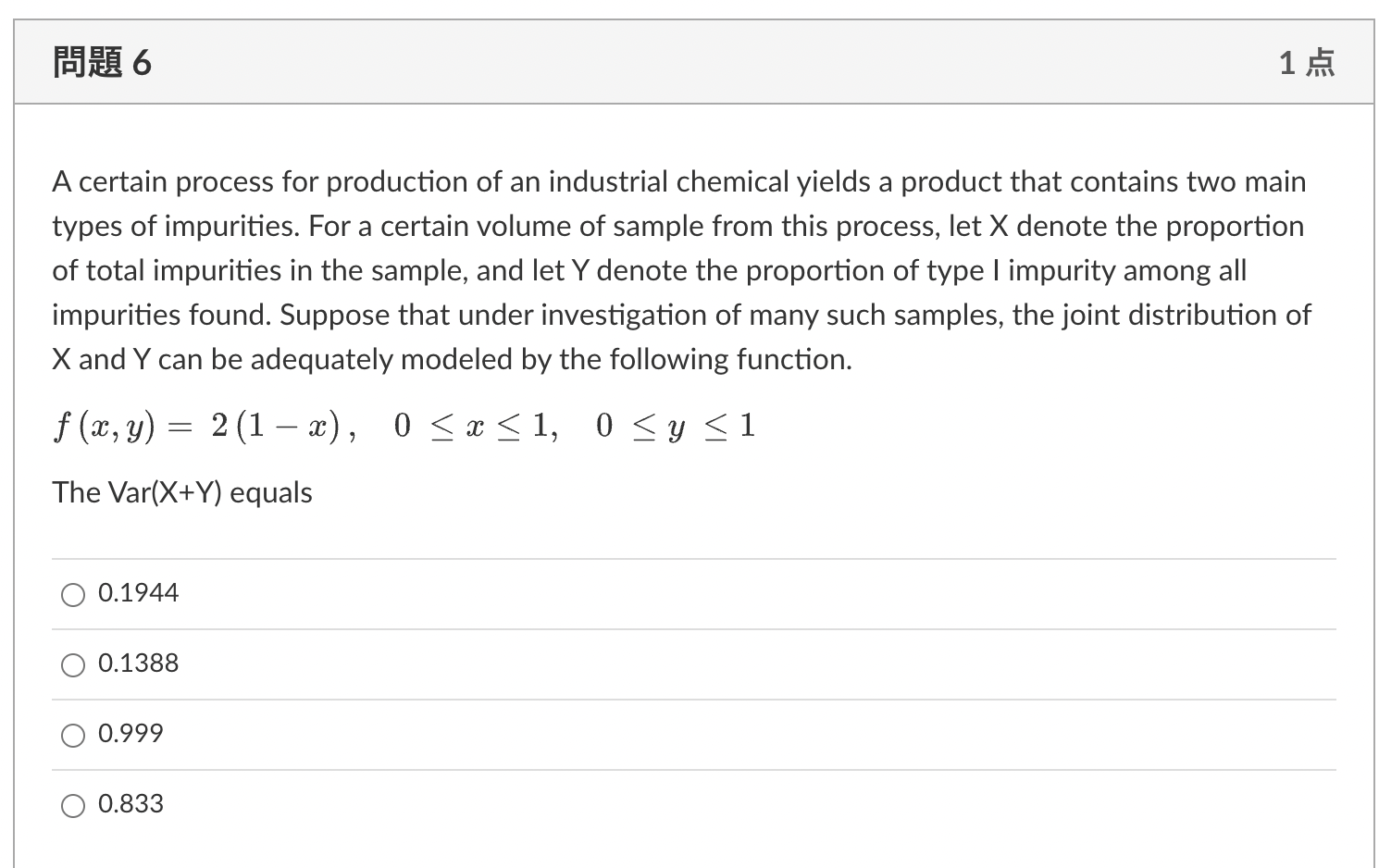
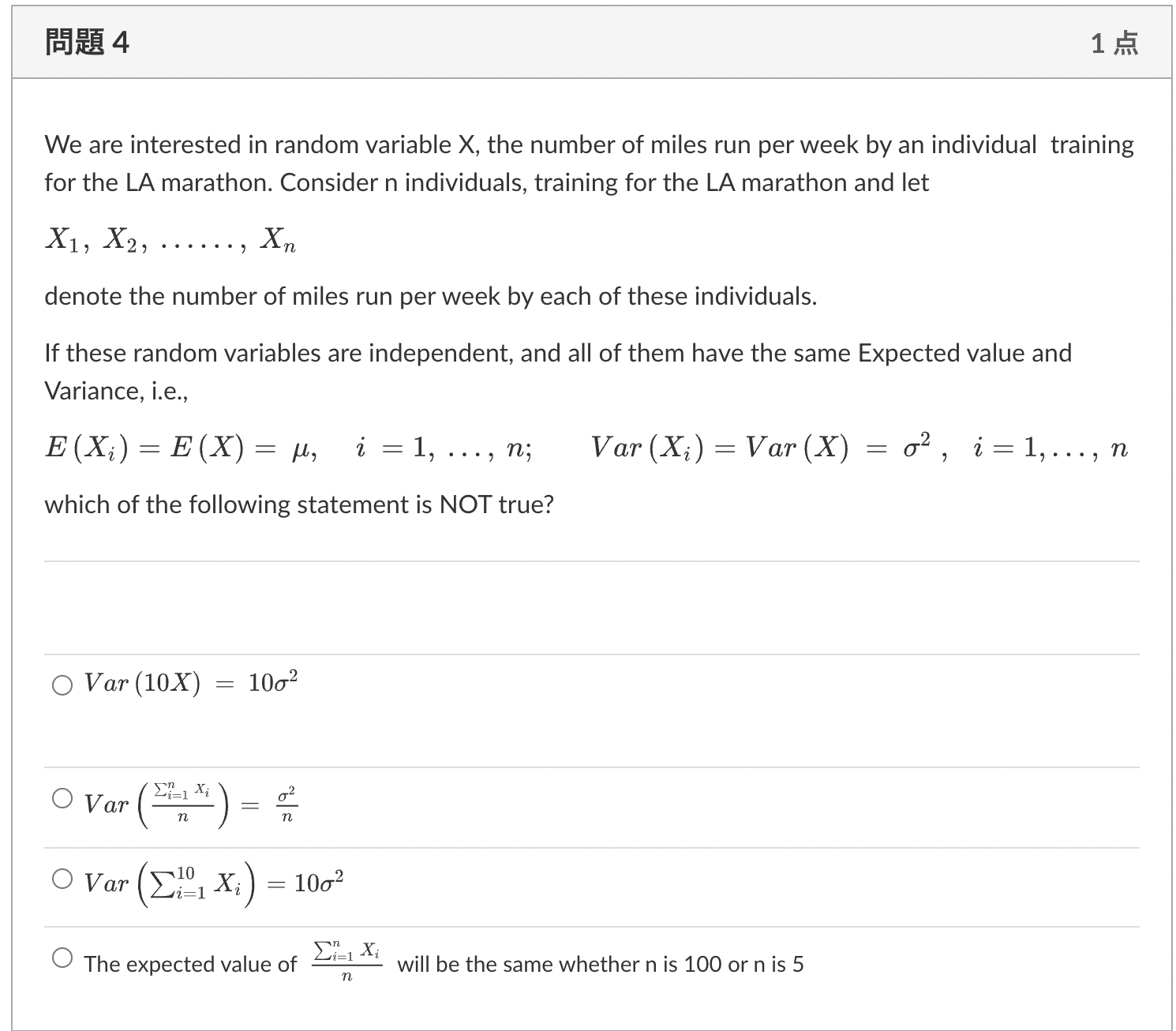
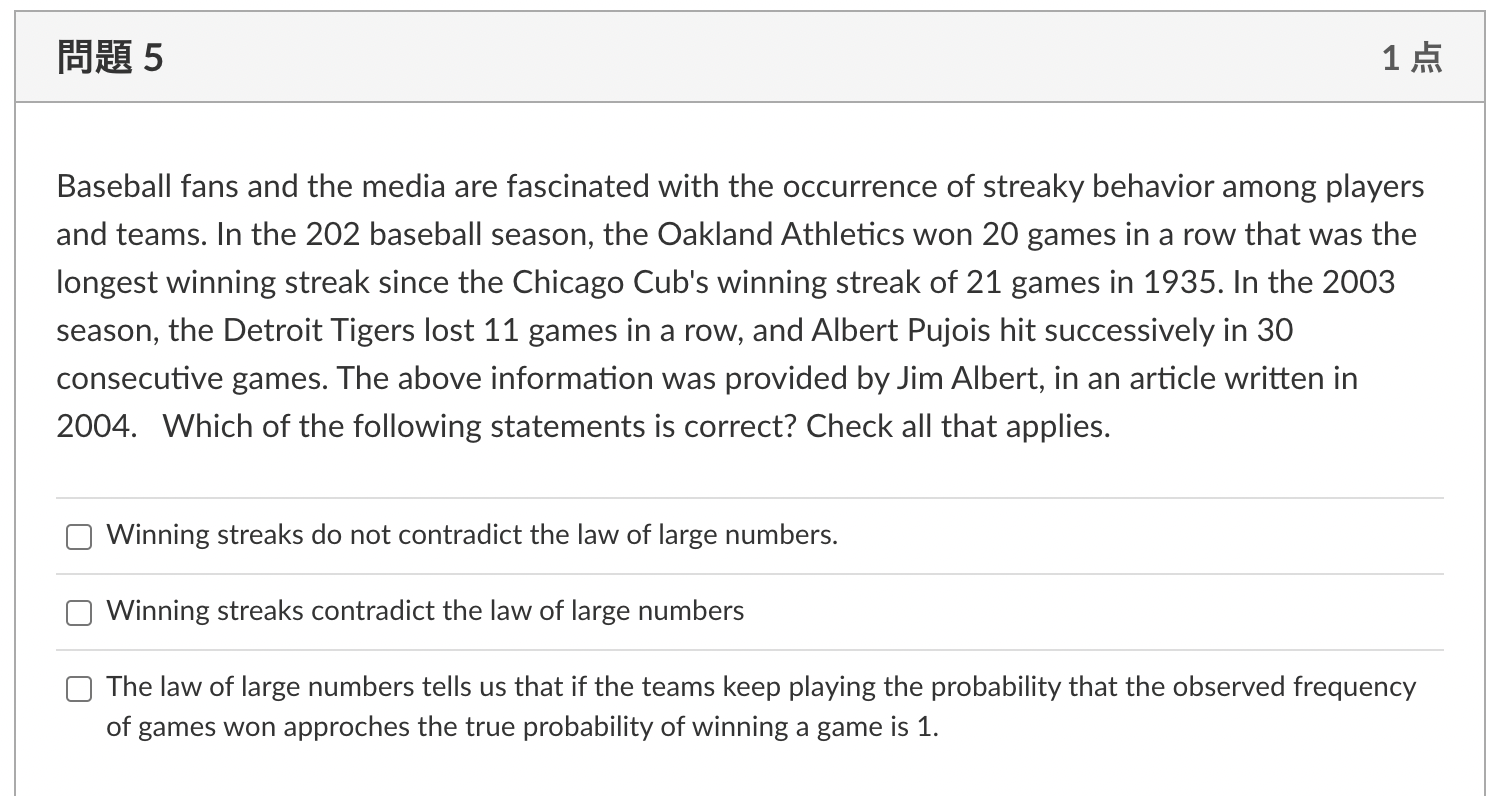
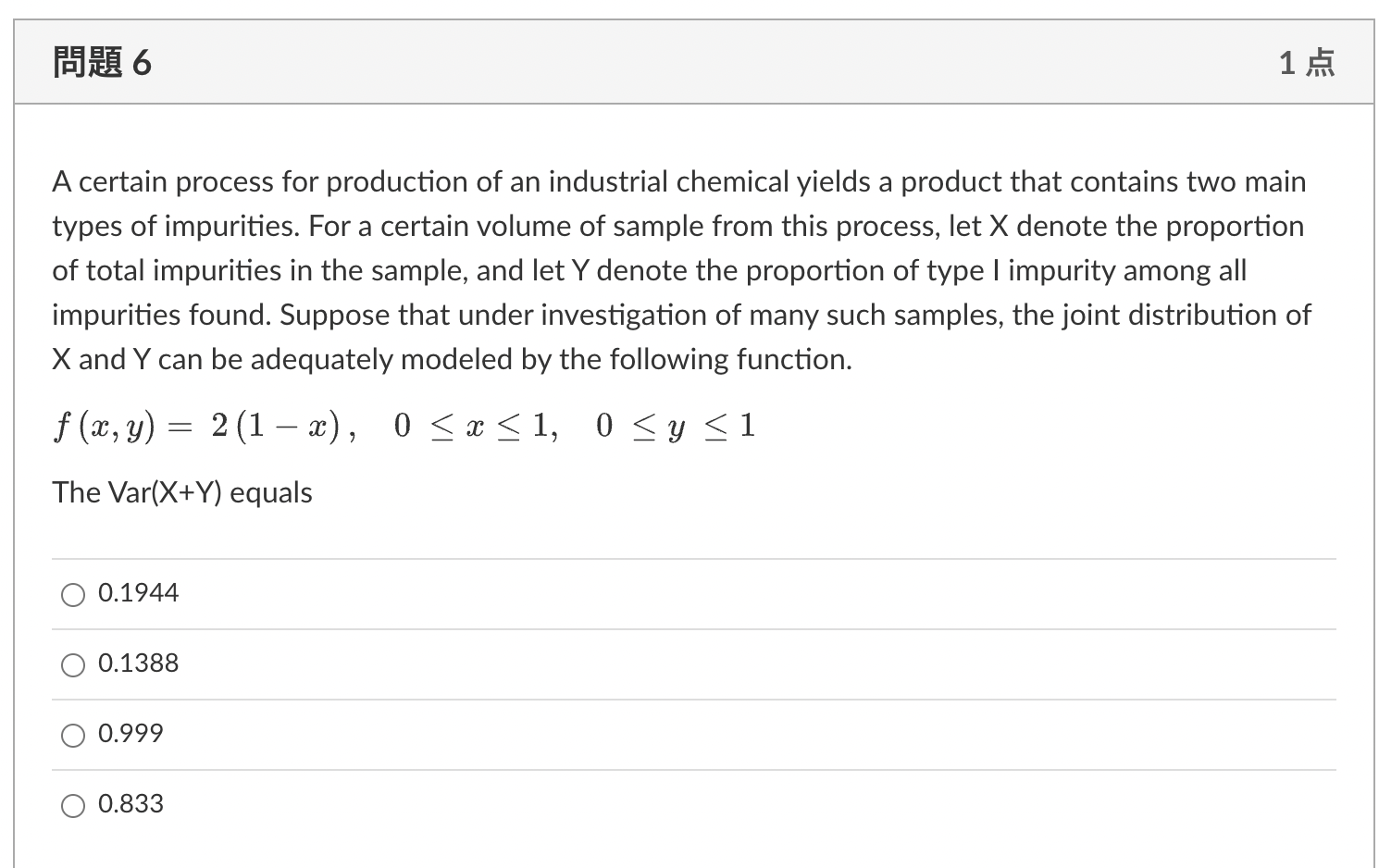
We are interested in random variable X, the number of miles run per week by an individual training for the LA marathon. Consider n individuals, training for the LA marathon and let X1, X2, ...... , Xn denote the number of miles run per week by each of these individuals. If these random variables are independent, and all of them have the same Expected value and Variance, i.e., E(Xi)=E(X):Ma i=1,---,n; VGT(X2')=VGT(X)=0'2, i=1,...,n which of the following statement is NOT true? 0 Var(10X) = 1002 O Var (2321 XI) = lcr2 '3' X:- . . . EM Will be the same whether n IS 100 or n IS 5 O The expected value of Baseball fans and the media are fascinated with the occurrence of streaky behavior among players and teams. In the 202 baseball season, the Oakland Athletics won 20 games in a row that was the longest winning streak since the Chicago Cub's winning streak of 21 games in 1935. In the 2003 season, the Detroit Tigers lost 11 games in a row, and Albert Pujois hit successively in 30 consecutive games. The above information was provided by Jim Albert, in an article written in 2004. Which of the following statements is correct? Check all that applies. C] Winning streaks do not contradict the law of large numbers. C] Winning streaks contradict the law of large numbers C] The law of large numbers tells us that if the teams keep playing the probability that the observed frequency of games won approches the true probability of winning a game is 1. A certain process for production of an industrial chemical yields a product that contains two main types of impurities. For a certain volume of sample from this process, let X denote the proportion of total impurities in the sample, and let Y denote the proportion of type | impurity among all impurities found. Suppose that under investigation of many such samples, the joint distribution of X and Y can be adequately modeled by the following function. rm): 2(1x), 0 5x31, 0 3y :1 The Var(X+Y) equals 0 0.1944 0 0.1388 0 0.999 O 0.833
Step by Step Solution
There are 3 Steps involved in it

Get step-by-step solutions from verified subject matter experts