







Question: We begin by defining the following sets. Let V = {x, y, z}. This is our set of variables. Let C = {1, V}. This
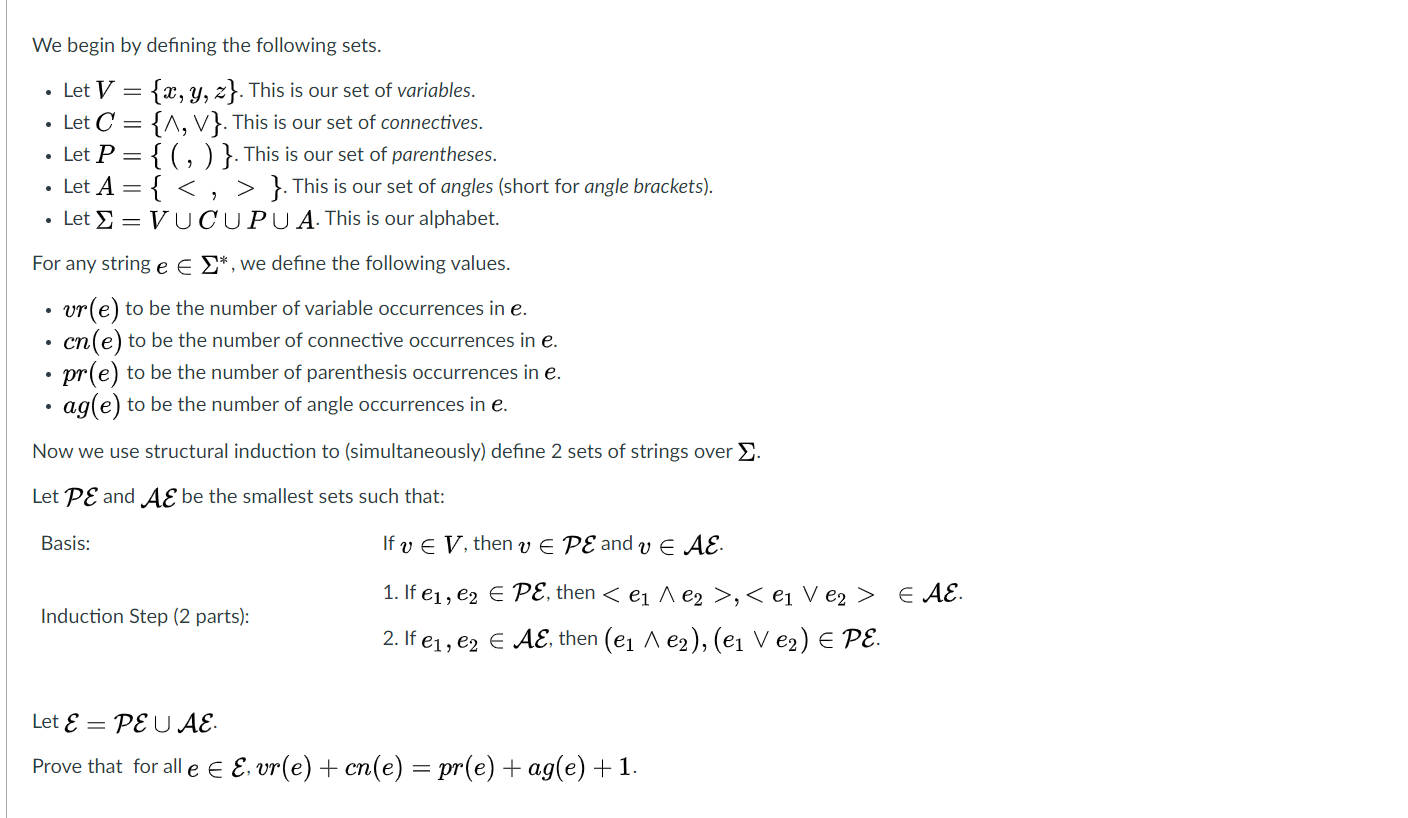
We begin by defining the following sets. Let V = {x, y, z}. This is our set of variables. Let C = {1, V}. This is our set of connectives. Let P= {(, ) }. This is our set of parentheses. Let A={ }. This is our set of angles (short for angle brackets). Let =VUCUPU A. This is our alphabet. For any string e *, we define the following values. vr(e) to be the number of variable occurrences in e. cn(e) to be the number of connective occurrences in e. pr(e) to be the number of parenthesis occurrences in e. ag(e) to be the number of angle occurrences in e. Now we use structural induction to (simultaneously) define 2 sets of strings over Let PE and AE be the smallest sets such that: Basis: If V EV, then v E PE and V E AE. Induction Step (2 parts): 1. If ei, e2 E PE, then , E AE. 2. If e1, C2 AE, then (ei 1e2), (ei Vez) E PE. Let E = PE U AE Prove that for all e e E, vr(e) + cn(e) = pr(e) + ag(e) +1. We begin by defining the following sets. Let V = {x, y, z}. This is our set of variables. Let C = {1, V}. This is our set of connectives. Let P= {(, ) }. This is our set of parentheses. Let A={ }. This is our set of angles (short for angle brackets). Let =VUCUPU A. This is our alphabet. For any string e *, we define the following values. vr(e) to be the number of variable occurrences in e. cn(e) to be the number of connective occurrences in e. pr(e) to be the number of parenthesis occurrences in e. ag(e) to be the number of angle occurrences in e. Now we use structural induction to (simultaneously) define 2 sets of strings over Let PE and AE be the smallest sets such that: Basis: If V EV, then v E PE and V E AE. Induction Step (2 parts): 1. If ei, e2 E PE, then , E AE. 2. If e1, C2 AE, then (ei 1e2), (ei Vez) E PE. Let E = PE U AE Prove that for all e e E, vr(e) + cn(e) = pr(e) + ag(e) +1
Step by Step Solution
There are 3 Steps involved in it

Get step-by-step solutions from verified subject matter experts
 Study Help