







Question: We can read and display images in Python as follows. import numpy as np import scipy.misc as sm import matplotlib.pyplot as plt from matplotlib.pyplot import
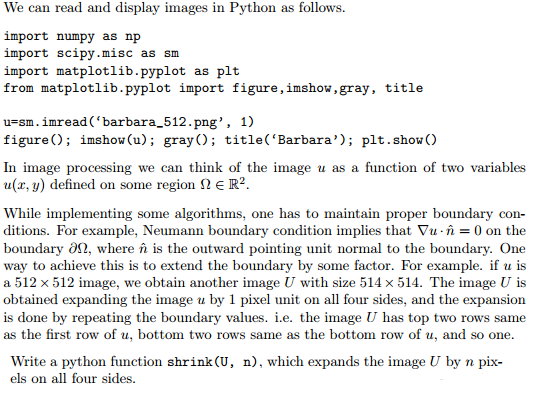
We can read and display images in Python as follows. import numpy as np import scipy.misc as sm import matplotlib.pyplot as plt from matplotlib.pyplot import figure,imshow,gray, title u=sm.imread('barbara_512.png', 1) figure(); imshow(u); gray(); title('Barbara') ; plt.show() In image processing we can think of the image u as a function of two variables u(x, y) defined on some region ohm R^2. While implementing some algorithms, one has to maintain proper boundary conditions. For example, Neumann boundary condition implies that u. n = 0 on the boundary deltaohm, where n is the outward pointing unit normal to the boundary. One way to achieve this is to extend the boundary by some factor. For example. if u is a 512 Times 512 image, we obtain another image U with size 514 Times 514. The image U is obtained expanding the image u by 1 pixel unit on all four sides, and the expansion is done by repeating the boundary values. i.e. the image U has top two rows same as the first row of u, bottom two rows same as the bottom row of u, and so one. Write a python function shrink(U, n), which expands the image U by n pixels on all four sides
Step by Step Solution
There are 3 Steps involved in it

Get step-by-step solutions from verified subject matter experts
 Study Help