



Question: We showed that E(M) = kk2 n OR n = = So now, let us say we repeat the experiment R-times independently and generate
![[ E(M)=frac{k_{1} k_{2}}{n} text { OR } n=frac{k_{1} k_{2}}{E(M)} ] So now, let us say we repeat the experiment ( R )-](https://dsd5zvtm8ll6.cloudfront.net/si.experts.images/questions/2023/02/63fc520e9dd7b_1677480461702.png)
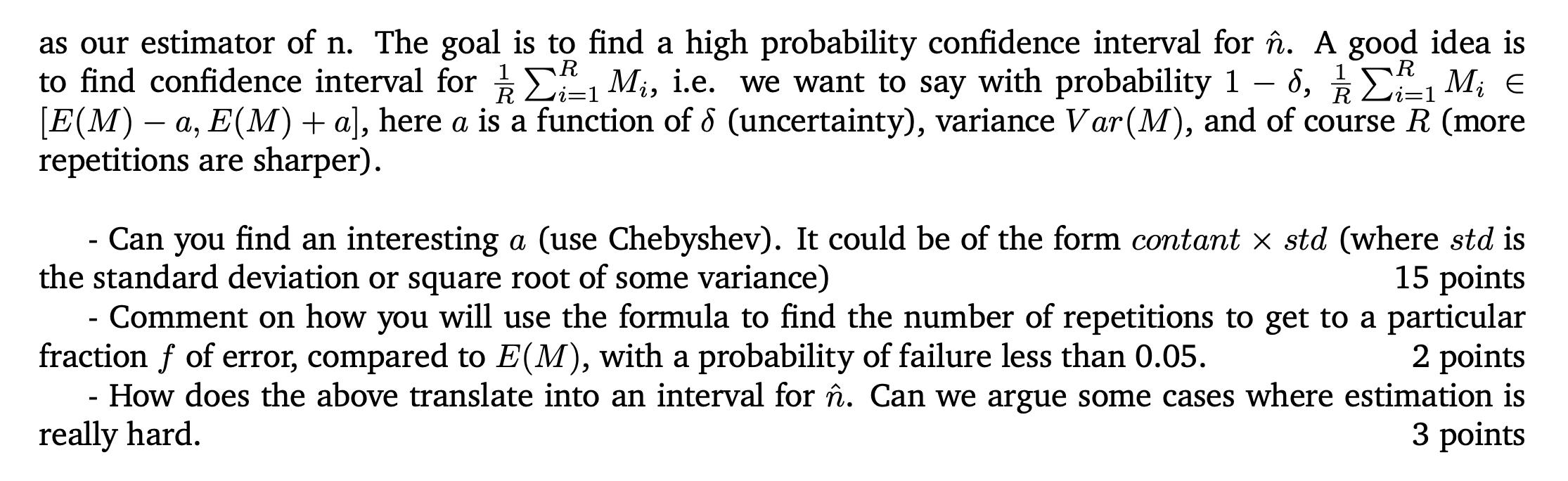
We showed that E(M) = kk2 n OR n = = So now, let us say we repeat the experiment R-times independently and generate R measurements M, M2, M2, ...MR. We report kk2 E(M) kk2 R 1/2 2 Mi i=1 R as our estimator of n. The goal is to find a high probability confidence interval for n. A good idea is to find confidence interval for M, i.e. we want to say with probability 1 - 6, M 1 1 [E(M) a, E(M) + a], here a is a function of 8 (uncertainty), variance Var(M), and of course R (more repetitions are sharper). R R i=1 R - - Can you find an interesting a (use Chebyshev). It could be of the form contant x std (where std is the standard deviation or square root of some variance) 15 points - Comment on how you will use the formula to find the number of repetitions to get to a particular fraction f of error, compared to E(M), with a probability of failure less than 0.05. 2 points - - How does the above translate into an interval for . Can we argue some cases where estimation is really hard. 3 points
Step by Step Solution
3.46 Rating (153 Votes )
There are 3 Steps involved in it
Based on the formula given it seems that the quantity represents the mean of the quantity kik2 over R independent measurements M1 M2 MR Specifically i... View full answer

Get step-by-step solutions from verified subject matter experts