







Question: We will solve the following linear system (D + uv ) x =b (1) by the Sherman-Morrison formula: Let D E RX be an invertible
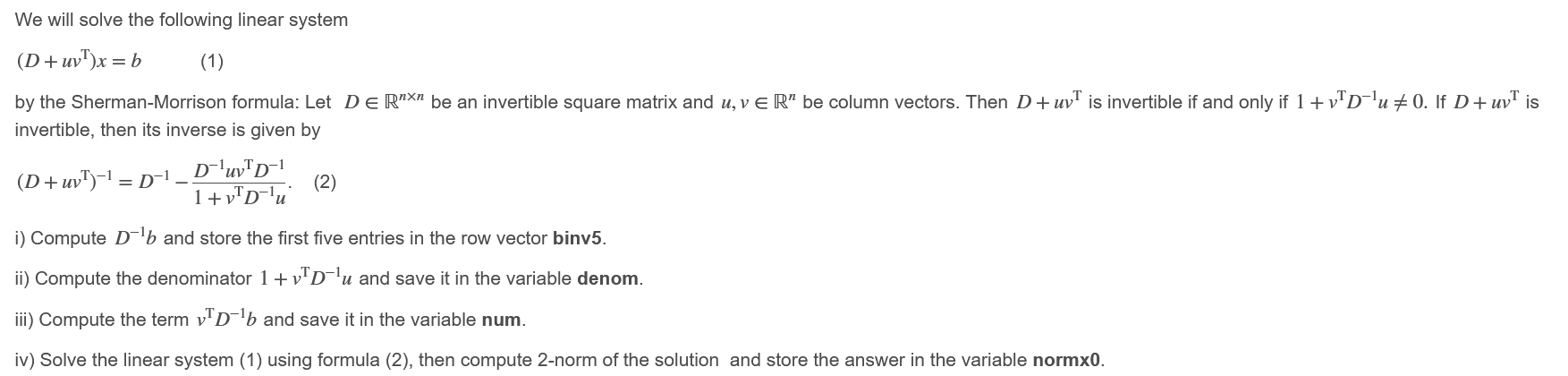
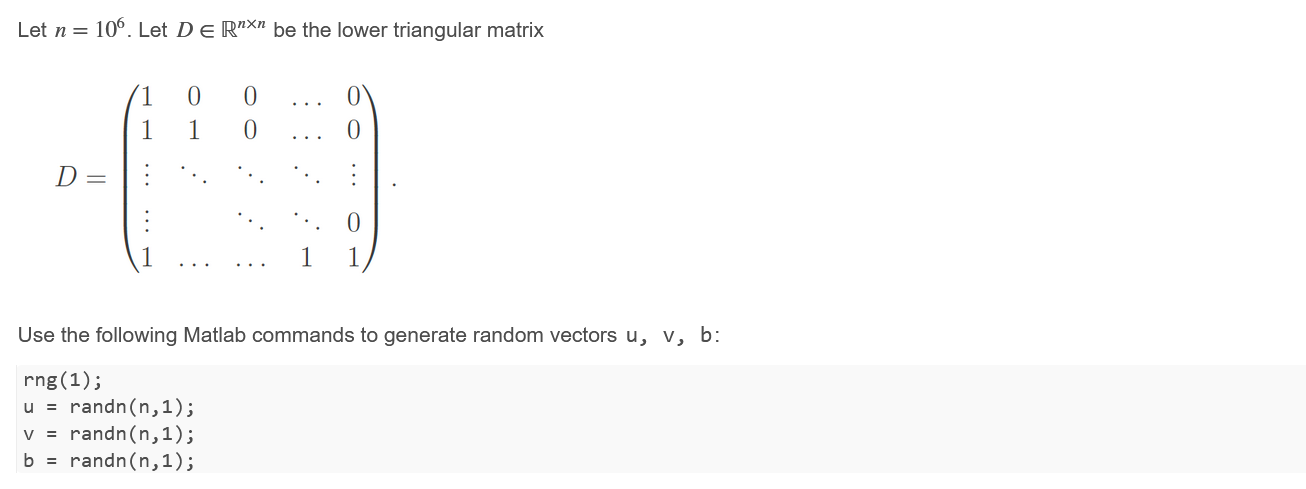

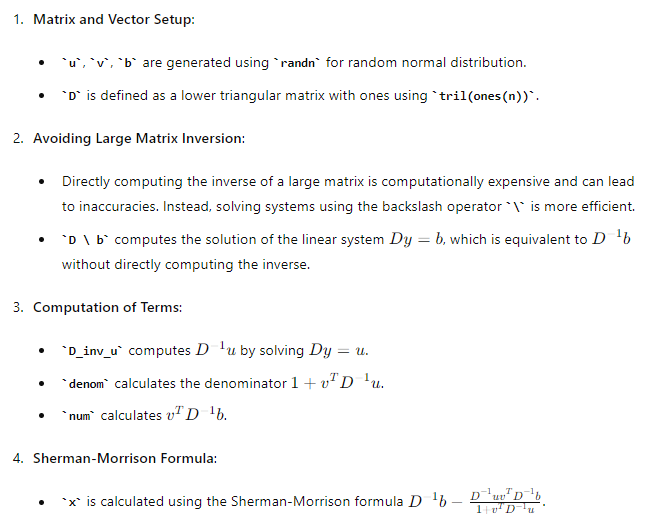
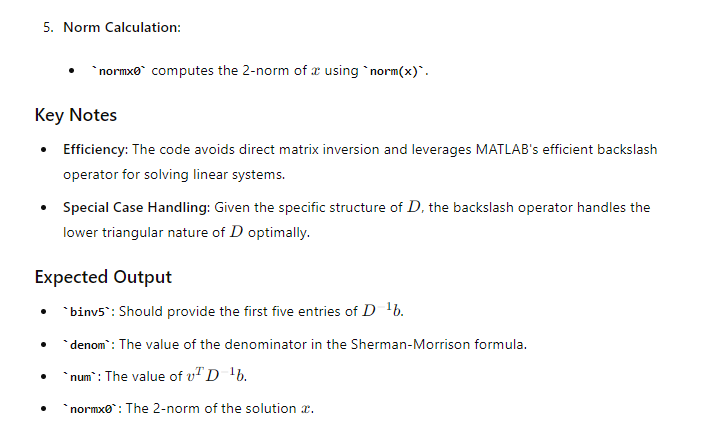
We will solve the following linear system (D + uv ) x =b (1) by the Sherman-Morrison formula: Let D E R"X" be an invertible square matrix and u, v E R" be column vectors. Then D + uv is invertible if and only if 1 + v Du # 0. If D + uv is invertible, then its inverse is given by (D + uv )-1 = D-1_ DuvD-1 1 + v D-'u (2) i) Compute D b and store the first five entries in the row vector binv5. ii) Compute the denominator 1 + v Du and save it in the variable denom. iii) Compute the term v D b and save it in the variable num. iv) Solve the linear system (1) using formula (2), then compute 2-norm of the solution and store the answer in the variable normx0.Let n = 10. Let D E R"X" be the lower triangular matrix O O OO 1 1 0 D = . . . . O Use the following Matlab commands to generate random vectors u, v, b: rng (1) ; u = randn (n, 1); v = randn(n, 1); b = randn(n, 1) ;(D + uv] )x = b We need to: 1. Compute D 'band store the first five entries in * binv5". 2. Compute the denominator 1 + v.D u and save it in *denom". 3. Compute the term v D 'band save it in * num". 4. Solve the linear system using the formula and compute the 2-norm of the solution *normx0".1. Matrix and Vector Setup: "b" are generated using * randn" for random normal distribution. "D" is defined as a lower triangular matrix with ones using * tril(ones (n))" . 2. Avoiding Large Matrix Inversion: . Directly computing the inverse of a large matrix is computationally expensive and can lead to inaccuracies. Instead, solving systems using the backslash operator * \\ is more efficient. *D \\ b' computes the solution of the linear system Dy = b, which is equivalent to D-1b without directly computing the inverse. 3. Computation of Terms: *D_inv_u' computes D lu by solving Dy = u. "denom" calculates the denominator 1 + u"D lu. "num" calculates v D-1b. 4. Sherman-Morrison Formula: ~x" is calculated using the Sherman-Morrison formula D 1b _ Du D l5. Norm Calculation: *normx0* computes the 2-norm of a using * norm(x)". Key Notes . Efficiency: The code avoids direct matrix inversion and leverages MATLAB's efficient backslash operator for solving linear systems. . Special Case Handling: Given the specific structure of D, the backslash operator handles the lower triangular nature of D optimally. Expected Output "binv5*: Should provide the first five entries of D-1b. *denom" : The value of the denominator in the Sherman-Morrison formula. "num" : The value of ofD-1b. *normx0": The 2-norm of the solution
Step by Step Solution
There are 3 Steps involved in it

Get step-by-step solutions from verified subject matter experts
 Study Help