







Question: We would like to add the srl (shift right logical) instruction to the single cycle datapath discussed in class. You will need to feed the
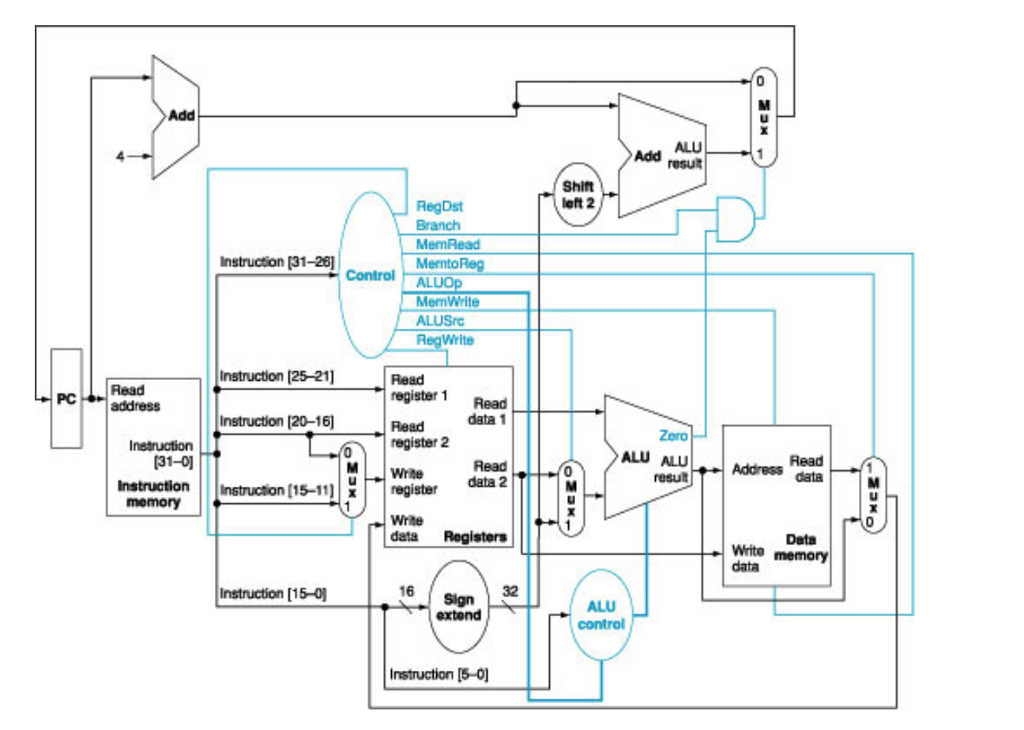
We would like to add the srl (shift right logical) instruction to the single cycle datapath discussed in class. You will need to feed the shamt field to the ALU so that it can shift using the shift amount. (You can assume that the ALU has an implementation of shift right logical if a shift amount and an integer to be shifted are inserted and its ALUOp is 11.) Trace which datapaths in the following picture are used to perform the srl instruction by marking the paths, and add datapath(s) and control signal(s) to the single-cycle datapath for the srl instruction, if it is necessary. (You should also make sure that previously existing instructions such as R-format (add,sub,and,or,slt), lw, sw, and beq still work with this additional instruction.) Download the following PDF/JPG file, use some software (for instance, Microsoft Paint) to draw any new datapath(s) and signal(s) using red color. (You can copy & paste your image back into your document such as MS Word.) Explain when the new signal(s) that you chose is set to 0, and also 1, if any. Also specify the value of other existing control signals RegDst, ALUSrc, MemtoReg, RegWrite, MemRead, MemWrite, Branch, ALUOp0, and ALUOp1.
. (S pts) We would like to add the "srl (shift right logical) instruction to the single eyele datapath discussed in class. You will need to feed the shamt field to the ALU so that it ean shift using the shift amount. (You can assume that the ALU has an implementation ot shift right logical if a shift amount and an integer to be shifted are inserted and its ALUOp is 11.) Trace which datapaths in the following picture are used to perform the "sr" instruction by marking the paths, and add datapath s) and control signal(s) to the single-cyclo datapath fo the "ri" instruction, ifit is necessary. (You should also make sure that previously existing instructions such as R-format (add, suh,and,or,slt), w, sw, and he still work with this additional instruction.) Download the following PDFPG file, use some software (for instance, Microsoft Paint) to draw any new datapath(s) and signal(s) using red color. (You can copy & paste your image back inta your document such as MS Word.) Explain when the new signalts) that you chose is set to O, and also 1, ifany. Also specify tbe valuc of other existing control signals RegDst, ALUSrc, MemtoRcg, RogWite, MemRcad, MemWrite, Branch, ALUOp0, and ALUOpl Download the figure from bere (PDF file). 30-1 . (S pts) We would like to add the "srl (shift right logical) instruction to the single eyele datapath discussed in class. You will need to feed the shamt field to the ALU so that it ean shift using the shift amount. (You can assume that the ALU has an implementation ot shift right logical if a shift amount and an integer to be shifted are inserted and its ALUOp is 11.) Trace which datapaths in the following picture are used to perform the "sr" instruction by marking the paths, and add datapath s) and control signal(s) to the single-cyclo datapath fo the "ri" instruction, ifit is necessary. (You should also make sure that previously existing instructions such as R-format (add, suh,and,or,slt), w, sw, and he still work with this additional instruction.) Download the following PDFPG file, use some software (for instance, Microsoft Paint) to draw any new datapath(s) and signal(s) using red color. (You can copy & paste your image back inta your document such as MS Word.) Explain when the new signalts) that you chose is set to O, and also 1, ifany. Also specify tbe valuc of other existing control signals RegDst, ALUSrc, MemtoRcg, RogWite, MemRcad, MemWrite, Branch, ALUOp0, and ALUOpl Download the figure from bere (PDF file). 30-1
Step by Step Solution
There are 3 Steps involved in it

Get step-by-step solutions from verified subject matter experts
 Study Help