







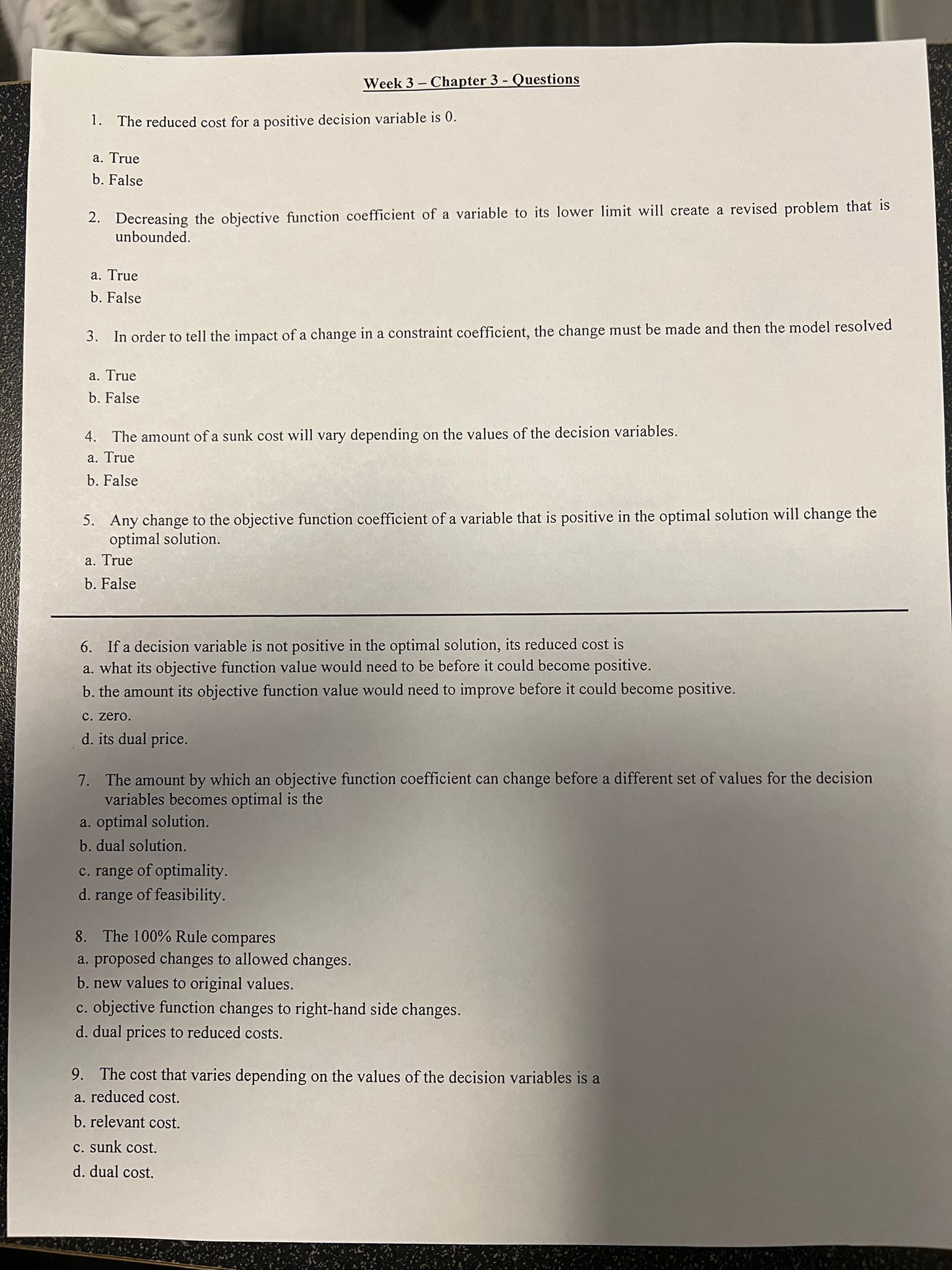
Question: Week 3 - Chapter 3 - Questions The reduced cost for a positive decision variable is 0 . a . True b . False Decreasing
Week Chapter Questions
The reduced cost for a positive decision variable is
a True
b False
Decreasing the objective function coefficient of a variable to its lower limit will create a revised problem that is
unbounded.
a True
b False
In order to tell the impact of a change in a constraint coefficient, the change must be made and then the model resolved
a True
b False
The amount of a sunk cost will vary depending on the values of the decision variables.
a True
b False
Any change to the objective function coefficient of a variable that is positive in the optimal solution will change the
optimal solution.
a True
b False
If a decision variable is not positive in the optimal solution, its reduced cost is
a what its objective function value would need to be before it could become positive.
b the amount its objective function value would need to improve before it could become positive.
c zero.
d its dual price.
The amount by which an objective function coefficient can change before a different set of values for the decision
variables becomes optimal is the
a optimal solution.
b dual solution.
c range of optimality.
d range of feasibility.
The Rule compares
a proposed changes to allowed changes.
b new values to original values.
c objective function changes to righthand side changes.
d dual prices to reduced costs.
The cost that varies depending on the values of the decision variables is a
a reduced cost.
b relevant cost.
c sunk cost.
d dual cost.
Step by Step Solution
There are 3 Steps involved in it
1 Expert Approved Answer
Step: 1 Unlock

Question Has Been Solved by an Expert!
Get step-by-step solutions from verified subject matter experts
Step: 2 Unlock
Step: 3 Unlock
 Study Help