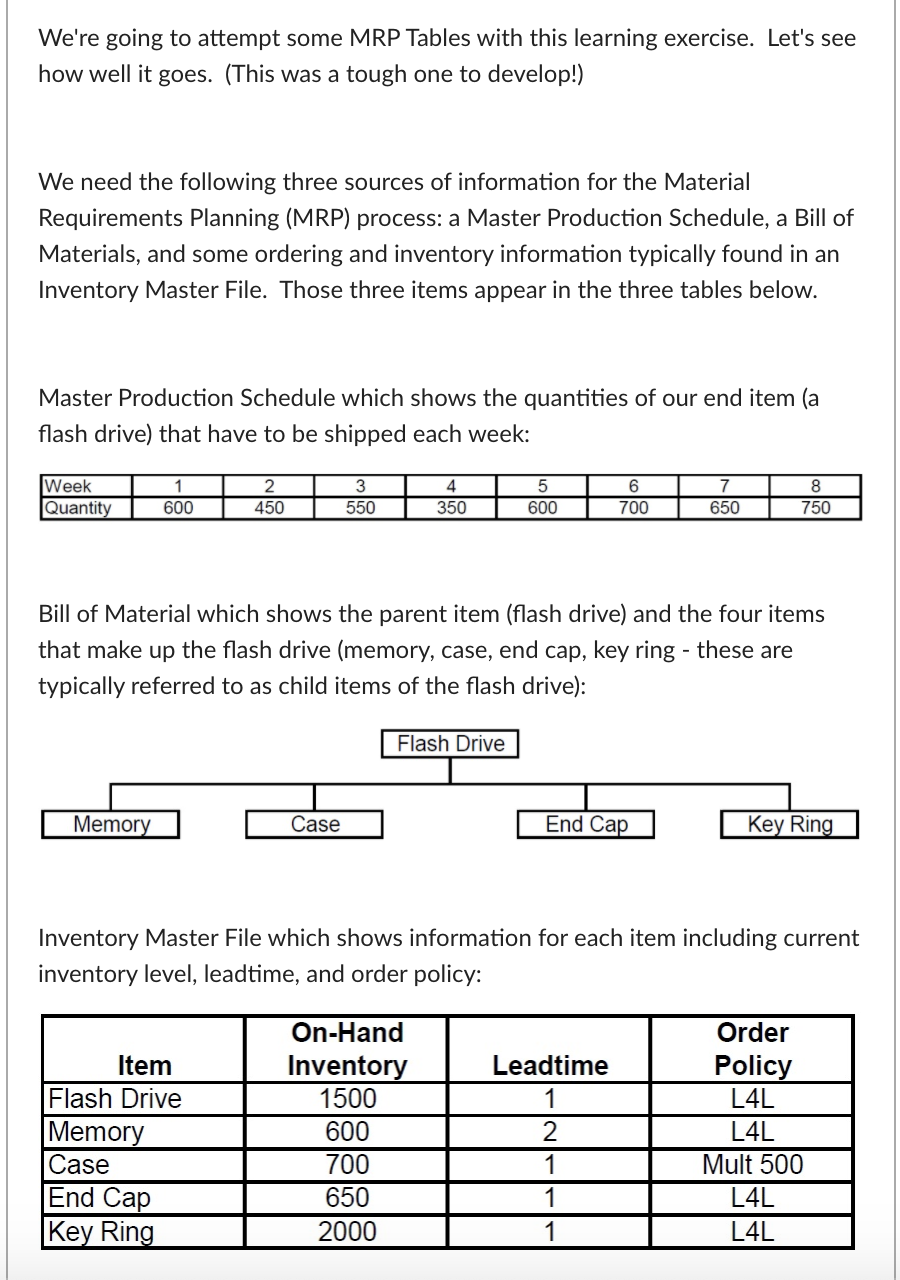
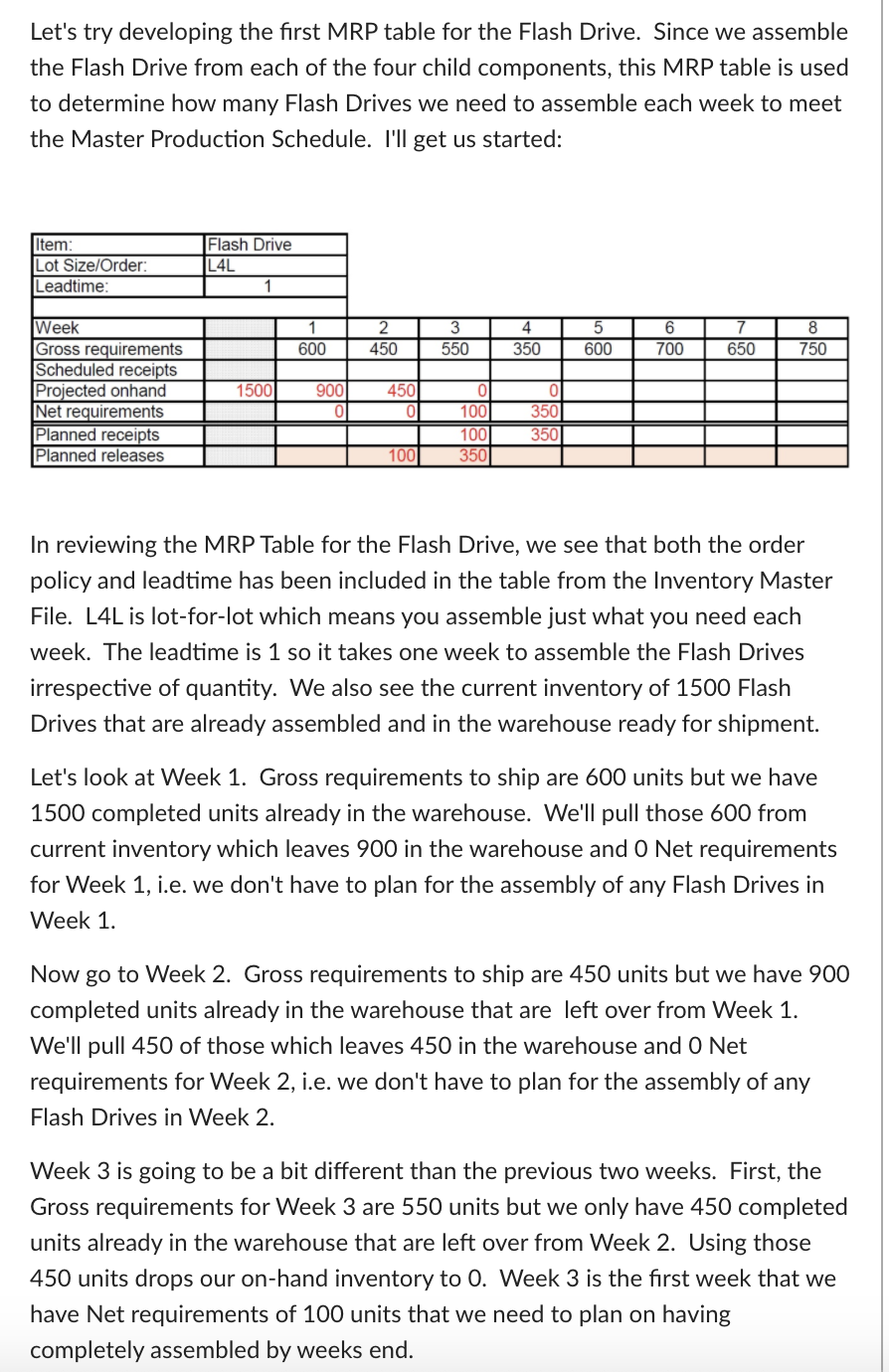
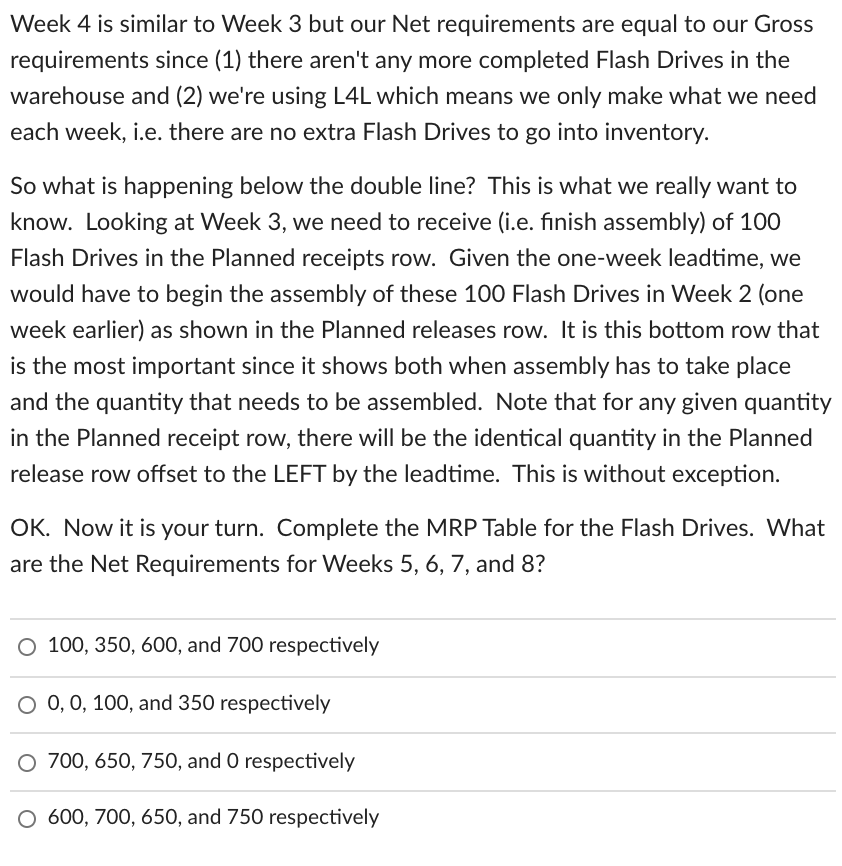
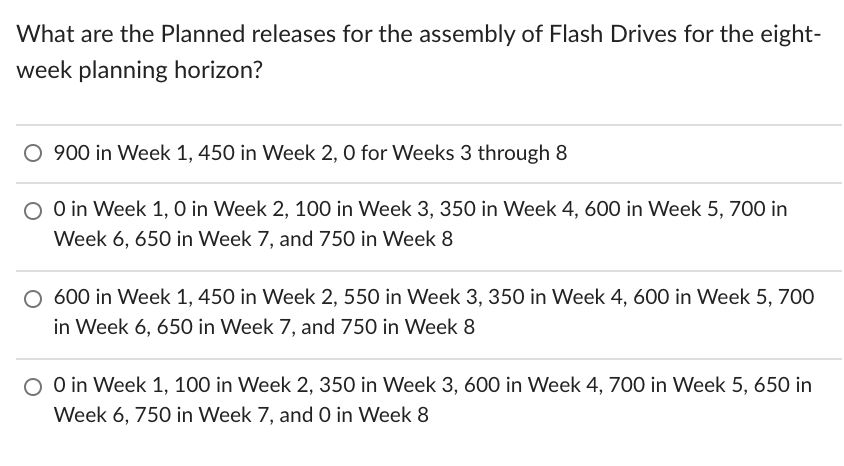
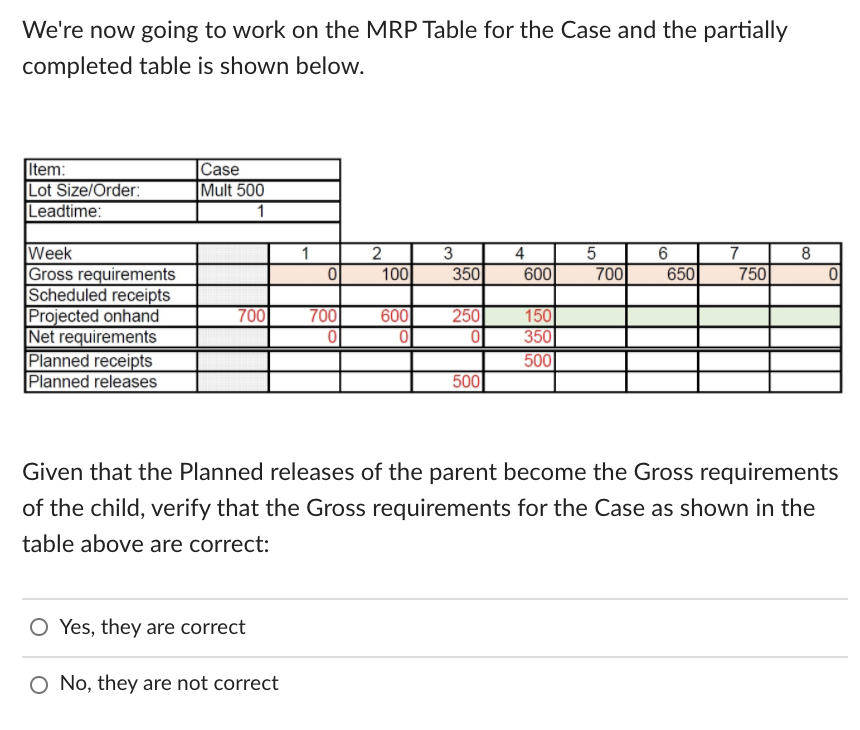
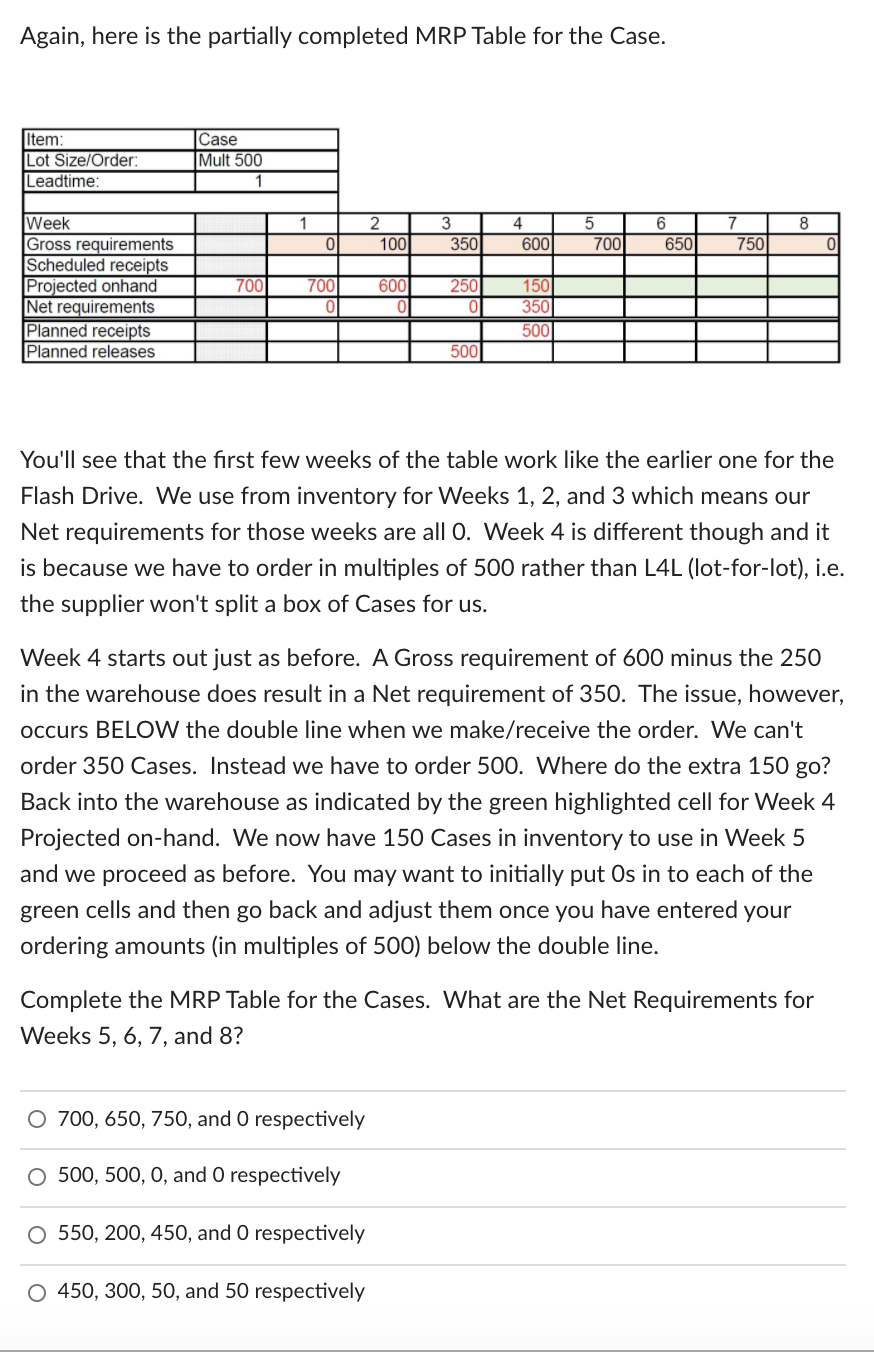
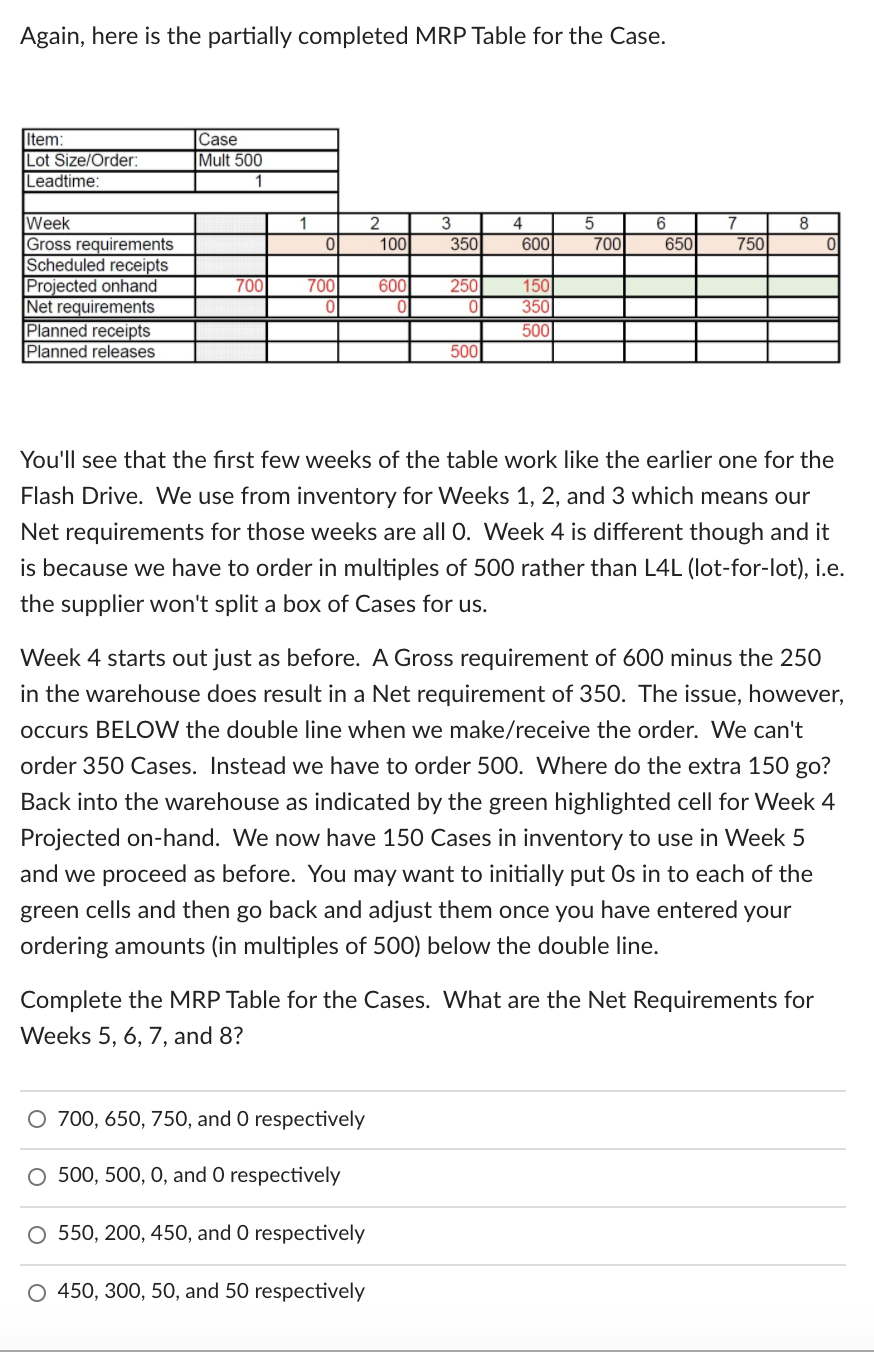
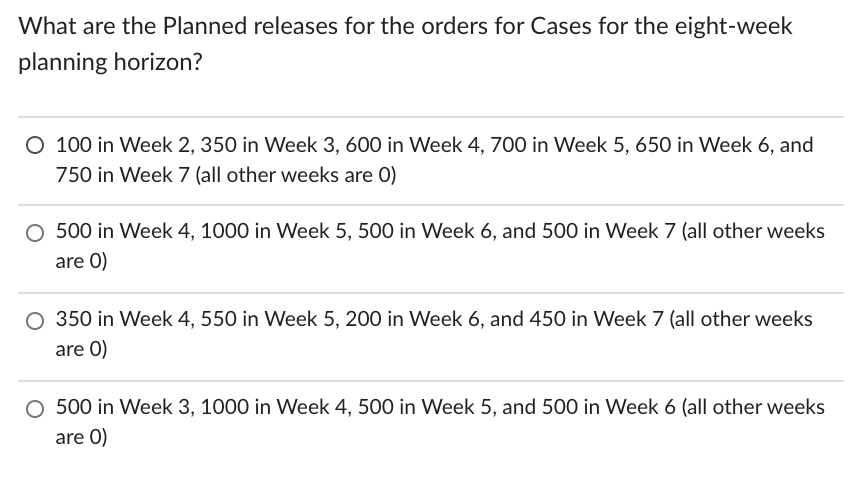
We're going to attempt some MRP Tables with this learning exercise. Let's see how well it goes. (This was a tough one to develop!) We need the following three sources of information for the Material Requirements Planning (MRP) process: a Master Production Schedule, a Bill of Materials, and some ordering and inventory information typically found in an Inventory Master File. Those three items appear in the three tables below. Master Production Schedule which shows the quantities of our end item (a flash drive) that have to be shipped each week: Week Quantity 1 600 2 450 3 550 4 350 5 600 6 700 7 650 8 750 Bill of Material which shows the parent item (flash drive) and the four items that make up the flash drive (memory, case, end cap, key ring - these are typically referred to as child items of the flash drive): Flash Drive Memory Case End Cap Key Ring Inventory Master File which shows information for each item including current inventory level, leadtime, and order policy: Item Flash Drive Memory Case End Cap Key Ring On-Hand Inventory 1500 600 700 650 2000 Leadtime 1 2 1 1 1 Order Policy L4L L4L Mult 500 L4L L4L Let's try developing the first MRP table for the Flash Drive. Since we assemble the Flash Drive from each of the four child components, this MRP table is used to determine how many Flash Drives we need to assemble each week to meet the Master Production Schedule. I'll get us started: Item: Lot Size/Order: Leadtime: Flash Drive L4L 1 1 600 2 450 3 550 4 350 5 600 6 700 8 750 650 Week Gross requirements Scheduled receipts Projected onhand Net requirements Planned receipts Planned releases 1500 900 0 450 0 01 100 100 350 350 350 100 In reviewing the MRP Table for the Flash Drive, we see that both the order policy and leadtime has been included in the table from the Inventory Master File. L4L is lot-for-lot which means you assemble just what you need each week. The leadtime is 1 so it takes one week to assemble the Flash Drives irrespective of quantity. We also see the current inventory of 1500 Flash Drives that are already assembled and in the warehouse ready for shipment. Let's look at Week 1. Gross requirements to ship are 600 units but we have 1500 completed units already in the warehouse. We'll pull those 600 from current inventory which leaves 900 in the warehouse and 0 Net requirements for Week 1, i.e. we don't have to plan for the assembly of any Flash Drives in Week 1. Now go to Week 2. Gross requirements to ship are 450 units but we have 900 completed units already in the warehouse that are left over from Week 1. We'll pull 450 of those which leaves 450 in the warehouse and O Net requirements for Week 2, i.e. we don't have to plan for the assembly of any Flash Drives in Week 2. Week 3 is going to be a bit different than the previous two weeks. First, the Gross requirements for Week 3 are 550 units but we only have 450 completed units already in the warehouse that are left over from Week 2. Using those 450 units drops our on-hand inventory 0. Week 3 is the first week that we have Net requirements of 100 units that we need to plan on having completely assembled by weeks end. Week 4 is similar to Week 3 but our Net requirements are equal to our Gross requirements since (1) there aren't any more completed Flash Drives in the warehouse and (2) we're using L4L which means we only make what we need each week, i.e. there are no extra Flash Drives to go into inventory. So what is happening below the double line? This is what we really want to know. Looking at Week 3, we need to receive (i.e. finish assembly) of 100 Flash Drives in the Planned receipts row. Given the one-week leadtime, we would have to begin the assembly of these 100 Flash Drives in Week 2 (one week earlier) as shown in the Planned releases row. It is this bottom row that is the most important since it shows both when assembly has to take place and the quantity that needs to be assembled. Note that for any given quantity in the Planned receipt row, there will be the identical quantity in the Planned release row offset to the LEFT by the leadtime. This is without exception. OK. Now it is your turn. Complete the MRP Table for the Flash Drives. What are the Net Requirements for Weeks 5, 6, 7, and 8? O 100, 350, 600, and 700 respectively O 0, 0, 100, and 350 respectively O 700, 650, 750, and O respectively O 600, 700, 650, and 750 respectively What are the planned releases for the assembly of Flash Drives for the eight- week planning horizon? O 900 in Week 1, 450 in Week 2, 0 for Weeks 3 through 8 O O in Week 1, 0 in Week 2, 100 in Week 3, 350 in Week 4, 600 in Week 5, 700 in Week 6, 650 in Week 7, and 750 in Week 8 O 600 in Week 1, 450 in Week 2, 550 in Week 3, 350 in Week 4, 600 in Week 5, 700 in Week 6, 650 in Week 7, and 750 in Week 8 O O in Week 1, 100 in Week 2, 350 in Week 3, 600 in Week 4, 700 in Week 5, 650 in Week 6, 750 in Week 7, and O in Week 8 We're now going to work on the MRP Table for the Case and the partially completed table is shown below. Item: Lot Size/Order: Leadtime: Case Mult 500 1 8 2 100 3 350 4 600 5 700 6 650 7 750 0 0 Week Gross requirements Scheduled receipts Projected onhand Net requirements Planned receipts Planned releases 700 700 600 0 250 0 0 150 350 500 500 Given that the Planned releases of the parent become the Gross requirements of the child, verify that the Gross requirements for the Case as shown in the table above are correct: : O Yes, they are correct O No, they are not correct Again, here is the partially completed MRP Table for the Case. Item: Lot Size/Order: Leadtime: Case Mult 500 1 8 2 100) 3 350 4 600 5 700 6 650 7 750 0 0 Week Gross requirements Scheduled receipts Projected onhand Net requirements Planned receipts Planned releases 700 700 0 600 0 250 O 1501 350 500 500 You'll see that the first few weeks of the table work like the earlier one for the Flash Drive. We use from inventory for Weeks 1, 2, and 3 which means our Net requirements for those weeks are all O. Week 4 is different though and it is because we have to order in multiples of 500 rather than L4L (lot-for-lot), i.e. the supplier won't split a box of Cases for us. Week 4 starts out just as before. A Gross requirement of 600 minus the 250 in the warehouse does result in a Net requirement of 350. The issue, however, occurs BELOW the double line when we make/receive the order. We can't order 350 Cases. Instead we have to order 500. Where do the extra 150 go? Back into the warehouse as indicated by the green highlighted cell for Week 4 Projected on-hand. We now have 150 Cases in inventory to use in Week 5 and we proceed as before. You may want initially put Os in to each of the green cells and then go back and adjust them once you have entered your ordering amounts (in multiples of 500) below the double line. Complete the MRP Table for the Cases. What are the Net Requirements for Weeks 5, 6, 7, and 8? O 700, 650, 750, and O respectively 500, 500, O, and O respectively O 550, 200, 450, and O respectively O 450, 300, 50, and 50 respectively Again, here is the partially completed MRP Table for the Case. Item: Lot Size/Order: Leadtime: Case Mult 500 1 8 2 100) 3 350 4 600 5 700 6 650 7 750 0 0 Week Gross requirements Scheduled receipts Projected onhand Net requirements Planned receipts Planned releases 700 700 0 600 0 250 O 1501 350 500 500 You'll see that the first few weeks of the table work like the earlier one for the Flash Drive. We use from inventory for Weeks 1, 2, and 3 which means our Net requirements for those weeks are all O. Week 4 is different though and it is because we have to order in multiples of 500 rather than L4L (lot-for-lot), i.e. the supplier won't split a box of Cases for us. Week 4 starts out just as before. A Gross requirement of 600 minus the 250 in the warehouse does result in a Net requirement of 350. The issue, however, occurs BELOW the double line when we make/receive the order. We can't order 350 Cases. Instead we have to order 500. Where do the extra 150 go? Back into the warehouse as indicated by the green highlighted cell for Week 4 Projected on-hand. We now have 150 Cases in inventory to use in Week 5 and we proceed as before. You may want initially put Os in to each of the green cells and then go back and adjust them once you have entered your ordering amounts (in multiples of 500) below the double line. Complete the MRP Table for the Cases. What are the Net Requirements for Weeks 5, 6, 7, and 8? O 700, 650, 750, and O respectively 500, 500, O, and O respectively O 550, 200, 450, and O respectively O 450, 300, 50, and 50 respectively What are the planned releases for the orders for Cases for the eight-week planning horizon? O 100 in Week 2, 350 in Week 3, 600 in Week 4, 700 in Week 5, 650 in Week 6, and 750 in Week 7 (all other weeks are 0) O 500 in Week 4, 1000 in Week 5, 500 in Week 6, and 500 in Week 7 (all other weeks are 0) O 350 in Week 4, 550 in Week 5, 200 in Week 6, and 450 in Week 7 (all other weeks are 0) O 500 in Week 3, 1000 in Week 4, 500 in Week 5, and 500 in Week 6 (all other weeks are 0)




