







Question: What effect does it have on the % error if you use different masses Fill in the table with units. aexpt is the average. 3SE
What effect does it have on the % error if you use different masses
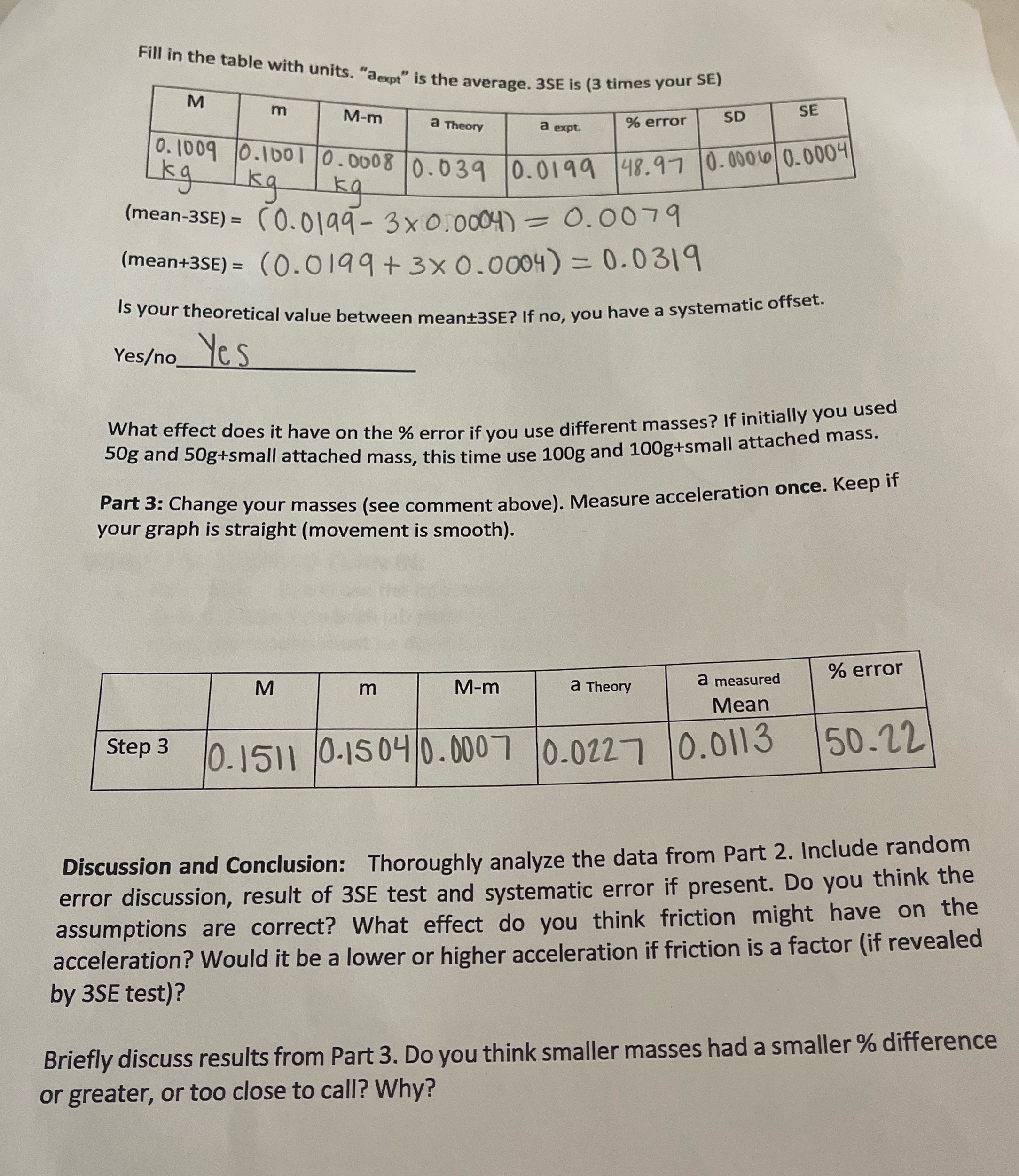
Fill in the table with units. "aexpt" is the average. 3SE is (3 times your SE) M m M-m a Theory a expt. % error SD SE kq 0. 1009 0. 1001 0. 0008 kq kq 0. 039 0. 0199 48. 97 0. 0006 0.0004 (mean-3SE) = ( 0. 0199- 3x 0:0004) = 0.0079 (mean+3SE) = (0.0199+ 3x 0_0004) = 0.0319 Is your theoretical value between mean+3SE? If no, you have a systematic offset. Yes / no_ Yes What effect does it have on the % error if you use different masses? If initially you used 50g and 50g+small attached mass, this time use 100g and 100g+small attached mass. Part 3: Change your masses (see comment above). Measure acceleration once. Keep if your graph is straight (movement is smooth) M m M-m a measured % error a Theory Mean Step 3 10. 1511 0-1504/0.0007 0-0227 10.0113 50. 22 Discussion and Conclusion: Thoroughly analyze the data from Part 2. Include random error discussion, result of 3SE test and systematic error if present. Do you think the assumptions are correct? What effect do you think friction might have on the acceleration? Would it be a lower or higher acceleration if friction is a factor (if revealed by 3SE test)? Briefly discuss results from Part 3. Do you think smaller masses had a smaller % difference or greater, or too close to call? Why
Step by Step Solution
There are 3 Steps involved in it

Get step-by-step solutions from verified subject matter experts
 Study Help