







Question: What exactly do we mean by request? In this case, a request is simply some user requesting a file from a web server, via

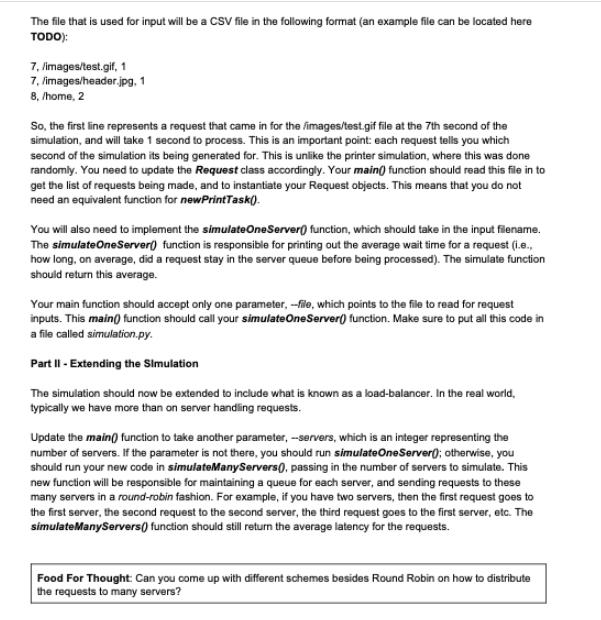

What exactly do we mean by request? In this case, a request is simply some user requesting a file from a web server, via a web browser. For example, when you go to www.google.com in your browser, you are making a network request to the web server hosting google.com. This request gets processed and eventually, the results are sent back to your browser to be displayed. In this assignment, we will look at how we can simulate this process, representing the server as a queue of requests that need to be processed. In the printer example, the printer can print x number of pages per second. In our case, each request will have its own 'processing time', which is the amount of time that is needed for the server to process this request. Also, in the real world, a server can process more than one request at a time, since servers typically have more than one CPU. However, just like the printer simulation, we can assume for now that the server only processes on request at a time. In essence, this assignment is very similar in structure to the printing simulation. Therefore, it is highly recommended to read over the printer simulation section again. This biggest difference between this and the printing simulation is that we will not be generating requests at random, but reading them from a file. This will help keep results consistent and easily testable. Part I - Implement Simulation with One Server To help outline a solution, you will have a Server class and a Request class. This are akin to the Printer and Task class in the reading. You will need to update these classes to represent the problem at hand.
Step by Step Solution
There are 3 Steps involved in it
Part I Implement Simulation with One Server To implement the simulation with one server we can use the following steps Create a Request class with the following attributes requestid A unique identifie... View full answer

Get step-by-step solutions from verified subject matter experts
 Study Help