







Question: What Is a Future Value, and How Is It Calculated? Under the concepts of the time value of money, you can determine the future value
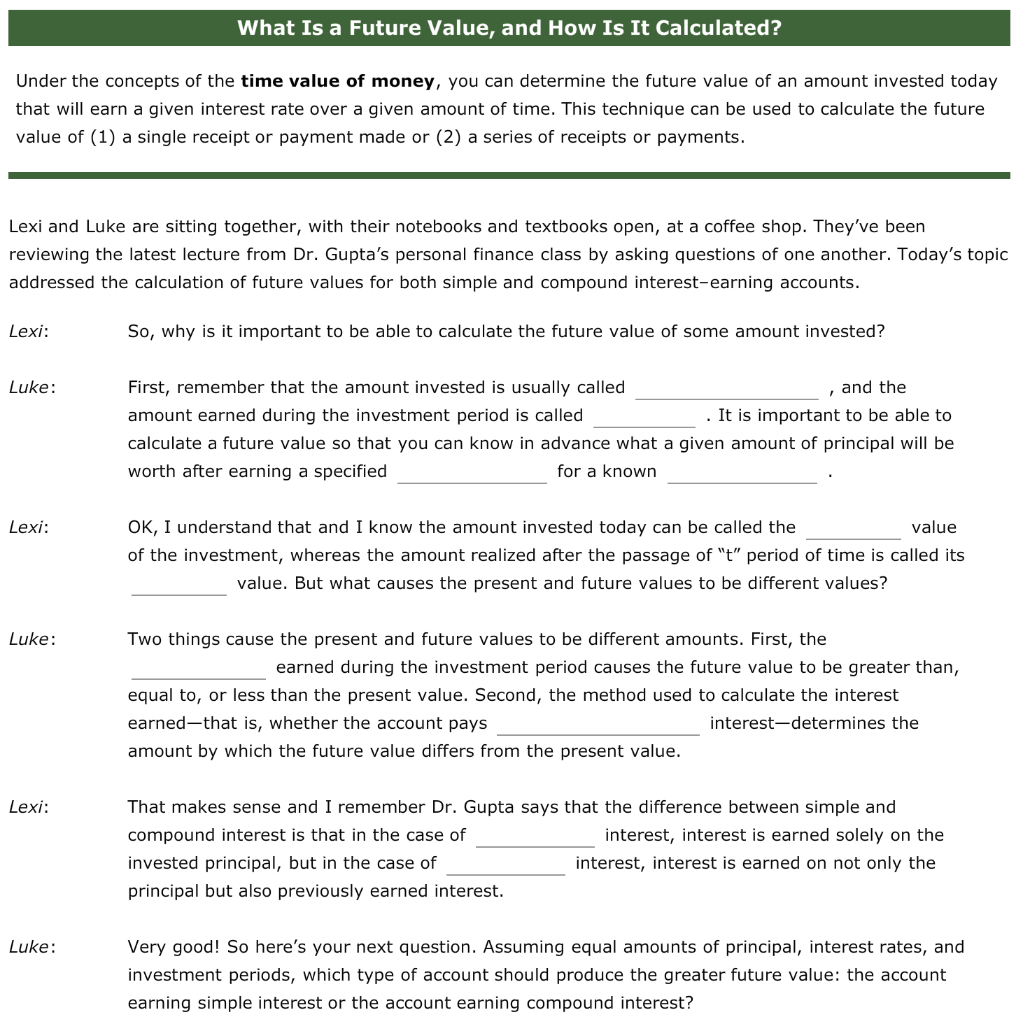
What Is a Future Value, and How Is It Calculated? Under the concepts of the time value of money, you can determine the future value of an amount invested today that will earn a given interest rate over a given amount of time. This technique can be used to calculate the future value of (1) a single receipt or payment made or (2) a series of receipts or payments. Lexi and Luke are sitting together, with their notebooks and textbooks open, at a coffee shop. They've been reviewing the latest lecture from Dr. Gupta's personal finance class by asking questions of one another. Today's topic addressed the calculation of future values for both simple and compound interest-earning accounts. Lexi: So, why is it important to be able to calculate the future value of some amount invested? Luke: First, remember that the amount invested is usually called , and the amount earned during the investment period is called It is important to be able to calculate a future value so that you can know in advance what a given amount of principal will be worth after earning a specified for a known Lexi: OK, I understand that and I know the amount invested today can be called the value of the investment, whereas the amount realized after the passage of "t" period of time is called its value. But what causes the present and future values to be different values? Luke: Two things cause the present and future values to be different amounts. First, the earned during the investment period causes the future value to be greater than, equal to, or less than the present value. Second, the method used to calculate the interest earned that is, whether the account pays interest-determines the amount by which the future value differs from the present value. Lexi: That makes sense and I remember Dr. Gupta says that the difference between simple and compound interest is that in the case of interest, interest is earned solely on the invested principal, but in the case of interest, interest is earned on not only the principal but also previously earned interest. Luke: Very good! So here's your next question. Assuming equal amounts of principal, interest rates, and investment periods, which type of account should produce the greater future value: the account earning simple interest or the account earning compound interest
Step by Step Solution
There are 3 Steps involved in it

Get step-by-step solutions from verified subject matter experts
 Study Help