







Question: What would be your Hypothesis? Self-service technology: Does co-production harm value co-creation? Toni Hilton, University of Westminster Which month were you born? Jan Feb Mar
What would be your Hypothesis?
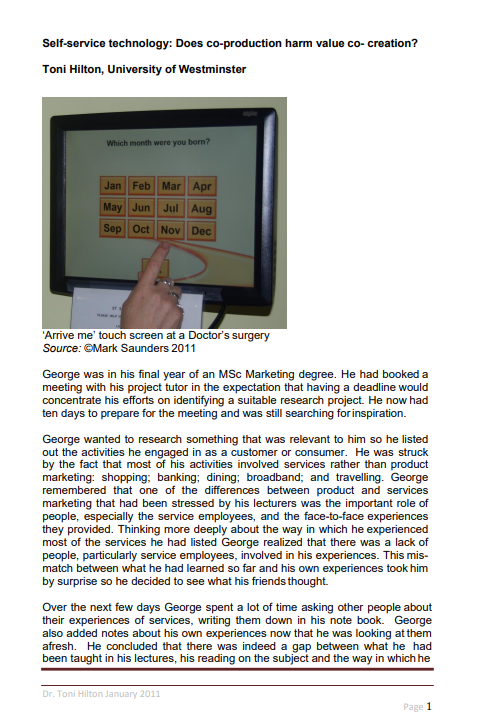
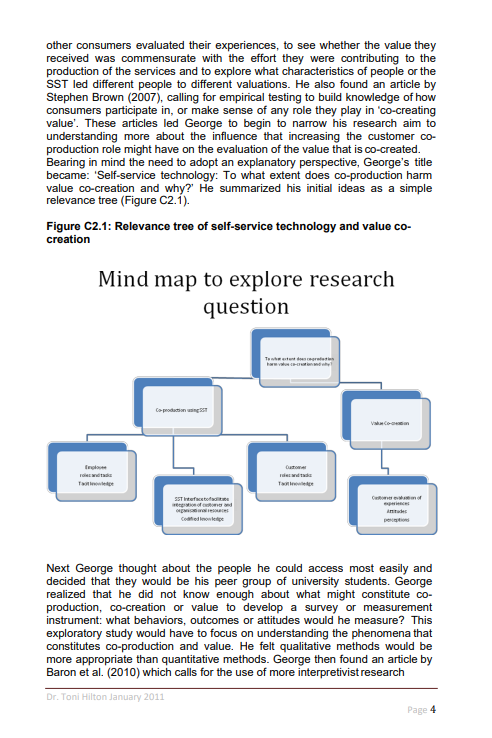
Self-service technology: Does co-production harm value co-creation? Toni Hilton, University of Westminster Which month were you born? Jan Feb Mar Apr May Jun Jul Aug Sep Oct Nov Dec 'Arrive me' touch screen at a Doctor's surgery Source: Mark Saunders 2011 George was in his final year of an MSc Marketing degree. He had booked a meeting with his project tutor in the expectation that having a deadline would concentrate his efforts on identifying a suitable research project. He now had ten days to prepare for the meeting and was still searching for inspiration. George wanted to research something that was relevant to him so he listed out the activities he engaged in as a customer or consumer. He was struck by the fact that most of his activities involved services rather than product marketing: shopping; banking; dining; broadband; and travelling. George remembered that one of the differences between product and services marketing that had been stressed by his lecturers was the important role of people, especially the service employees, and the face-to-face experiences they provided. Thinking more deeply about the way in which he experienced most of the services he had listed George realized that there was a lack of people, particularly service employees, involved in his experiences. This mis- match between what he had learned so far and his own experiences took him by surprise so he decided to see what his friends thought. Over the next few days George spent a lot of time asking other people about their experiences of services, writing them down in his note book. George also added notes about his own experiences now that he was looking at them afresh. He concluded that there was indeed a gap between what he had been taught in his lectures, his reading on the subject and the way in which he Dr. Toni Hilton January 2011 Page 1 and his friends experienced services today. George decided that this was probably interesting enough to him to form the basis of his research project. George remembered that he needed to read around the topic to find out what had already been written, and to ensure that much of this reading was in academic journals because that is where current thinking is more likely to be found. George enlisted the help of a librarian as he did not feel confident to use the search engines within the business and management databases. She encouraged him to think of words that might bring up relevant articles. After several false starts George stumbled on 'self-service', 'self-service technologies', the abbreviation 'SST' and 'technology-based self-service' often abbreviated to 'TBSS'. These key words resulted in a number of interesting articles that seemed relevant. Many of the articles seemed to deal with the technology systems and how easy or difficult they were to follow. Others dealt with the security aspects or customer satisfaction (Meuter et al., 2000) while another article talked about the need to incorporate a sense of 'fun' to encourage customers to use the SST (Curran and Meuter, 2007). George realized that he needed to do some serious thinking to come up with a practical project. Reviewing the notes, he had made when talking to his friends and considering his own SST experiences George realized that SSTs were everywhere. Some are 'in situ': self-scanning in shops or ticket machines at the train station and self-check-ins at airports. Then there were all the services that could be accessed via the Internet including banking and travelling. A friend had even mentioned an 'arrive me' touch screen at the doctor's surgery. His father had done his tax return online and his grandfather, who had just had his 70th birthday, had renewed his driving license online - so SST experiences are not confined to the young! The day before the meeting with his project tutor, George attended a seminar for the Contemporary Issues in Marketing module titled: 'Service-Dominant Logic'. He read the two articles prescribed for the seminar, both by Vargo and Lusch (2004 and 2008), and felt that much of what he had heard and read was relevant to self-service technologies. Service-dominant logic talks about 'co-creating value' and it seemed to George that customers using SST were co-creating the services they received. He also noted that Vargo and Lusch suggest that the knowledge, skills and effort (operant resources) are the basis for competitive advantage and what that might mean for consumer experiences if SSTs substitute customer resources for employee resources (Hilton, 2008). George made a list for the meeting with his project tutor: Self-service technologies: everywhere and for everyone. Service-dominant logic framework: o co-creating value o operant resources being the basis for competitive advantage. Does SST facilitate co-creation? Page 2 Are companies relying too much on the operant resources of their customers to gain a competitive advantage when using SST? Although the project tutor was very supportive of George's initial ideas, saying that it was very topical and had lots of potential, it was clear that he still had a lot of work to do before he could put his proposal together. George still needed to determine a research question, a clear aim for his research and research objectives. George's project tutor also drew his attention to the descriptive nature of the two questions he had identified and reaffirmed the need for research questions to have an explanatory dimension in order to generate new insights. During the meeting they discussed service-dominant logic and the emphasis on co-creation of value. George was asked to consider whether customers were co-creating value or co-producing the service and what the difference might be. That had not occurred to George. He had assumed the two words meant the same thing and realized he had to read more thoroughly to become familiar with the terminology being used. George was also not able to answer any of the project tutor's questions about the research design at the meeting. He did not know what data he needed to collect, from whom, or how he would go about it. George began to realize that defining terms and words is critical when framing the research question and planning the research project. His project tutor reminded him that, realistically, he would only have two months to collect his data because he had to also allow time for data analysis, writing his draft project report, submitting the draft for project tutor feedback and preparing the final submission. His research design had to be achievable within the time constraints. He needed to think about how easy it would be to get access to the people who he needed to collect data from for his research. They had discussed the fact that SST changed the role of the service employee as well as the customer and that might be an interesting angle to pursue. However, George did not think he could get access to an organization in the time allowed. He felt that might be more of an HRM (Human Resource Management) or Organizational Studies project and one that did not draw as heavily upon marketing literature as he needed to do for his degree. George also had to consider the costs involved in collecting any data. Then George came across a weblink to an article about self-service technology, co-production and co-creation that helped him to narrow down his ideas: http://www.mycustomer.com/topic/customer-experience/does-self-service- technology-mean-co-production-harming-co-creation/119301. Reading this article George became aware of the different ways in which he evaluated his own SST experiences. He found great value in online banking because it was 'open' 24/7 and he had more control over his banking arrangements than he would have if he had to deal with branch employees. However, he did not get a lot of value from the self-scanning in the supermarket because he invariably needed an employee to help him with some aspect of it which was very frustrating. George wanted to know how Dr. Toni Hilton January 2011 Page 3 other consumers evaluated their experiences, to see whether the value they received was commensurate with the effort they were contributing to the production of the services and to explore what characteristics of people or the SST led different people to different valuations. He also found an article by Stephen Brown (2007), calling for empirical testing to build knowledge of how consumers participate in, or make sense of any role they play in 'co-creating value'. These articles led George to begin to narrow his research aim to understanding more about the influence that increasing the customer co- production role might have on the evaluation of the value that is co-created. Bearing in mind the need to adopt an explanatory perspective, George's title became: 'Self-service technology: To what extent does co-production harm value co-creation and why?' He summarized his initial ideas as a simple relevance tree (Figure C2.1). Figure C2.1: Relevance tree of self-service technology and value co- creation Mind map to explore research question Tradi Co-production in randa roleta Tat ration of and Codified Inowledge Next George thought about the people he could access most easily and decided that they would be his peer group of university students. George realized that he did not know enough about what might constitute co- production, co-creation or value to develop a survey or measurement instrument: what behaviors, outcomes or attitudes would he measure? This exploratory study would have to focus on understanding the phenomena that constitutes co-production and value. He felt qualitative methods would be more appropriate than quantitative methods. George then found an article by Baron et al. (2010) which calls for the use of more interpretivist research Dr. Toni Hilton January 2011 Page 4 SST Interfac D-0 Come of approaches that encourage consumers to reflect upon their experiences when researching the application of service-dominant logic to marketing practice. This confirmed George's decision to adopt qualitative methods. George realized that he had now narrowed down the area for his literature review to something manageable: co-production, co-creation and value. He had also managed to align his project to an emerging area of theory development (service-dominant logic) and a growing area of marketing practice. This he felt was a topical project that had the potential to be useful to both academics and practitioners. Questions 1. a. Why is it important that George's research draws upon existing theory? b. At what point in the process should he identify a relevant model, theory or framework to guide his work? 2. George has identified the need for qualitative, rather than quantitative, methods in order to understand the phenomena that constitutes co- production, co-creation and value. What ways of collecting data might he consider using and why? 3. George plans to collect his data from his fellow university students. a. Is this a good idea? b. What issues should George consider before commencing and why? 4. What do you recommend as a research question? 5. What would be your Hypothesis? 6. What are the variables in your hypothesis? 7. What type of research would advice George to pursue? Why? References Baron, S., Patterson, A., Warnaby, G. and Harris, K. (2010) 'Service-dominant logic: marketing research implications and opportunities', Journal of Customer Behaviour, Vol. 9, No. 3, pp. 253-264. Brown, S. (2007) 'Are we nearly there yet? On the retro-dominant logic of marketing', Marketing Theory, Vol. 7, No. 3, pp. 291-300. Curran, J.M. and Meuter, M.L. (2007) 'Encouraging existing customers to switch to self-service technologies: put a little fun in their lives', Journal of Marketing Theory and Practice, Vol. 15, No. 4 (fall), pp. 283-298. Hilton, T. (2008) 'Leveraging operant resources of consumers: improving consumer experiences or productivity?", The Marketing Review, Vol. 8, No. 4, pp. 359-366. Hilton, T. (2011) 'Self-service technology: How co-production could be harming co-creation', http://www.mycustomer.com/topic/customer- experience/does-self-service-technology-mean-co-production-harming-co- creation/119301. Accessed 31 January 2011. Dr. Toni Hilton January 2011 Page 5Step by Step Solution
There are 3 Steps involved in it
1 Expert Approved Answer
Step: 1 Unlock

Question Has Been Solved by an Expert!
Get step-by-step solutions from verified subject matter experts
Step: 2 Unlock
Step: 3 Unlock
 Study Help