



Question: When a molecule contains a H attached to a F,O or N, the non-hydrogen atom draws the electrons from the bond strongly to it. When
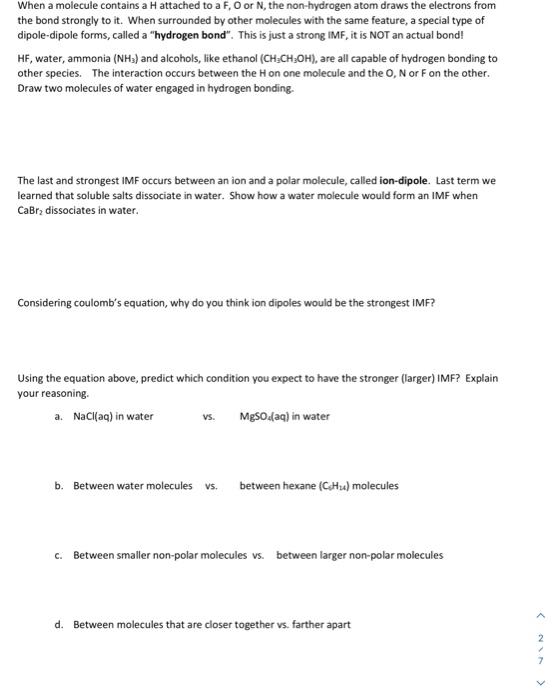
When a molecule contains a H attached to a F,O or N, the non-hydrogen atom draws the electrons from the bond strongly to it. When surrounded by other molecules with the same feature, a special type of dipole-dipole forms, called a "hydrogen bond". This is just a strong IMF, it is NOT an actual bond! HF, water, ammonia ( NH3) and alcohols, like ethanol (CH3CH3OH), are all capable of hydrogen bonding to other species. The interaction occurs between the H on one molecule and the O,N or F on the other. Draw two molecules of water engaged in hydrogen bonding. The last and strongest IMF occurs between an ion and a polar molecule, called ion-dipole. Last term we learned that soluble salts dissociate in water. Show how a water molecule would form an IMF when CaBr2 dissociates in water. Considering coulomb's equation, why do you think ion dipoles would be the strongest IMF? Using the equation above, predict which condition you expect to have the stronger (larger) IMF? Explain your reasoning. a. NaCl(aq) in water vs. MgSO4(aq) in water b. Between water molecules vs. between hexane (CLH2) molecules c. Between smaller non-polar molecules vs. between larger non-polar molecules d. Between molecules that are closer together vs. farther apart
Step by Step Solution
There are 3 Steps involved in it

Get step-by-step solutions from verified subject matter experts