







Question: When conducting a hypothesis test, there are four possible outcomes. Rejecting a false null hypothesis would constitute a . Retaining a null hypothesis would also
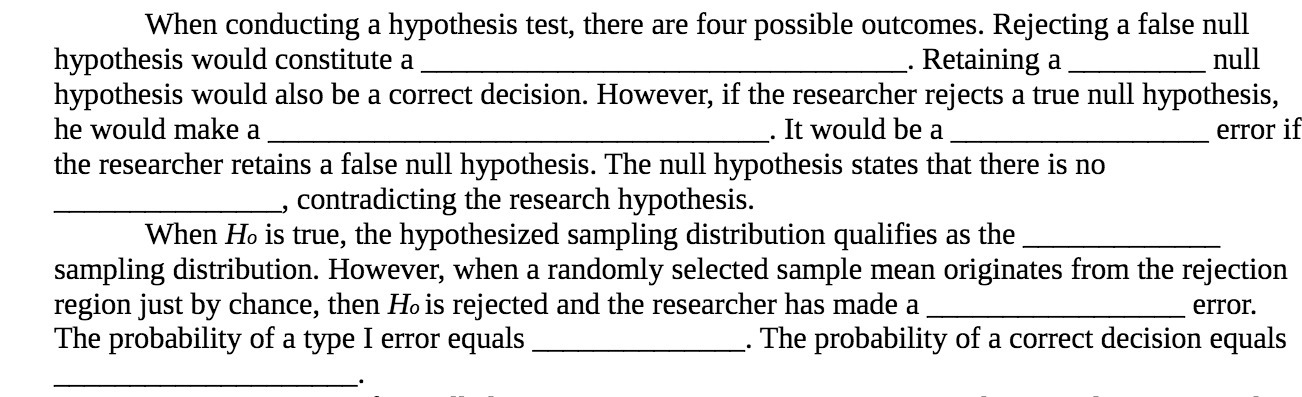
When conducting a hypothesis test, there are four possible outcomes. Rejecting a false null hypothesis would constitute a . Retaining a null hypothesis would also be a correct decision. However, if the researcher rejects a true null hypothesis, he would make a . It would be a error if the researcher retains a false null hypothesis. The null hypothesis states that there is no contradicting the research hypothesis. When Ho is true, the hypothesized sampling distribution qualifies as the sampling distribution. However, when a randomly selected sample mean originates from the rejection region just by chance, then Ho is rejected and the researcher has made a error. The probability of a type I error equals . The probability of a correct decision equals
Step by Step Solution
There are 3 Steps involved in it

Get step-by-step solutions from verified subject matter experts
 Study Help