Question: When doing the assignment for this week's Case Study, be sure to review the OB Case Analysis Requirements under the 'Course Documents' tab. To summarize
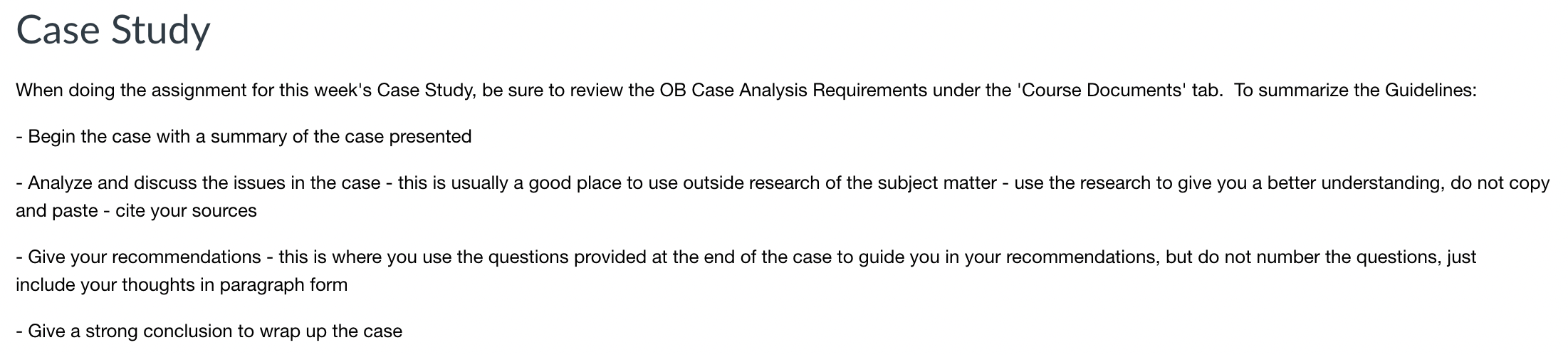
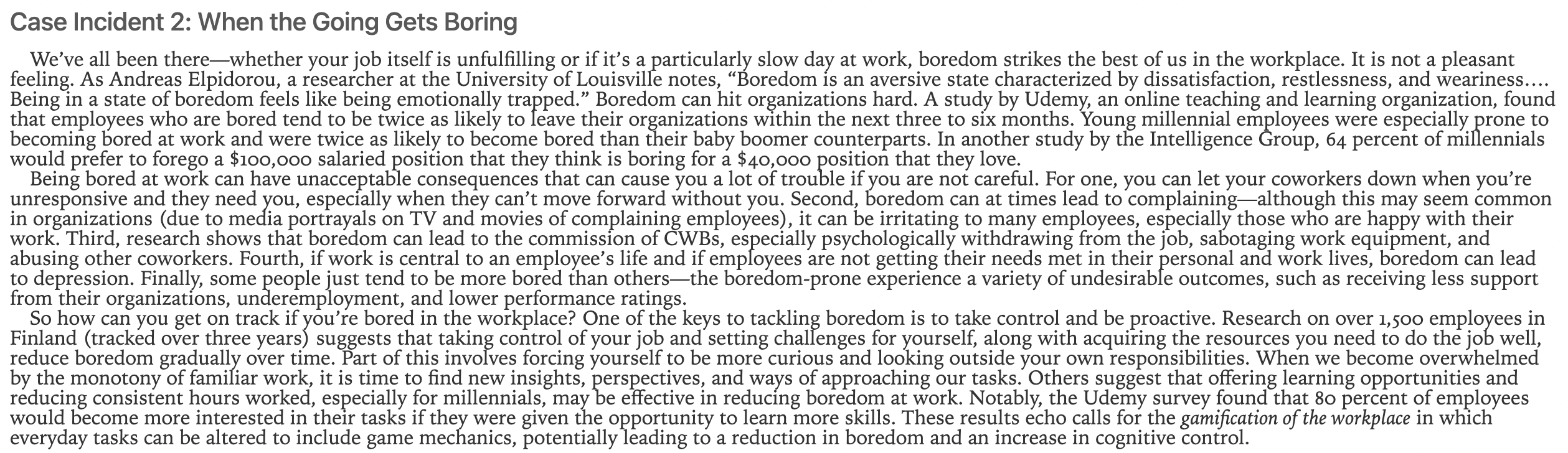
When doing the assignment for this week's Case Study, be sure to review the OB Case Analysis Requirements under the 'Course Documents' tab. To summarize the Guidelines: - Begin the case with a summary of the case presented - Analyze and discuss the issues in the case - this is usually a good place to use outside research of the subject matter - use the research to give you a better understanding, do not cop: and paste - cite your sources - Give your recommendations - this is where you use the questions provided at the end of the case to guide you in your recommendations, but do not number the questions, just include your thoughts in paragraph form - Give a strong conclusion to wrap up the case Case Incident 2: When the Going Gets Boring We've all been there-whether your job itself is unfulfilling or if it's a particularly slow day at work, boredom strikes the best of us in the workplace. It is not a pleasant feeling. As Andreas Elpidorou, a researcher at the University of Louisville notes, "Boredom is an aversive state characterized by dissatisfaction, restlessness, and weariness.... Being in a state of boredom feels like being emotionally trapped." Boredom can hit organizations hard. A study by Udemy, an online teaching and learning organization, found that employees who are bored tend to be twice as likely to leave their organizations within the next three to six months. Young millennial employees were especially prone to becoming bored at work and were twice as likely to become bored than their baby boomer counterparts. In another study by the Intelligence Group, 64 percent of millennials would prefer to forego a $100,000 salaried position that they think is boring for a $40,000 position that they love. Being bored at work can have unacceptable consequences that can cause you a lot of trouble if you are not careful. For one, you can let your coworkers down when you're unresponsive and they need you, especially when they can't move forward without you. Second, boredom can at times lead to complaining-although this may seem common in organizations (due to media portrayals on TV and movies of complaining employees), it can be irritating to many employees, especially those who are happy with their work. Third, research shows that boredom can lead to the commission of CWBs, especially psychologically withdrawing from the job, sabotaging work equipment, and abusing other coworkers. Fourth, if work is central to an employee's life and if employees are not getting their needs met in their personal and work lives, boredom can lead to depression. Finally, some people just tend to be more bored than others-the boredom-prone experience a variety of undesirable outcomes, such as receiving less support from their organizations, underemployment, and lower performance ratings. So how can you get on track if you're bored in the workplace? One of the keys to tackling boredom is to take control and be proactive. Research on over 1,50o employees in Finland (tracked over three years) suggests that taking control of your job and setting challenges for yourself, along with acquiring the resources you need to do the job well, reduce boredom gradually over time. Part of this involves forcing yourself to be more curious and looking outside your own responsibilities. When we become overwhelmed by the monotony of familiar work, it is time to find new insights, perspectives, and ways of approaching our tasks. Others suggest that offering learning opportunities and reducing consistent hours worked, especially for millennials, may be effective in reducing boredom at work. Notably, the Udemy survey found that 80 percent of employees would become more interested in their tasks if they were given the opportunity to learn more skills. These results echo calls for the gamification of the workplace in which everyday tasks can be altered to include game mechanics, potentially leading to a reduction in boredom and an increase in cognitive control









 Study Help