







Question: When filling out a truth table you should count in binary to ensure you have all possible inputs. The amount of input rows you
![[30] Complete the following truth tables for the given equation. Note, variables next to each other zy](https://dsd5zvtm8ll6.cloudfront.net/questions/2023/11/6542353de813d_1698837818568.jpg)
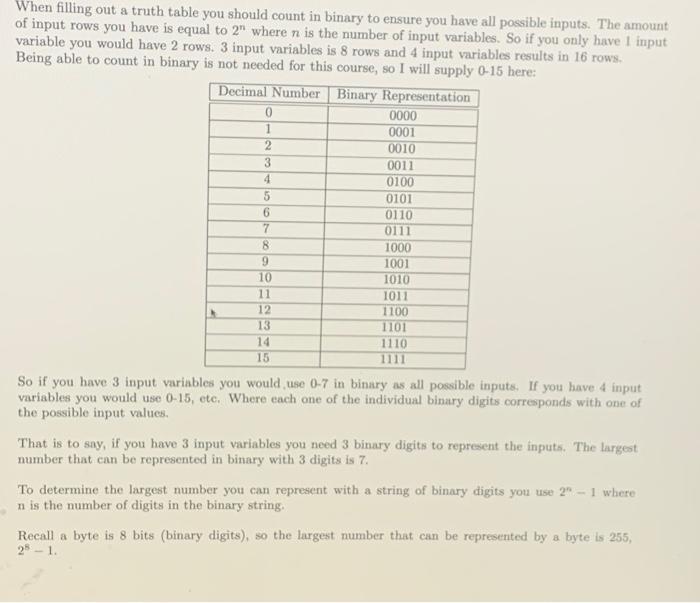
When filling out a truth table you should count in binary to ensure you have all possible inputs. The amount of input rows you have is equal to 2" where n is the number of input variables. So if you only have 1 input variable you would have 2 rows. 3 input variables is 8 rows and 4 input variables results in 16 rows. Being able to count in binary is not needed for this course, so I will supply 0-15 here: Decimal Number Binary Representation 0 1 2 3 4 5 6 7 8 9 10 11 12 13 14 15 0000 0001 0010 0011 0100 0101 0110 0111 1000 1001 1010 1011 1100 1101 1110 1111 So if you have 3 input variables you would use 0-7 in binary as all possible inputs. If you have 4 input variables you would use 0-15, etc. Where each one of the individual binary digits corresponds with one of the possible input values. That is to say, if you have 3 input variables you need 3 binary digits to represent the inputs. The largest number that can be represented in binary with 3 digits is 7. To determine the largest number you can represent with a string of binary digits you use 2"-1 where n is the number of digits in the binary string. Recall a byte is 8 bits (binary digits), so the largest number that can be represented by a byte is 255, 28-1. [30] Complete the following truth tables for the given equation. Note, variables next to each other zy denotes AND and variables listed as x + y denotes OR 2.1 f(x)=x [2pts] 2.2 f(x)=x [2pts] where denotes negation 2.3 f(x,y) = xy [4pts] 2.4 f(x, y) = x+y [4pts] x f(x) x f(r) xy f(x,y) x y f(z,y)
Step by Step Solution
3.45 Rating (164 Votes )
There are 3 Steps involved in it
The truth tables for the given eq... View full answer

Get step-by-step solutions from verified subject matter experts
 Study Help