







Question: When modeling fluid flows with small changes in temperature and pressure, the Boussinesq approximation is often used in which the fluid density is assumed to
When modeling fluid flows with small changes in temperature and pressure, the Boussinesq approximation is often used in which the
fluid density is assumed to vary linearly with changes in temperature. The Boussinesq approximation is where is
assumed to be constant over the given temperature range; is evaluated at reference temperature taken as some average or mid
value temperature in the flow; and is a reference density, also evaluated at The Boussinesq approximation is used to model a
flow of air at nearly constant pressure, kPa, but the temperature varies between and Using the midway point
as the reference temperature, calculate the density at the two temperature extremes using the Boussinesq approximation, and
compare with the actual density at these two temperatures obtained from the ideal gas law. In particular, for both temperatures
calculate the percentage error caused by the Boussinesq approximation. Take the reference density of air at and
kPa as The coefficient of volume expansion at is
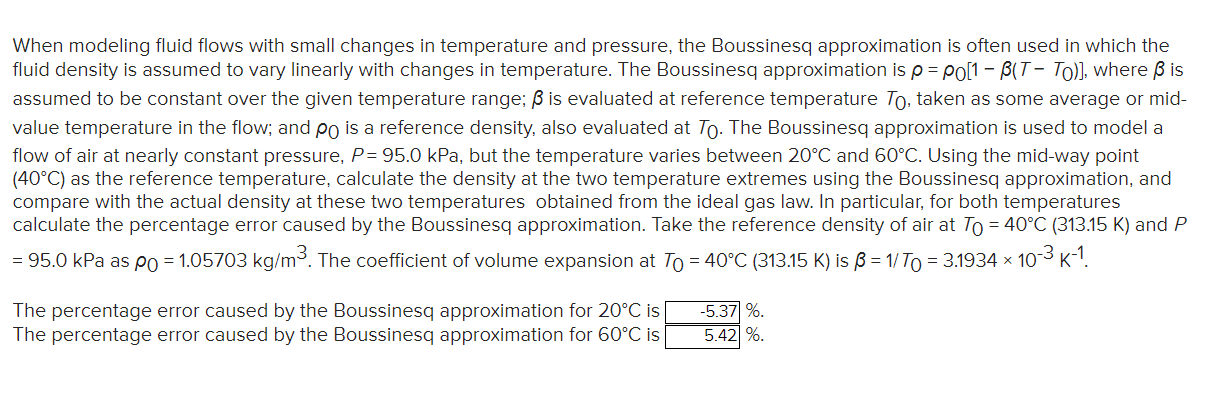
The percentage error caused by the Boussinesq approximation for is
The percentage error caused by the Boussinesq approximation for is
Step by Step Solution
There are 3 Steps involved in it
1 Expert Approved Answer
Step: 1 Unlock

Question Has Been Solved by an Expert!
Get step-by-step solutions from verified subject matter experts
Step: 2 Unlock
Step: 3 Unlock
 Study Help