







Question: When solving the equation + 0 dy + by = f(z), da2 The procedure of 'guessing' at a particular solution yo as seen in the
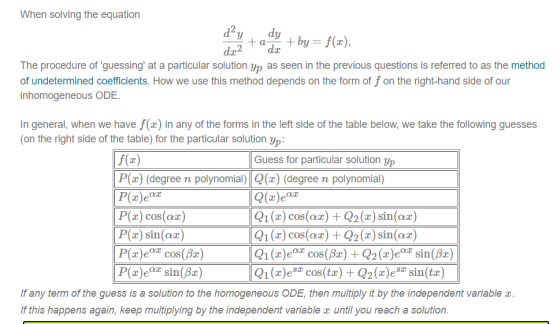
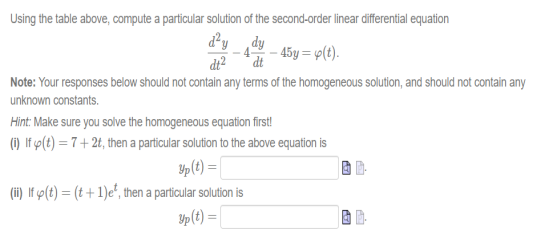
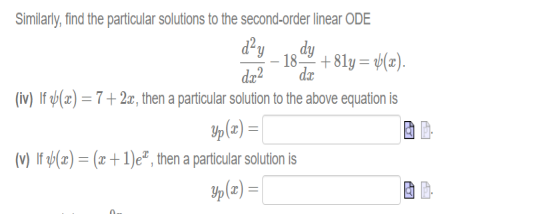
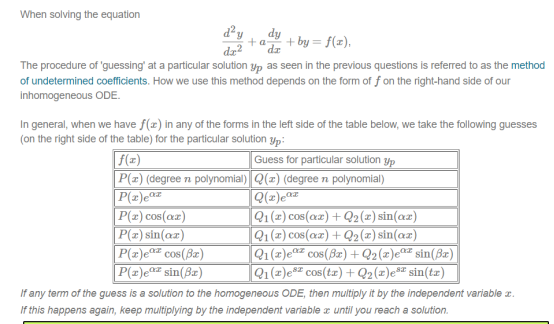
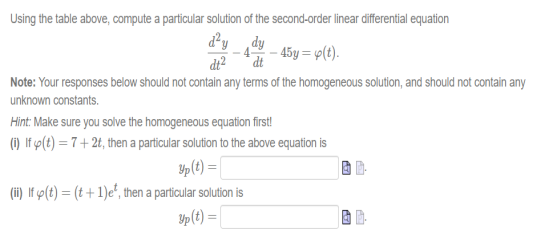
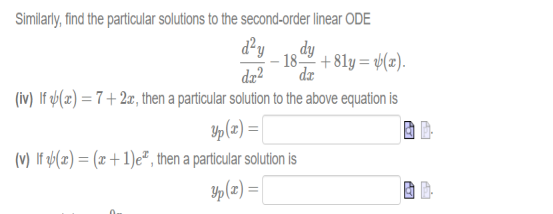
When solving the equation + 0 dy + by = f(z), da2 The procedure of 'guessing' at a particular solution yo as seen in the previous questions is referred to as the method of undetermined coefficients. How we use this method depends on the form of f on the right-hand side of our Inhomogeneous ODE. In general, when we have f() in any of the forms in the left side of the table below, we take the following guesses (on the right side of the table) for the particular solution Up: f(E) Guess for particular solution yp P(x) (degree n polynomial) Q(z) (degree n polynomial) Q(x)e P(z) cos (ar) Q1 () cos(ax) + Q2(x) sin(az) P(x) sin(ax) Q1 (x) cos(ax) + Q2(x) sin(az) P(x)ed cos(Bx) Q1 (x)ez cos(Bx) + Q2(x)e sin(Bx) P(x)ed sin(Br) Q1(z)el cos(tx) + Q2(z)ed sin(tz) If any term of the guess is a solution to the homogeneous ODE, then multiply it by the independent variable c. If this happens again, keep multiplying by the independent variable ax until you reach a solution.Using the table above, compute a particular solution of the second-order linear differential equation day dy dt 2 dt - 45y = 4(t). Note: Your responses below should not contain any terms of the homogeneous solution, and should not contain any unknown constants. Hint: Make sure you solve the homogeneous equation first! (i) If up(t) = 7 + 2t, then a particular solution to the above equation is Up (t) = (ii) If up(t) = (t + 1)es, then a particular solution is Up (t ) =Similarly, find the particular solutions to the second-order linear ODE d2 y 18 dy + 8ly = (x). dar 2 (iv) If ?(z) = 7 + 2.x, then a particular solution to the above equation is Up (3) = (v) If (x) = ( + 1)ed, then a particular solution is Up(z) =
Step by Step Solution
There are 3 Steps involved in it

Get step-by-step solutions from verified subject matter experts
 Study Help