Question: When you sit down with the next Apple product you are using-whether that be your iPhone, your iPad, your MacPro, or whatever else-it's worth taking
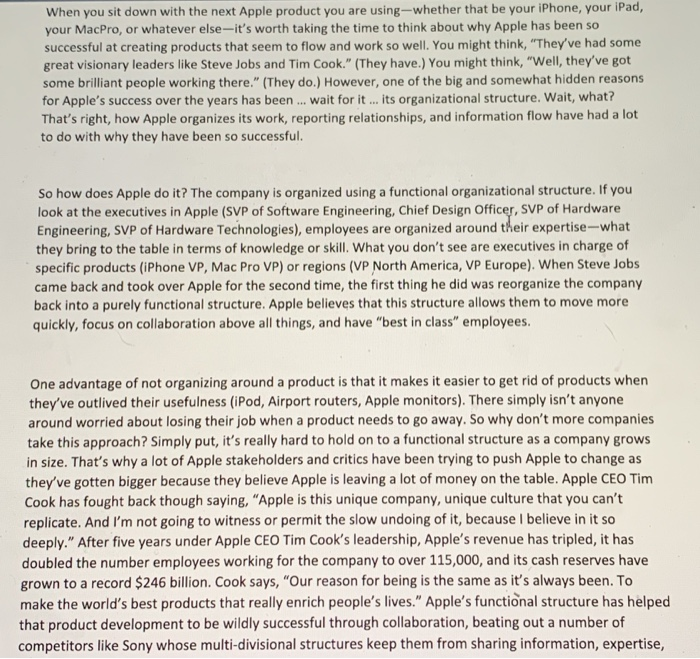
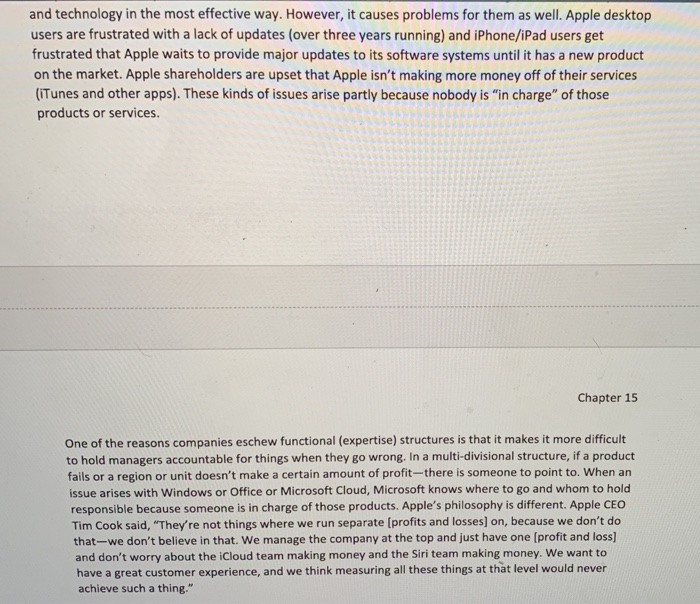
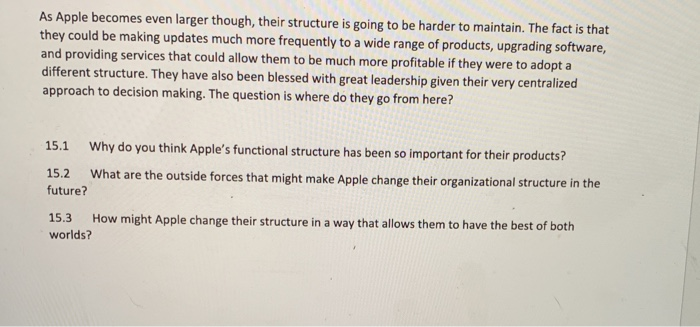
When you sit down with the next Apple product you are using-whether that be your iPhone, your iPad, your MacPro, or whatever else-it's worth taking the time to think about why Apple has been so successful at creating products that seem to flow and work so well. You might think, "They've had some great visionary leaders like Steve Jobs and Tim Cook." (They have.) You might think, "Well, they've got some brilliant people working there." (They do.) However, one of the big and somewhat hidden reasons for Apple's success over the years has been ... wait for it ... its organizational structure. Wait, what? That's right, how Apple organizes its work, reporting relationships, and information flow have had a lot to do with why they have been so successful. So how does Apple do it? The company is organized using a functional organizational structure. If you look at the executives in Apple (SVP of Software Engineering, Chief Design Officer, SVP of Hardware Engineering, SVP of Hardware Technologies), employees are organized around their expertise-what they bring to the table in terms of knowledge or skill. What you don't see are executives in charge of specific products (iPhone VP, Mac Pro VP) or regions (VP North America, VP Europe). When Steve Jobs came back and took over Apple for the second time, the first thing he did was reorganize the company back into a purely functional structure. Apple believes that this structure allows them to move more quickly, focus on collaboration above all things, and have "best in class" employees. One advantage of not organizing around a product is that it makes it easier to get rid of products when they've outlived their usefulness (iPod, Airport routers, Apple monitors). There simply isn't anyone around worried about losing their job when a product needs to go away. So why don't more companies take this approach? Simply put, it's really hard to hold on to a functional structure as a company grows in size. That's why a lot of Apple stakeholders and critics have been trying to push Apple to change as they've gotten bigger because they believe Apple is leaving a lot of money on the table. Apple CEO Tim Cook has fought back though saying, "Apple is this unique company, unique culture that you can't replicate. And I'm not going to witness or permit the slow undoing of it, because I believe in it so deeply." After five years under Apple CEO Tim Cook's leadership, Apple's revenue has tripled, it has doubled the number employees working for the company to over 115,000, and its cash reserves have grown to a record $246 billion. Cook says, "Our reason for being is the same as it's always been. To make the world's best products that really enrich people's lives." Apple's functional structure has helped that product development to be wildly successful through collaboration, beating out a number of competitors like Sony whose multi-divisional structures keep them from sharing information, expertise, and technology in the most effective way. However, it causes problems for them as well. Apple desktop users are frustrated with a lack of updates (over three years running) and iPhone/iPad users get frustrated that Apple waits to provide major updates to its software systems until it has a new product on the market. Apple shareholders are upset that Apple isn't making more money off of their services (iTunes and other apps). These kinds of issues arise partly because nobody is "in charge of those products or services. Chapter 15 One of the reasons companies eschew functional (expertise) structures is that it makes it more difficult to hold managers accountable for things when they go wrong. In a multi-divisional structure, if a product fails or a region or unit doesn't make a certain amount of profit--there is someone to point to. When an issue arises with Windows or Office or Microsoft Cloud, Microsoft knows where to go and whom to hold responsible because someone is in charge of those products. Apple's philosophy is different. Apple CEO Tim Cook said, "They're not things where we run separate (profits and losses) on, because we don't do that-we don't believe in that. We manage the company at the top and just have one (profit and loss] and don't worry about the iCloud team making money and the Siri team making money. We want to have a great customer experience, and we think measuring all these things at that level would never achieve such a thing." As Apple becomes even larger though, their structure is going to be harder to maintain. The fact is that they could be making updates much more frequently to a wide range of products, upgrading software, and providing services that could allow them to be much more profitable if they were to adopt a different structure. They have also been blessed with great leadership given their very centralized approach to decision making. The question is where do they go from here? 15.1 Why do you think Apple's functional structure has been so important for their products? 15.2 What are the outside forces that might make Apple change their organizational structure in the future? 15.3 How might Apple change their structure in a way that allows them to have the best of both worlds